Hello! Welcome to the third lesson in our analog circuits course.
In the last lesson, we mastered Ohm's Law (), the fundamental relationship governing voltage, current, and resistance. We saw how it allows us to predict the behavior of a simple circuit and even use it as a design tool, like when we calculated a current-limiting resistor for an LED.
Today, we will build directly on that knowledge. We'll revisit the concept of power (the rate of energy transfer) and see how combining the basic power formula with Ohm's Law gives us a versatile set of tools for circuit analysis. Your goal for this lesson is to be able to calculate the power dissipated by a resistor using various forms of the power equation.
Understanding power dissipation is crucial. It's not just about energy consumption; it's a fundamental aspect of hardware design. The power a resistor handles is converted into heat, and every real-world component has a limit to how much heat it can safely withstand.
1. The Three Forms of the Power Equation
In our first lesson, we defined electrical power as the product of voltage and current.
Where:
- is power in Watts (W)
- is voltage in Volts (V)
- is current in Amperes (A)
This is the foundational definition. Now, by using the algebraic power of Ohm's Law (), we can derive two other extremely useful forms of this equation. This process of substitution is a common technique in circuit analysis.
To see how this is done, let's turn to a clear textual explanation.
Recall and Use P = VI, P = I²R, P = V² / R
This article provides a concise and clear derivation of the alternative power formulas. It shows how simple algebraic substitution allows us to express power in terms of resistance.
Please read the section titled 'Derivation of Power Equations'. Focus on how Ohm's Law (V = IR) is used in two different ways to transform the original power equation, P = VI.
Let's summarize that key derivation:
-
To get Power from Current and Resistance:
We start with . From Ohm's Law, we know that . If we substituteIRforVin the power equation, we get: -
To get Power from Voltage and Resistance:
Again, we start with . This time, we rearrange Ohm's Law to solve for current: . Now we substituteV/RforIin the power equation:
So, we now have three equivalent tools at our disposal:
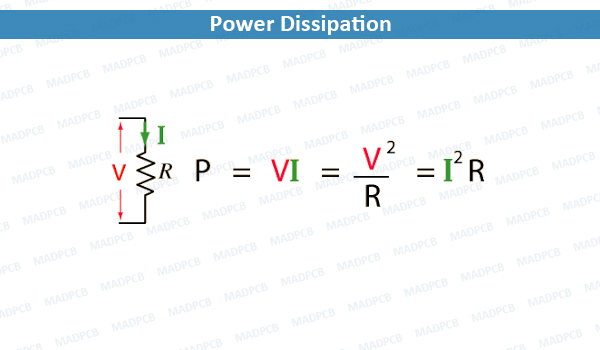
The formula you choose simply depends on which two quantities you already know.
2. Resolving a Common Confusion
Having three formulas can sometimes lead to a bit of confusion. Look at the last two:
- seems to imply that power increases as resistance increases.
- seems to imply that power decreases as resistance increases.
So, which is it? Does increasing a resistor's value generate more or less heat? The answer, beautifully, is "it depends on what you hold constant."
This is a subtle but critical point for developing a deep intuition about circuit behavior. Let's watch a video that explores this question by considering two distinct physical scenarios.
Power dissipated formula confusion (RESOLVED)
This video from FloatHeadPhysics does a fantastic job of resolving the apparent contradiction between the power formulas by grounding them in physical intuition.
Watch the segment from 00:26 to 08:40. Pay close attention to the two different experiments he discusses: What happens to power when resistance changes but the voltage source is held constant. What happens to power when resistance changes but the current is forced to be constant.
As the video explained:
- If voltage is held constant (e.g., you connect a different resistor to the same battery), increasing the resistance will decrease the current (Ohm's Law). The drop in current is more significant than the increase in resistance, so the total power decreases. This scenario is described by .
- If current is held constant (e.g., you have a special power supply that adjusts its voltage to maintain a constant current), increasing the resistance will require a larger voltage drop across the resistor. Both and increase, so the power increases. This scenario is described by .
In most simple DC circuits we'll be looking at, the voltage source is constant (like a battery), so the first scenario is more common.
3. Putting it into Practice: Calculation Examples
Now that we have the theory and intuition, let's use the formulas to solve some problems.
Let's consider a simple circuit: a 9V battery is connected to a 250 resistor.

Our goal is to find the power dissipated by the resistor.
Step 1: Identify your knowns.
We know and .
Step 2: Choose the best formula.
Since we know voltage and resistance, the most direct formula to use is .
Step 3: Calculate.
Verification: What if we wanted to use one of the other formulas? We could! We would just need to find the current first using Ohm's Law.
Now we can use the other two power formulas to check our work:
- Using :
- Using :
All three formulas give the same answer, as expected.
For more practice, watch this short segment of a problem-solving video.
Electric Current & Circuits Explained, Ohm's Law, Charge, Power, Physics Problems, Basic Electricity
The Organic Chemistry Tutor channel provides very clear, step-by-step examples. This clip demonstrates a similar calculation.
Watch the problem worked out from 07:23 to 09:03. Notice how he calculates the power dissipated by the resistor and also the power supplied by the battery, showing that they balance.
Test your understanding!
A car's headlight filament is a resistor. When it's connected to the car's 12V battery, a current of 4A flows through it.
- What is the resistance of the headlight filament?
- How much power does the headlight dissipate? Calculate it using all three power formulas to prove they give the same result.
Show answer
-
Find Resistance: We know V = 12V and I = 4A. Using Ohm's Law ():
-
Calculate Power: Now we know V=12V, I=4A, and R=3. We can use any of the three formulas.
All three methods yield the same result: the headlight dissipates 48 Watts of power, primarily as heat and light.
Conclusion
In this lesson, we combined Ohm's Law with the definition of power to create a powerful and flexible set of analytical tools.
Key Takeaways:
- Power dissipated by a resistor can be calculated using three interchangeable formulas: , , and .
- The latter two formulas are derived from by substituting for voltage or current using Ohm's Law.
- The choice of which formula to use is a matter of convenience, based on the known quantities in the circuit.
- This dissipated power manifests primarily as heat. For this reason, physical resistors have power ratings (e.g., 1/4 W, 1/2 W, 1 W) which must not be exceeded, or the component will be destroyed.
So far, we've only dealt with very simple circuits containing a single source and a single resistor. Real-world circuits are rarely so simple. They have multiple components and multiple paths for current to flow. In our next lesson, we will introduce our first tool for analyzing these more complex circuits: Kirchhoff's Current Law (KCL). This law governs how current behaves at the junctions where components meet.