Hello! Let's dive into our next lesson on time-based trading.
In our last session, we pinpointed the specific, high-probability time windows within the broader market sessions—the session opens and the "Silver Bullet" hours. We answered the question of when the market is most likely to offer significant moves.
Today, we will build directly on that knowledge to address the learning outcome: Apply killzone timing as a filter for trade setups. You will learn how to transition from simply knowing these times to actively using them as a powerful filtering tool. This is the crucial step where time and price analysis merge to create a high-probability trading methodology. We will move from theory to a practical, rule-based application.
1. The Core Principle: Time is a Non-Negotiable Filter
In ICT, a technically perfect setup (like an order block or fair value gap) that appears at the wrong time is considered a low-probability trade. Why? Because institutional order flow, the engine that drives significant price moves, is most active during specific windows. Trading outside these windows is like trying to catch a wave when the tide is out.
Killzones are not a strategy in themselves; they are the environment in which our strategies are designed to work. By deciding to only look for setups within these windows, you automatically filter out a vast amount of market noise and avoid chasing low-quality moves.
This article from TradingView articulates this principle perfectly.
Ultimate Guide to Master ICT Killzones
Let's read the article 'Ultimate Guide to Master ICT Killzones' from TradingView user TehThomas. It does an excellent job explaining why timing is a core part of the trading edge and how killzones act as your primary filter.
Please read the following sections: 'Why Timing Matters Just as Much as Price' and 'What Are Killzones?' at the beginning. 'The Discipline Edge' and 'Final Thoughts' at the end. Focus on the core message: killzones are a filter that provides context and discipline, immediately reducing the number of bad trades.
As the article emphasizes, "Good setups in the right timing window are even rarer. That’s where consistency comes from." Your first job as an ICT trader is to wait for the right time.
2. A Practical Framework for Applying the Time Filter
So, how do we put this into practice? Here is a systematic process for integrating time into your analysis. This framework ensures you are always aligning your potential trades with institutional intent.
Step 1: Have a Higher Timeframe (HTF) Bias
Before the session begins, you should have a general idea of where the price is likely to go based on the higher timeframe market structure and liquidity targets. Are we in a bullish trend looking to take out an old high? Or a bearish trend aiming for a low?
Step 2: Wait for a Killzone to Begin
This is the filtering step. Do not actively look for trade setups during the Asian session (unless trading Asia-specific pairs) or the midday lulls. Your primary focus should be on the London and New York killzones.
Step 3: Observe the Initial Killzone Activity
Once the killzone starts (e.g., 2:00 AM NY time for London), watch how the price behaves. Does it immediately move to sweep the Asian session high or low? This is the classic "Judas Swing" or manipulation move we discussed.
Step 4: Identify a Setup After the Initial Move
The highest-probability trade is rarely the first move. It's the one that comes after the liquidity sweep. Once price has taken liquidity and shown its hand with a strong rejection or a market structure shift, you can then look for a familiar ICT entry pattern (like a return to an order block or fair value gap) to get in sync with the real move.
This process is about patience. You are waiting for the market to reveal its intention within the high-activity time window.
3. Chart Examples: The Filter in Action
Let's watch a video that demonstrates this filtering process with clear chart examples. It shows how to interpret the action within the killzone and adapt whether the price action is "typical" or not.
Master ICT Killzones in 6 MINUTES! (EASY)
The video 'Master ICT Killzones in 6 MINUTES!' by CallistoFX provides concise examples of applying this thought process.
Watch from 02:01 to 05:30. The video covers: The typical daily profile: Asia consolidates, London sweeps liquidity, and then expands. A chart example of this 'typical' profile (03:16). A 'non-typical' example where London fails to sweep the Asian low but still provides a valid entry within the killzone (04:22). Notice how in both cases, the trade is identified and taken only within the active killzone, after observing the initial price action.
This next resource provides an even more detailed walkthrough of a complete London Killzone strategy, which is a perfect illustration of our four-step framework.
ICT London Killzone Time & Strategy for Precision Entries
This article, 'ICT London Killzone Time & Strategy for Precision Entries', details the strategic thinking behind using this specific killzone.
Please read the sections titled 'Typical Price Behaviour During the Killzone' and 'Advanced Entry Techniques'. Pay close attention to how it describes spotting false moves, identifying liquidity grabs, and waiting for a market structure shift before looking for an entry on an order block or FVG. This reinforces our framework.
4. Confluence: Where Time, Price, and Liquidity Meet
The ultimate goal is to find setups where everything aligns. We call this confluence. A high-probability ICT setup exists at the intersection of three key elements:
- Time: The setup occurs within a designated killzone.
- Liquidity: The price action is clearly related to a draw on liquidity (e.g., sweeping stops above an old high or below an old low).
- Price Pattern: A valid ICT entry model, such as a market structure shift followed by a return to a fair value gap or order block, presents itself.
When you have all three, you have a setup worth considering. If one is missing—especially time—the probability of success decreases significantly.

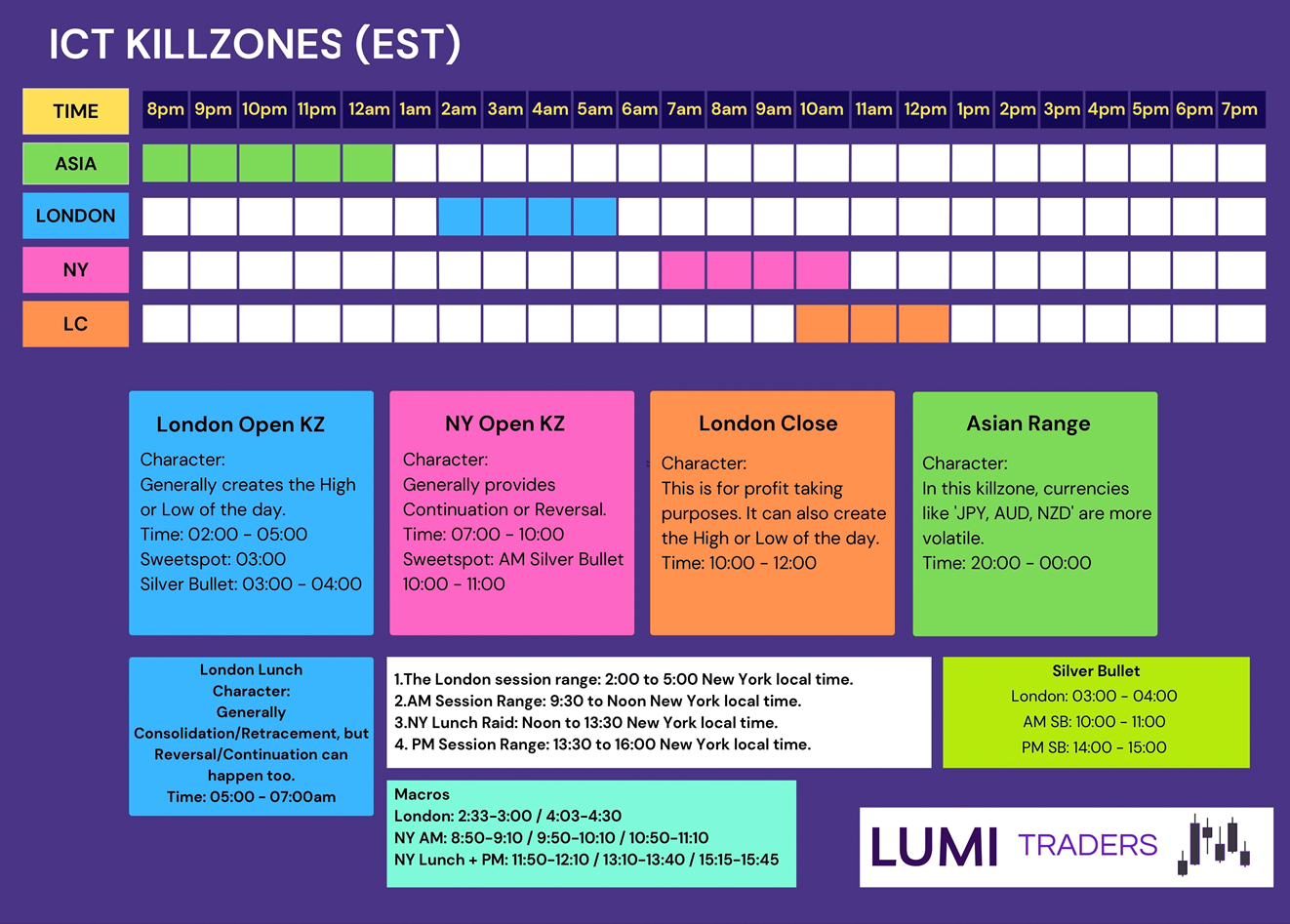
To help you keep track of these important times, here is a detailed reference chart. You may want to save this for future use.
Conclusion
You now have a practical and robust method for filtering your trade setups. By strictly adhering to killzone timing, you force yourself to be patient and selective, focusing only on the periods when institutional activity provides the volatility and momentum needed for our strategies to work effectively.
Key Takeaways:
- Killzone timing is a non-negotiable filter. A setup outside of a killzone is a low-probability setup.
- The application process involves: determining HTF bias, waiting for the killzone, observing the initial manipulation, and then identifying a valid entry pattern.
- The highest-probability trades occur at the confluence of Time, Liquidity, and a valid Price Pattern.
- Using time as a filter builds discipline and prevents you from overtrading in low-quality market conditions.
Preview of the Next Lesson:
We've now established the 'when' (killzones) and a framework for applying it. In the next module, we will dive deep into the 'what' and 'why' of daily price movements by introducing the Power of 3. You'll learn to interpret the daily candle as a narrative of Accumulation, Manipulation, and Distribution, and you will see how the killzone timings we've studied align perfectly with these phases of the daily price algorithm.