Hello! Welcome back to our course on ICT trading.
In our last lesson, we learned how to spot a failing or invalidated order block by reading price delivery. We saw that a full candle close beyond the block's boundary is a definitive sign of invalidation.
Today, we'll shift our focus to the opposite end of the spectrum: identifying the strongest, most reliable order blocks. This lesson directly addresses the learning outcome: to identify high-probability order blocks using price displacement. We will learn to spot the energetic signature that institutional traders leave behind, which is the key to filtering for A+ trade setups.
1. The Key Ingredient: Price Displacement
Before we can find a high-probability order block, we must first understand the concept that gives it power: displacement.
In simple terms, displacement is a strong, energetic, and sudden price movement in one direction. It's not just any move; it's a move that shows conviction. It suggests that large institutions ("smart money") have entered the market with significant volume, creating a powerful imbalance between buying and selling pressure.
To get a formal definition and learn how to spot it, please study the following article.
ICT Displacement: What It Is and How to Use It in Trading
The article 'ICT Displacement: What It Is and How to Use It in Trading' from HowToTrade.com provides an excellent foundation for this concept. It clearly defines displacement and tells you what to look for.
Please read the following sections: 'What is Displacement in ICT Trading?', 'Types of Displacement in ICT', 'How Do You Identify ICT Displacements in 2 Steps?', and the FAQ question 'How Do You Identify Displacement in Trading'. Focus on the visual characteristics: strong consecutive candlesticks with large bodies and the Fair Value Gaps (FVGs) they create.
As you just read, the visual clues for displacement are:
- A series of consecutive, large-bodied candles moving in the same direction.
- Very small wicks on these candles, indicating one-sided momentum.
- The creation of a Fair Value Gap (FVG), which is the price inefficiency left behind by the rapid move.
This image provides a simple but effective visual contrast between candles that show displacement and those that don't.

2. How Displacement Creates a High-Probability Order Block
Now, let's connect this back to order blocks. A high-probability order block is simply the origin of a strong displacement move. The order block itself (the last opposing candle) is where institutions accumulated their position, and the displacement is the forceful move that reveals their hand and validates the block.
The most critical sign of this is the FVG that the displacement creates.
Understanding Order Blocks – The ICT Trader
The article 'Understanding Order Blocks' by The ICT Trader offers a concise checklist for what makes an order block high-probability. Let's focus on the section that discusses displacement.
Please read the section titled 'Strong Displacement Criteria'. It explains why the formation of a Fair Value Gap after the move is so significant.
To summarize, when you see an order block followed by a strong displacement that leaves behind an FVG, it's a powerful signal. It tells you that institutions not only entered at the order block but did so with enough force to create a price imbalance, which is a footprint we can follow.
3. The Full Checklist for a High-Probability Order Block
While displacement is the most important factor, other elements add to the probability of an order block holding. A truly high-probability setup is a confluence of several factors.
The following video from Smart Risk provides a structured way to think about these factors.
How to Identify Best Order Blocks to Trade?
This video breaks down the essential rules for identifying the best order blocks. It introduces a clear framework that we can use as a mental checklist.
Watch from 01:22 to 02:50, then from 05:08 to 10:26. Pay close attention to the three major rules (inefficiency, break of structure, unmitigated) and the additional high-probability patterns like liquidity grabs and trading with the trend.
Let's synthesize what you've just watched and read into a clear checklist. A high-probability order block typically has these four characteristics:
- Causes Displacement with an FVG: The move away from the block is strong and creates a price imbalance. This is non-negotiable.
- Leads to a Break of Structure (BOS): The displacement is powerful enough to break a recent swing high (for a bullish OB) or swing low (for a bearish OB). This confirms a shift in momentum.
- Sweeps Liquidity: The most powerful order blocks are often formed immediately after taking liquidity from an old high or low. This "stop hunt" provides the fuel for the sharp reversal.
- Is "Fresh" (Unmitigated): The order block has not been previously tested. As we learned in the last lesson, each tap can weaken a block, so the first return to a fresh block is the highest probability setup.
4. Chart Examples in Action
Theory is great, but seeing this on a chart is what solidifies the knowledge. Let's watch some practical examples where these criteria are applied to find high-probability setups.
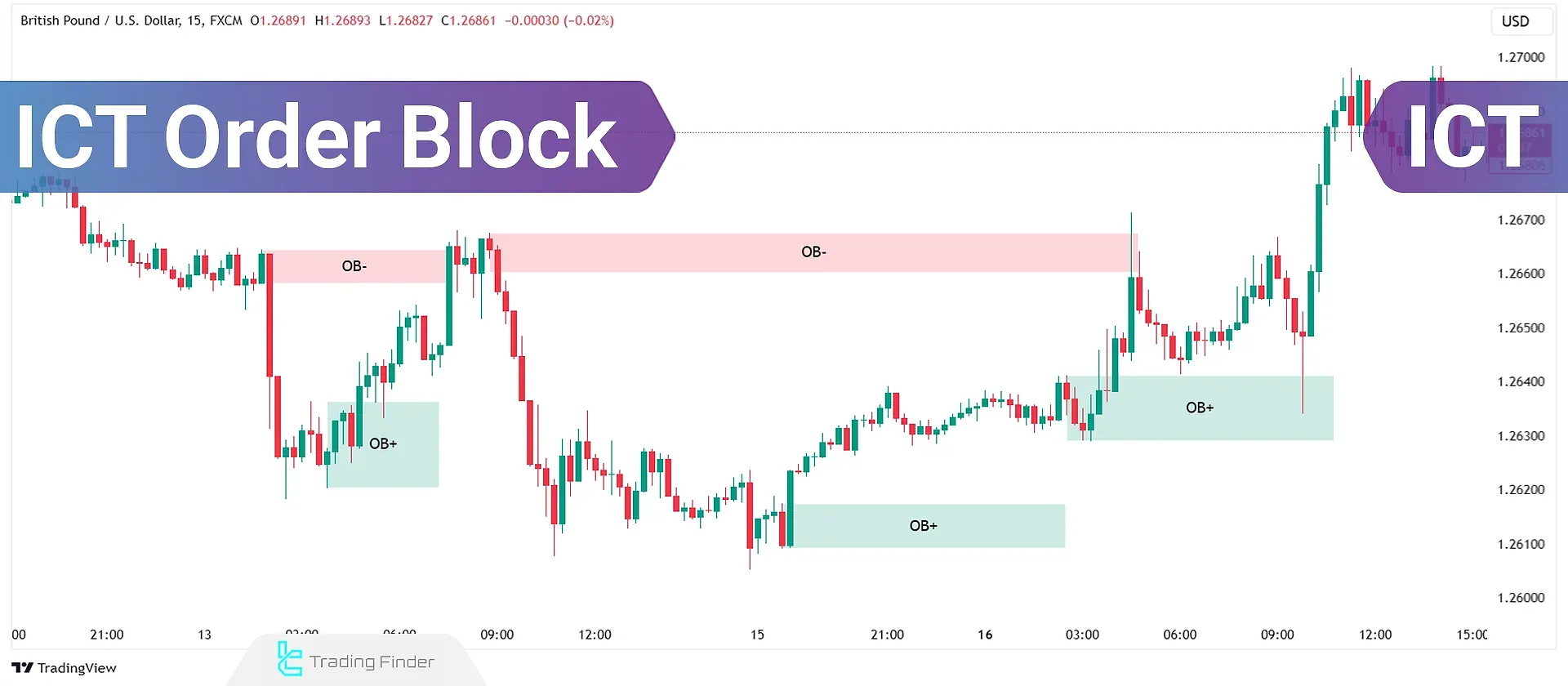
Now, let's watch a video that walks through this process step-by-step.
Orderblocks Simplified - ICT Concepts
The 'Orderblocks Simplified' video from TTrades provides excellent, clear chart examples of finding both bullish and bearish high-probability order blocks.
Watch from 02:16 to 04:32. For the bullish example, notice how the order block forms after sweeping a low and then displaces upward, breaking structure. For the bearish example, see how it sweeps a high before displacing down and breaking structure.
By watching for this specific sequence—liquidity sweep -> displacement -> break of structure—you can filter out mediocre setups and focus only on the order blocks that have the highest likelihood of producing a significant price reaction.
Conclusion
You now have a robust framework for moving beyond simply identifying any order block to selectively targeting high-probability ones. By prioritizing order blocks that are the source of strong price displacement, you are aligning your trades with demonstrated institutional force.
Key Takeaways:
- Displacement is the key characteristic of a high-probability order block. It is a strong, energetic price move that creates a Fair Value Gap (FVG).
- A high-probability order block is the source of a displacement move that also causes a Break of Structure (BOS).
- The most powerful order blocks often form after a liquidity sweep (stop hunt).
- Always prioritize fresh, unmitigated order blocks, as they contain the most unfilled institutional orders.
Preview of the Next Lesson:
In the last lesson, we learned that a failed order block is considered "invalidated." But what happens to that price level? It doesn't just disappear. Often, a level of support or resistance that has been forcefully broken transforms and takes on a new role. This leads us to the concept of a Breaker Block. In our next lesson, we will define what a breaker block is, how it forms from a failed order block, and how to identify it on your charts.