Welcome to the final lesson of your course, "Mastering ICT from A to Z."
Congratulations on reaching this significant milestone. Over the past 11 modules, you have built a comprehensive understanding of the ICT methodology, from foundational price action to advanced trade execution models. In our last lesson, we tackled the crucial topic of cognitive biases, establishing the routines necessary to manage your own psychology—a cornerstone of professional trading.
Today, we transition from the structured environment of this course to the self-directed world of a professional trader. This lesson is not an end but a beginning. Our final learning outcome is to formulate a long-term plan for continuous learning and skill refinement. We will equip you with a durable framework to ensure your growth continues for years to come, transforming the knowledge you've gained into lasting skill and, ultimately, a sustainable trading career.
1. The Professional's Mindset: The Continuous Improvement Cycle
The most significant shift you will make now is from being a student who consumes information to a professional who actively refines their process. Success in trading is not a destination you arrive at; it's a continuous, iterative process of improvement.
This process can be visualized as a cycle.
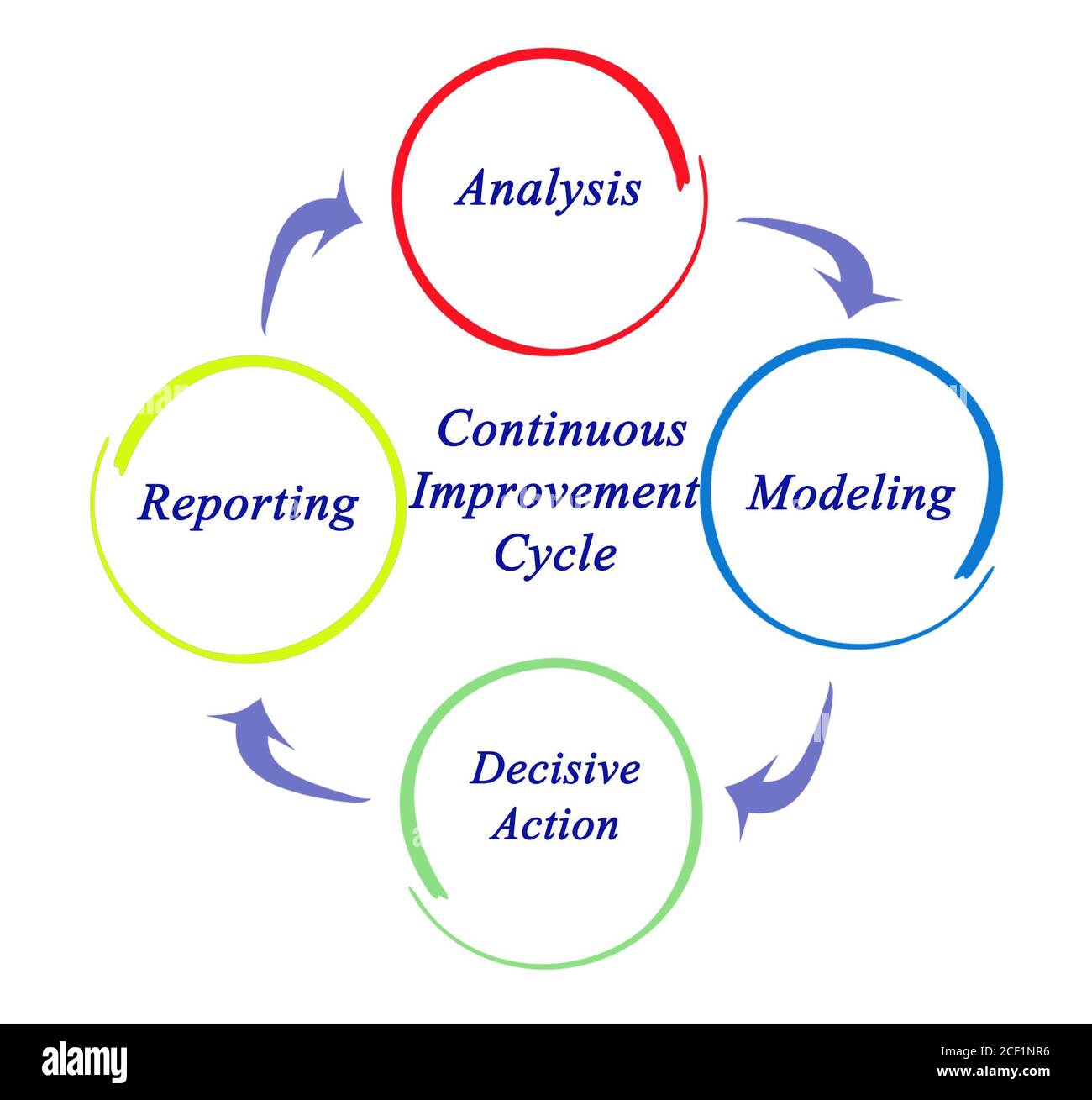
Let's define these stages in a trading context:
- Analysis: Reviewing your past performance (wins, losses, and missed opportunities) through your journal to identify strengths, weaknesses, and patterns.
- Modeling: Based on your analysis, you hypothesize a small, testable improvement to your trading plan. For example, "I will test adding a rule to only take 2022 Model entries if the displacement leg closes above/below 50% of the prior swing."
- Decisive Action: You apply your refined model in the live or demo market, executing trades according to the updated plan.
- Reporting: You meticulously document the results of your trades in your journal, gathering new data for the next round of analysis.
This cycle is the engine of your long-term development. The fuel for this engine is your daily journaling practice.
2. The Cornerstone of Your Career: Masterful Journaling
Throughout this course, we've emphasized journaling for backtesting and trade logging. Now, it's time to elevate your understanding of the journal as your primary tool for continuous, career-long skill refinement. No one explains the profound importance of this better than ICT himself.
ICT Mentorship 2023 - Proper Learning & The Importance Of Journaling
In this video, ICT explains why journaling is the single most important activity for any aspiring trader. He frames it not as a chore, but as the direct path to developing a deep, intuitive understanding of price.
Watch these three key clips, as they form the philosophical foundation for your ongoing development: The Prerequisite for Profitability (00:17 - 01:53): Listen to why ICT states that all of his profitable students went through this process. Conditioning Your Mind for Success (21:22 - 25:34): This is a critical follow-up to our last lesson on psychology. Pay close attention to how you should frame your notes—avoiding negative language and reinforcing confidence. The 'Love Story' with Price Action (43:22 - 46:12): Understand the powerful analogy of building a long-term relationship with price. This is how you develop the 'sixth sense' that separates amateurs from professionals.
As ICT makes clear, your journal is where you:
- Build Your Personalized Manual: You are writing the one trading book that is perfectly tailored to you.
- "Hotwire" Your Experience: By meticulously analyzing price action after the fact and annotating it, you compress the learning curve.
- Condition Your Subconscious: By using positive, forward-looking language, you are training your brain to see opportunities and build confidence, actively combating the biases we discussed in the last lesson.
- Discover Your Unique Model: Over time, you will see which concepts (order blocks, FVGs, breakers, etc.) you resonate with most. Your unique trading style will emerge from this data, not from forcing a model that doesn't suit you.
Journaling is not something you do until you become profitable. It is what you do to become and remain profitable. It is your daily meditation on price.
3. A Practical Framework for Lifelong Growth
With the right mindset and journaling as your core tool, you now need a practical, repeatable structure. The following article outlines an excellent system for implementing this continuous improvement cycle.
Understanding ICT Trading Fundamentals
This article from ChartGuys provides a superb, systematic framework that we will adapt into your personal plan for long-term development.
Read the sections titled 'Practical Implementation Strategies' and 'Common Mistakes and Pitfalls.' Focus on how the strategies create a structured routine and how awareness of pitfalls helps you stay on track.
Let's use this as a blueprint to define your professional routine:
Daily Routine (approx. 30-45 minutes):
- Pre-Session Analysis: As detailed in your trading plan, mark up your HTF charts, define your daily bias, and identify key liquidity levels and POIs.
- Post-Session Review:
- Log any trades taken, complete with screenshots and psychological notes.
- If no trades were taken, find one "A+" setup that occurred (or almost did) and annotate it in your journal. Title it "Trade Study for [Date]". This keeps your pattern recognition skills sharp even on slow days.
Weekly Routine (approx. 1-2 hours):
- Performance Review (The "Analysis" Stage):
- Review every trade from the week.
- Calculate your metrics: Win Rate, Average R:R, and total R gain/loss.
- Categorize your losses: Was it a good setup that failed, or was it a mistake (e.g., FOMO, rule break)?
- Read through your psychological log. Do you see a recurring emotional pattern?
Monthly Routine (approx. 1-2 hours):
- System Refinement (The "Modeling" Stage):
- Review your weekly analyses. Is there a persistent issue? (e.g., "I am consistently taking profit too early," or "My Silver Bullet setups have a low win rate.")
- Formulate one single, small, testable hypothesis for the next month. Example: "For the next month, I will trail my stop loss behind the structure on winning trades instead of using a fixed 2R target, to see if I can capture more of the move."
- Update your written trading plan with this temporary change and track the results.
This structured process ensures you are always learning and adapting in a controlled, data-driven way.
4. Your Ongoing Curriculum: A Roadmap Through ICT's Content
This course has given you the foundational structure. However, ICT's free content on YouTube is a vast library that can provide years of deeper study. Navigating it can be daunting. The following video offers a logical path.
Beginners Guide To Learning ICT Concepts | Step by Step
Now that you have a solid foundation, you can approach ICT's own material with a discerning eye. This video by Dane Trades provides a well-regarded roadmap for navigating ICT's free mentorships.
Watch two key segments: The Suggested Learning Path (01:28 - 05:09): Note the progression. You have already covered many of these concepts, but reviewing them from ICT directly will provide deeper context. Crucial Study Advice (05:28 - 08:01): This is vital. Pay close attention to the warnings about realistic timeframes (1-2 years), the necessity of re-watching, and not skipping the 'rants' where psychological gold is often hidden.
Based on this guide and what you've learned here, your long-term curriculum could look like this:
- Revisit the 2022 Mentorship: Go through ICT's official 2022 Mentorship playlist on YouTube. With your current knowledge, you will pick up nuances you would have missed as a beginner.
- Explore the Market Maker Series: This will deepen your understanding of the "why" behind price movements.
- Advanced Study (Optional, after 1-2 years): If you wish to go even deeper, the 2016/2017 mentorships offer a graduate-level education in these concepts.
Remember the key principles:
- No Binge-Watching: Treat each video like a university lecture. Take notes, re-watch, and study the examples on your own charts.
- Be Patient: As the Phidias Prop Firm article "ICT Trading Strategy: Complete Guide" suggests, achieving consistent profitability can take 18-24 months or more. This is a marathon. Embrace the process.
Conclusion and Course Farewell
You have reached the end of this structured learning path, but your journey as a trader is just beginning. You now possess the technical knowledge, the risk management framework, the psychological awareness, and—most importantly—a plan for continuous, lifelong improvement.
Key Takeaways from Today's Lesson:
- Professional trading is a career of continuous improvement, not a final destination.
- Your journal is your single most important tool for analysis, skill refinement, and psychological conditioning. Fall in love with the process of journaling.
- A structured routine for daily, weekly, and monthly review is what turns your trading into a professional business.
- You have a clear roadmap for your future studies, allowing you to delve deeper into ICT's concepts with purpose and direction.
It has been a privilege to guide you through this comprehensive curriculum. You have demonstrated immense dedication, and you are now equipped with a powerful and coherent methodology for analyzing the market. Trust your plan, respect your risk, and never stop learning.
I wish you the very best in your trading career.