Hello! Welcome to the final lesson in our module on Trade Management and Professional Development.
In our last session, you created a blueprint for your personalized trading plan. This is a monumental step, as it provides the structure and rules for your entire trading business. However, a plan is only as good as the trader executing it. Even the most well-defined, backtested strategy can fail if the person behind the screen deviates from it under pressure.
Today, we address the root cause of that deviation: our own minds. This lesson is dedicated to helping you identify common cognitive biases in trading and implement routines to mitigate them. This is the final piece of the professional puzzle—mastering your own psychology.
Given your background in marketing, you're likely familiar with how cognitive biases are used to influence consumer decisions. Concepts like social proof, scarcity, and anchoring are tools of the trade. In trading, our goal is the opposite: to recognize these same mental shortcuts in ourselves and neutralize their influence so we can make objective, logical decisions based on our trading plan, not on emotion.
1. The Real Battlefield: Your Mind
Before we dive into specific biases, it's crucial to understand why this topic is paramount. All the technical analysis skills you've acquired—identifying order blocks, fair value gaps, and liquidity—are useless if your psychological state sabotages your execution. ICT himself has stated that psychology is the "missing piece" for most traders.
Let's hear his perspective on where the real work of trading is done.
ICT Explains How to Build a Disciplined Trader Psychology - The Missing Piece
In this powerful clip, ICT explains that the true battle is won in your head, not on the charts. He emphasizes that you are the final piece of the puzzle.
Watch the section from 02:51 to 03:39. Pay close attention to his insistence that it's not a new 'ICT gimmick' that brings success, but the trader's own psychological fortitude.
This underscores our goal for today: to start building that fortitude by shining a light on the mental traps that affect every single trader.
2. Identifying the "Silent Killers" in Your Trading
Cognitive biases are systematic patterns of deviation from norm or rationality in judgment. They are essentially mental shortcuts that, while useful in other areas of life, can be destructive in the probabilistic environment of the financial markets.
To get a broad overview of the most common biases, let's start with a video that clearly defines five of the most dangerous ones for traders and investors.
🚨 5 Most Dangerous Cognitive Biases in Investing/Trading
The video '5 Most Dangerous Cognitive Biases in Investing/Trading' provides a clear and concise introduction to the key biases we will dissect.
Watch the segments covering each of the five biases: Confirmation Bias: (03:36 - 05:57) Anchoring Bias: (05:57 - 07:22) Overconfidence Bias: (07:22 - 09:53) Loss Aversion Bias: (09:53 - 12:30) Recency Bias: (12:30 - 14:14) As you watch, think about times you may have experienced these feelings during your charting exercises or demo trading.
Now, let's break these down in the context of your ICT trading plan and establish practical routines to combat each one.
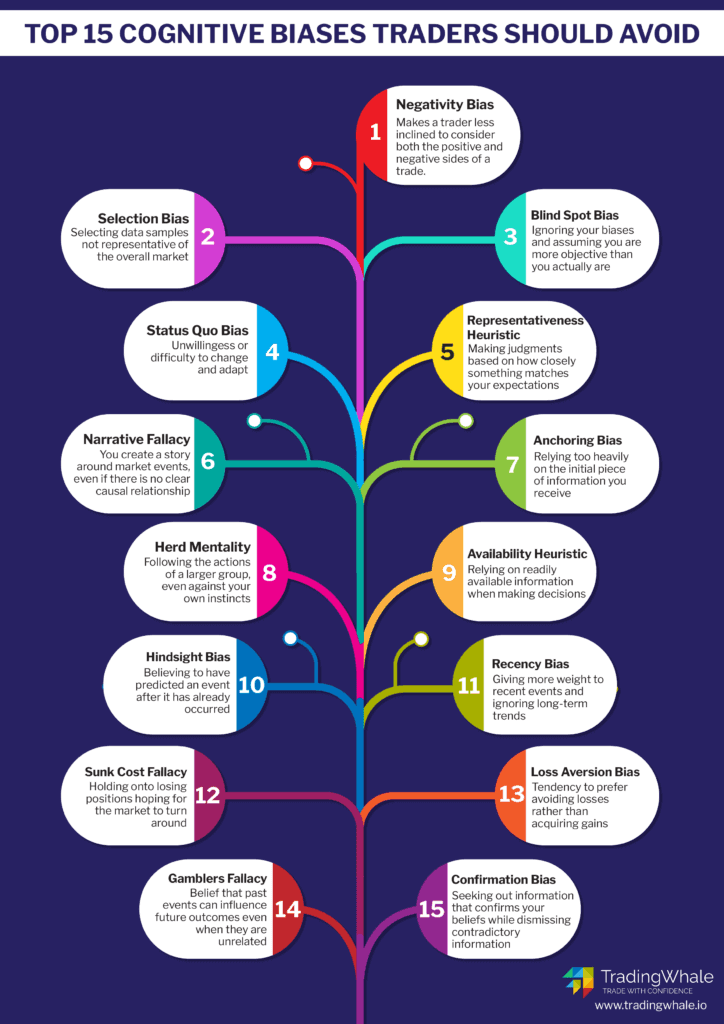
3. From Identification to Mitigation: Building Your Routines
Awareness is the first step, but it's not enough. You must implement concrete, daily routines to counteract these biases. The article "5 Cognitive Biases That Sabotage Traders" provides excellent, actionable solutions for each bias. I encourage you to read it alongside this section.
5 Cognitive Biases That Sabotage Traders
To reinforce what you learned from the video and get specific solutions, this article from City Traders Imperium provides a great breakdown of each bias and its fix.
Read through the sections on Recency Bias, Loss Aversion, Confirmation Bias, Overconfidence Bias, and Anchoring Bias. Pay special attention to the 'How to Fix It' lists for each.
Let's integrate these fixes into your ICT workflow.
A. Confirmation Bias
- What it is: Seeking out information that confirms your directional bias and ignoring evidence that contradicts it.
- ICT Example: You've determined the daily bias is bullish. On the 1-minute chart, price sweeps a high and has a bearish Market Structure Shift (MSS) with displacement. You ignore this, telling yourself "the daily bias is up," and wait for a long entry that never comes or fails.
- Mitigation Routine:
- Play Devil's Advocate: Before entering any trade, you must articulate one clear reason why the trade might fail based on current price action. "This trade could fail if this bearish MSS is the true signal and my HTF bias is wrong for this session."
- Strict Checklist Adherence: Your trading plan's checklist is your primary defense. If even one box isn't ticked (e.g., the LTF structure does not confirm HTF bias), you cannot take the trade. No exceptions.
B. Recency Bias
- What it is: Giving too much importance to recent trades. A winning streak makes you feel invincible; a losing streak makes you fearful.
- ICT Example: You've just won three 2022 Model trades in a row. For the fourth setup, you notice the displacement wasn't as strong, but you take it anyway, thinking you're "on a roll." It fails.
- Mitigation Routine:
- Trust Your Stats: Keep your backtested expectancy (e.g., "+0.5R per trade") visible. This reminds you that your edge plays out over hundreds of trades, not the last three. Individual outcomes are random.
- Constant Risk: Your risk per trade (e.g., 0.5%) is non-negotiable. It does not change whether you are winning or losing. This mechanically prevents recency bias from affecting your position size.
C. Overconfidence Bias
- What it is: Believing you are more skilled than you are, leading to breaking rules. This is the direct result of a winning streak fueled by recency bias.
- ICT Example: After a profitable week, you decide to trade outside the London Killzone because you "feel" a move coming. You take a trade that is not part of your plan and give back two days' worth of profits.
- Mitigation Routine:
- The Professional's Routine: Never, ever skip your pre-session analysis or deviate from your plan's execution windows. Professionals are defined by their consistency, not their feelings.
- Mandatory Loss Review: As part of your weekly review, you must analyze your losing trades. This provides a regular dose of humility and reminds you that the market is always supreme.
D. Loss Aversion
- What it is: The pain of a loss feels twice as bad as the pleasure of an equal gain. This leads traders to let losers run (hoping they'll come back to breakeven) and cut winners short (to lock in a small profit).
- ICT Example: You're in a trade, and price has moved 1R in your favor. Your target is 2.5R at an old high, but you see a small candle move against you and you close the trade, fearing a reversal. Later, price runs to your original target.
- Mitigation Routine:
- Accept the Risk Pre-Trade: Before you click "buy" or "sell," consciously accept that the money you are risking is already gone. It is the cost of doing business. This detaches you from the outcome of this single trade.
- Follow the Plan's Management Rules: Your trading plan dictates where your stop loss is, where you take partials, and where your target is. You are a plan-executor, not an in-the-moment decision-maker. Let the plan manage the trade.
E. Impatience & The Fear of Missing Out (FOMO)
- What it is: The overwhelming need to be "in the action," which leads to overtrading and taking suboptimal setups.
- ICT Example: It’s 9:00 AM NY time, and the setup for your 2022 model hasn’t formed yet. You get anxious watching the price move and jump into a trade that doesn't meet all your checklist criteria, just to be in the market.
- ICT's Blunt Advice: ICT has a very direct way of describing this feeling. He calls it being a "fiend" for the next trade.
ICT Explains How to Build a Disciplined Trader Psychology - The Missing Piece
Listen to ICT describe the psychological state of a trader who isn't ready. This highlights the danger of always needing to be in a trade.
Watch from 01:24 to 02:22. His comparison of a trader needing the 'next trade' to an addict is a powerful metaphor for the bias of impatience.
- Mitigation Routine:
- Quality Over Quantity: Remind yourself: "My job is not to trade every day. My job is to wait patiently for my A+ setup and execute it flawlessly."
- Close the Charts: Your plan defines your trading hours (the Killzones). If it's outside those hours, or if market conditions are not conducive to your model, your job is to close the platform and walk away. Being flat is a position.
4. Your Ultimate Tool: The Psychological Journal
The trading journal you learned to create is not just for tracking stats; it's your laboratory for mastering psychology.
Actionable Step: Add a new section to your journal template titled "Psychological Log." For every trade, you will answer these questions:
- Pre-Trade: Why am I taking this trade? Is it 100% aligned with my plan, or am I feeling impatient/greedy/fearful?
- During-Trade: What temptations am I feeling? (e.g., "Tempted to move my stop," "Anxious to take profit early").
- Post-Trade: How do I feel about the outcome? Am I angry about the loss? Eager to jump back in?
During your weekly review, you will analyze this log to find your personal bias patterns. "I notice that after two losses, I tend to revenge trade." This self-awareness, backed by your own data, is what allows you to anticipate and manage these biases before they take control.
Conclusion
Mastering trading psychology is a lifelong journey, but today you have built the foundational toolkit. You can now identify the most common cognitive biases and, more importantly, have a set of concrete, daily routines to mitigate their impact. Your trading plan provides the rules, and your journal provides the feedback loop for ensuring you follow them.
Key Takeaways:
- Your mind is the biggest variable in your trading performance. Success requires psychological discipline.
- Cognitive biases like Confirmation, Recency, Overconfidence, and Loss Aversion are predictable mental shortcuts that lead to irrational trading decisions.
- You can combat biases by implementing strict routines grounded in your trading plan: always use your checklist, adhere to risk rules, play devil's advocate, and respect your process.
- Your trading journal is your most powerful tool for psychological improvement, allowing you to track and analyze your emotional patterns.
Preview of the Final Lesson:
This was our final lesson on professional development. You now have the skills to analyze price, build a model, create a plan, and manage your own psychology. In the final lesson of this course, we will put it all together to "Formulate a long-term plan for continuous learning and skill refinement." This will ensure your growth as a trader continues long after you complete this structured curriculum, setting you on a path for a sustainable career.