Hello! Welcome to the first lesson of our final module, "Trade Management and Professional Development."
In our last module, we reached the pinnacle of ICT's analytical framework. You learned how to synthesize time, price, and liquidity to formulate a daily bias and anticipate the market's narrative. You now have a complete toolkit for identifying and entering high-probability trades.
But entering a trade is only half the battle. What you do after you're in a position is just as critical to your long-term success. This is where professional trade management begins. Today's lesson focuses on a foundational aspect of this: implementing partial profit-taking at logical levels using ICT arrays.
This lesson will teach you how to systematically secure profits, reduce risk, and manage your psychology once a trade moves in your favor.
1. The Philosophy: Why Take Partial Profits?
Many traders, especially those new to the field, adopt an "all or nothing" approach, holding their entire position for a single, ambitious target. While this can lead to large wins, it can also lead to the frustrating experience of watching a profitable trade reverse and turn into a loss.
ICT advocates for a more pragmatic approach: paying yourself when the market offers you profit. This isn't a sign of weakness or lack of conviction; it's a core component of professional risk and psychological management.
Let's hear this philosophy directly from Michael Huddleston (ICT).
ICT Explains Why He Takes Partials While Trading
In this clip, 'ICT Explains Why He Takes Partials While Trading,' Michael makes a passionate case for securing profits as a trade develops. He directly addresses the common arguments against it and frames it as a crucial practice for new and developing traders.
Please watch these segments from the video: The Core Argument (00:33 - 01:58): Listen to his analogy comparing trading without partials to working a week and not taking your paycheck. This highlights the fundamental logic of taking profits when they are available. Benefits for New Traders (01:58 - 02:57): He explains how taking small, consistent profits helps you get accustomed to the feeling of winning and builds confidence. Emotional Management (03:07 - 05:20): Pay attention to his description of traders 'squirming' and stressing over unrealized gains. Taking partials is a direct remedy for this emotional turmoil. The Signal to Take Partials (07:03 - 08:39): He provides a very practical tell-tale sign: if you feel yourself becoming audibly or physically anxious about a trade, it's a clear signal that you need to take some profit off the table.
As you can see, taking partials achieves several things:
- It secures profit: You are moving money from unrealized "paper" profit to realized profit in your account.
- It reduces risk: By taking some of the position off, you lower your overall exposure to a potential reversal.
- It manages psychology: It alleviates the fear of a winning trade turning into a loser, allowing you to manage the remainder of the position with a clearer, more objective mind.
2. The Logic: Where to Take Profits?
Profit-taking in the ICT methodology is not random. Your targets are determined by the same logic you used to enter the trade. You are simply targeting the opposing PD Arrays.
Recall the PD Array Matrix. When you enter a long trade, you are buying at a discount. Your logical profit targets are the PD arrays located in the premium side of the price leg. Conversely, when you enter a short trade from a premium, your targets are the PD arrays in the discount zone.
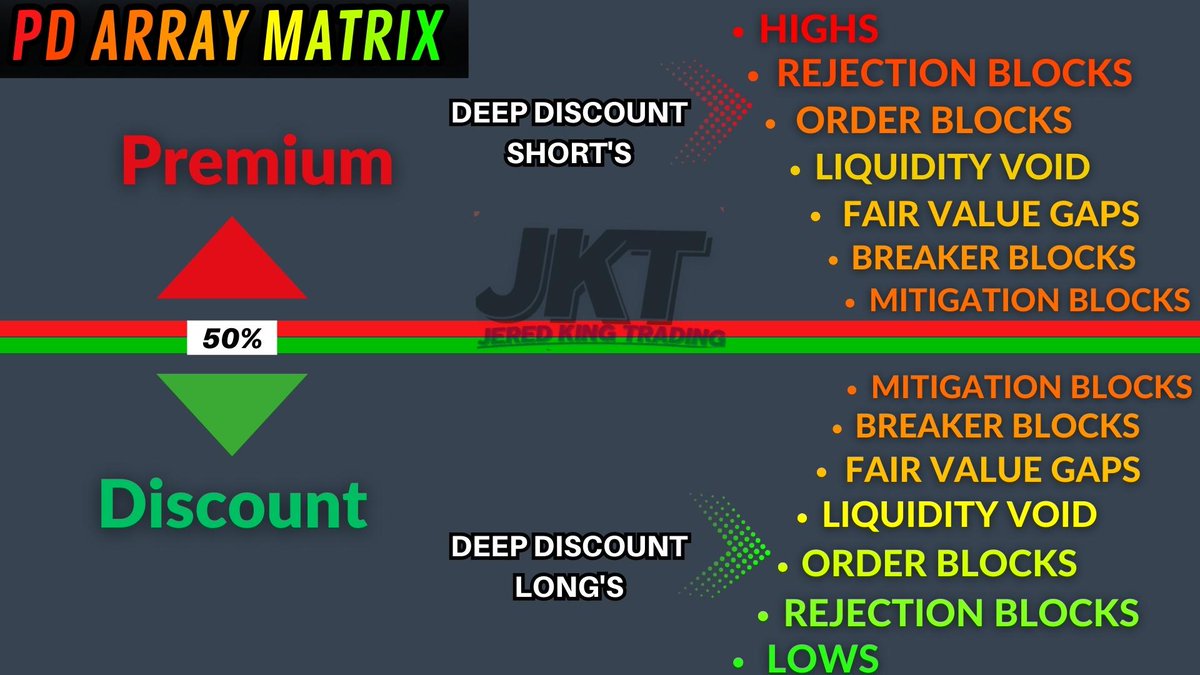
So, what are these specific levels? They are the same ICT concepts you've already mastered.
PD Arrays in ICT: What They Are and How They Work
To refresh your memory on the specific tools available in the PD Array, please review this section from the FXOpen article 'PD Arrays in ICT'.
Read the section titled 'Tools Within the PD Array.' This list—Order Blocks, FVGs, Breaker/Mitigation Blocks, Liquidity Voids, and Old Lows/Highs—is your menu of potential profit targets.
Here are the most common and logical levels to take partial profits:
- Fair Value Gaps (FVGs): Price is magnetically drawn to these imbalances. An FVG on an opposing side of the market is a high-probability target.
- Order Blocks (OBs): An opposing order block represents a significant level where the other side of the market may step in. It is a natural place for price to pause or reverse.

- Liquidity Pools: The obvious old swing highs (for longs) or swing lows (for shorts) where stop-loss orders are clustered. These are prime targets for the algorithm.
- Equilibrium (50%): The 50% level of the price range you are trading within is often the first major hurdle. It's a logical place for an initial reaction and a great spot for a first partial profit.
3. The Implementation: A Practical Framework
Knowing where to take profits is one thing; having a system is another. Here is a structured, three-tiered approach to taking partial profits that you can adapt.
Let's assume you've entered a long trade from a discount FVG, targeting a higher timeframe draw on liquidity.
-
TP1: The "De-Risk" Target
- Level: The first logical point of resistance. This is often the equilibrium (50%) of the current price swing or the first minor, opposing FVG.
- Action: Take off a portion of your position (e.g., 25-50%).
- Next Step: Immediately after TP1 is hit, move your stop loss on the remaining position to your entry price (break-even). We will cover this in detail in the next lesson.
- Outcome: You have now locked in a small profit and removed all risk from the trade. The remaining position is a "free ride."
-
TP2: The "Bread & Butter" Target
- Level: A more significant PD Array in the premium. This could be a clear Bearish Order Block on the 15-minute or 1-hour chart, or the fill of a significant FVG.
- Action: Take off another, larger portion of your position (e.g., another 25-50%).
- Outcome: You have now secured the bulk of your intended profit.
-
TP3: The "Runner"
- Level: The ultimate draw on liquidity that formed your initial trade idea, such as a major weekly high (buy-side liquidity).
- Action: Let the final portion of your trade (e.g., the last 25%) run toward this final target. You might use a trailing stop or simply let it run until the target is hit or the market structure tells you the move is over.
- Outcome: This allows you to participate in an extended, high-momentum move without managing a large position, capturing outsized returns when they occur.
This framework is also highlighted as a sound practice in the risk management section of many trading guides.
Order Block Trading Strategy: Complete ICT Guide for Prop Firms ...
The article 'Order Block Trading Strategy' briefly mentions this concept. It's a good reminder that partial profit-taking is a universal principle of sound risk management.
Read the short subsection titled '3. Taking Partial Profits' within the 'Risk Management for Order Block Traders' section. This reinforces the idea of locking in gains while letting a portion of the position run.
4. A Chart Example
Let's apply this framework to a scenario. The video below shows an entry based on an OTE in a discount zone. While the video presents it as a single trade, we can overlay our partial profit-taking framework onto it.
Discount & Premium - ICT Concepts
This video, 'Discount & Premium - ICT Concepts', demonstrates a trade that moves from a discount entry to a premium target. We will use it to map out our partial profit strategy.
Watch the example starting at 05:52. The narrator identifies a long entry setup at the Optimal Trade Entry (OTE) level within a discount zone, targeting a daily Fair Value Gap above. Imagine you took this trade. Here is how you could apply our framework: Entry: Long at the OTE level (deep discount). TP1 (De-Risk): As price rallies, your first target would be the equilibrium (0.5 Fib level) of that range. Once hit, you'd take off 25% and move your stop to break-even. TP2 (Bread & Butter): A good second target would be the high of the range that was created before the retracement, as this is a minor liquidity pool. TP3 (Runner): The final target is the one identified in the video: the daily Fair Value Gap, which is the major draw on liquidity.
This structured approach turns trade management from a guessing game into a repeatable, logical process.
Conclusion
You have now learned the "why," "where," and "how" of taking partial profits using ICT concepts. This is a significant step in your journey from trade analyst to professional trade manager. It's a skill that protects your capital, manages your emotions, and ultimately contributes to your long-term consistency.
Key Takeaways:
- Taking partial profits is a professional habit that secures gains, reduces risk, and aids emotional stability.
- Logical profit targets are not arbitrary; they are the opposing PD arrays (FVGs, Order Blocks, Liquidity Pools) in the premium or discount zone.
- A structured framework (e.g., TP1, TP2, Runner) allows for systematic profit-taking.
- The first partial profit target should be your trigger to de-risk the trade by moving your stop loss to break-even.
Preview of the Next Lesson:
We've mentioned it several times today, and it's the inseparable partner to taking your first partial profit. In our next lesson, we will dedicate the entire session to the art of moving your stop loss to break-even, detailing the precise mechanics and strategic considerations for de-risking your trades effectively.