Introduction
Welcome back. In our last lesson, you learned how to use the Unicorn model as a high-precision entry technique by placing it within a complete trade thesis built on higher-timeframe context. This reinforced the core ICT principle that an entry pattern is only as good as the narrative it completes.
Today, we shift our focus from a specific entry pattern to a key daily event: the London Swing. The London session is pivotal; its price action often sets the directional tone for the rest of the day. This lesson will teach you how to identify the characteristics of a valid London Swing when it acts as a session continuation play. Your goal is to learn how to read the London open not for a reversal, but to see when it is confirming an existing trend, setting the stage for a high-probability continuation move.
1. London Session: Reversal vs. Continuation
The London session typically unfolds in one of two ways: as a reversal or as a continuation.
- London Reversal (Judas Swing): This is the classic manipulation pattern. Price moves against the expected daily direction to sweep liquidity from the Asian session highs or lows, tricking traders before reversing to follow the true directional bias. Many traders focus exclusively on this pattern.
- London Continuation: This occurs when the higher-timeframe trend is strong and already in motion. Instead of a major reversal, the London session simply provides a shallow retracement or pause before continuing the established trend.
Trading a continuation play often means you are trading in alignment with institutional order flow, which can be a higher-probability approach than trying to catch a reversal.
The following video introduces these two scenarios and makes a crucial point about why focusing only on reversals can be a mistake.
How To Trade London Session (Full Trading Plan)
Let's watch this segment from 'How To Trade London Session' by Rize Trades. It clearly distinguishes between a London reversal and a London continuation, highlighting why the continuation model can be a more reliable setup.
Watch from 01:25 to 02:32. Pay close attention to the argument that market structure over the past days or weeks is more important than the Asia session structure alone. This is the foundational idea behind trading continuations.
As you just saw, when the higher-timeframe market structure is clear, anticipating a continuation can keep you on the right side of the market. The "London Swing" in this context is the initial move during the London Killzone that confirms this continuation.
2. Characteristics of a Valid London Swing for Continuation
For a London Swing to be considered a valid setup for continuation, it must satisfy a clear set of contextual conditions. Much like the framework for the Unicorn model, this involves analyzing time, price, and structure before the session even begins.
A valid London Swing for continuation is characterized by the following:
A. Clear Higher-Timeframe (HTF) Directional Bias
This is non-negotiable. Before looking at the London session, you must have a directional bias from the 4-hour or 1-hour chart.
- Bullish Bias: Market structure is making higher highs and higher lows. Your expectation is for price to eventually seek buy-side liquidity or a premium array.
- Bearish Bias: Market structure is making lower lows and lower highs. Your expectation is for price to eventually seek sell-side liquidity or a discount array.
B. Price Retraces to a Key HTF PD Array
Price moves from liquidity to inefficiency. For a continuation to occur, we expect the London session to retrace into a significant HTF Point of Interest (PD Array) that aligns with your bias. This could be:
- A bullish order block or Fair Value Gap (FVG) in a discount zone.
- A bearish order block or FVG in a premium zone.
C. The Role of the Asian Session
Often in a continuation scenario, the Asian session has already done the "heavy lifting" of the retracement. For instance, in a bullish trend, the Asian session may have been the one to trade down into the HTF discount FVG. In this case, London's job is not to reverse, but simply to confirm the upward move and continue the expansion.
The video below outlines a three-step strategy that encapsulates these characteristics.
How To Trade London Session (Full Trading Plan)
The Rize Trades video also provides a systematic strategy for identifying these setups. This framework will help you build a checklist for spotting valid London continuation plays.
Watch from 02:32 to 09:20. First, focus on the 'Step 2: Market Structure' section (03:30 - 04:30). Notice how the setup depends on price trading into a 1H or 4H Fair Value Gap. Also, note the key difference he points out: sometimes Asia trades into the gap, setting up a London continuation. Then, watch the detailed examples of 'continuation trades' from 05:27 onwards. Observe how price is already bearish on the hourly chart and the London session simply offers entries to join that existing trend, without a major sweep of the Asia high.
3. Visualizing the London Swing for Continuation
Let's look at a static chart example to solidify this concept. In a bearish scenario, the London Swing for continuation would involve a small rally during the London Killzone that fails to create a major reversal, instead offering an opportunity to sell in line with the HTF bearish trend.
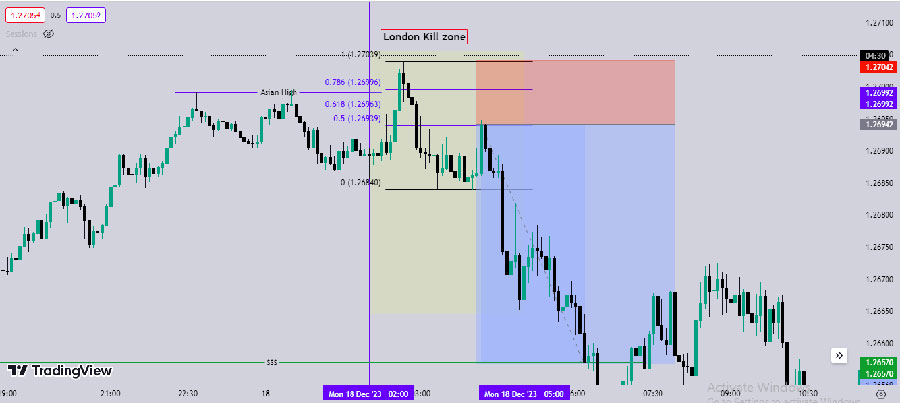
What you are looking for is confirmation, not contradiction. The London Swing should respect the established market structure and flow. If the 4H trend is bearish, you want to see the London session rally into a premium PD array and then show weakness—this is your continuation setup. A move that aggressively breaks multiple bullish structures and displaces higher would signal a potential reversal (a Judas Swing), which is a different pattern altogether.
4. Distinguishing from the London Reversal (Judas Swing)
To master the continuation play, you must be able to clearly distinguish it from its opposite: the London Reversal, or Judas Swing.
| Feature | London Swing (Continuation) | London Reversal (Judas Swing) |
|---|---|---|
| Purpose | To confirm the existing HTF trend. | To manipulate against the HTF trend to grab liquidity. |
| Price Action | A relatively shallow pullback into a supportive PD Array. | A sharp, aggressive move sweeping the Asian session high or low. |
| Context | Price respects the HTF structure and order flow. | Price appears to break HTF structure before violently reversing. |
| Trader's Goal | Join the established trend. | Fade the manipulation and catch the "true" move. |
The Judas Swing is a powerful concept tied to the "Power of 3" (Accumulation, Manipulation, Distribution), where London creates the manipulative wick of the daily candle. While we won't dive deep into that model today, it's useful to know that it represents the reversal profile that you must learn to differentiate from the continuation profile.
The resource "ICT Daily Profile - London Reversal / New York Continuation" (ID: LINK) explains this reversal profile in detail and is excellent supplementary material if you wish to explore the contrast further. We will revisit these ideas in the next lesson.
Conclusion
You have now learned to identify one of the key narratives of the trading day: the London session continuation. By focusing on setups that align with the higher-timeframe direction, you can position yourself alongside institutional order flow.
Key Takeaways:
- The London session can either produce a reversal (Judas Swing) or a continuation.
- A valid London Swing for continuation is characterized by a clear HTF directional bias and a retracement into a key HTF PD Array.
- This pattern confirms the existing trend rather than contradicting it, making it a high-probability setup.
- The key is to trade what you see: if the market is showing strong directional momentum, look for the continuation play rather than trying to force a reversal.
Preview of the Next Lesson:
Now that you can identify when the London session is setting up a continuation, the next logical step is to trade it. In our next lesson, we will focus on executing entries for the New York session continuation model, which uses the direction established by the London Swing as its foundation for high-probability trade setups.