Welcome to the next stage of our journey into flight simulation! In the previous module, you built and validated a robust simulation for a projectile, even accounting for air resistance. By comparing your numerical results to an exact analytical solution, you confirmed that your code correctly models the fundamental laws of motion. That validation was crucial, as it gives us confidence to tackle more complex physics where no simple formulas exist.
Now, we shift our focus from a passive projectile to an active vehicle: a rocket. This lesson begins our exploration of rocket propulsion by answering the most fundamental question: how does a rocket generate the immense force needed to overcome gravity and launch into space? Our goal is to describe how a rocket motor produces thrust by expelling mass, connecting this process to the basic laws of physics you're already familiar with.
The Principle of Action and Reaction
At its core, a rocket works by throwing stuff out the back. This might sound overly simple, but it's the absolute truth. The principle behind this is Sir Isaac Newton's Third Law of Motion: for every action, there is an equal and opposite reaction.
Let's start with a simple, high-level explanation from NASA.
This NASA webpage provides a clear, non-mathematical introduction to the physics of rocket propulsion.
Please read the first two main sections: Start with the section beginning A rocket in its simplest form. This introduces the basic concept using the balloon analogy. Continue to the section titled "Newton's Third Law," reading from the beginning down to the discussion of air. This section uses analogies like stepping from a boat or riding a skateboard to explain the action-reaction principle and clarifies a common misconception about rockets needing air to "push against."
As the text explains, the rocket expels hot gas backward (the "action"). In response, the gas pushes the rocket forward (the "reaction"). This forward push is what we call thrust. It's an internal process; the rocket pushes on its own exhaust, not on the air or the launchpad. This is precisely why a rocket works so effectively in the vacuum of space, where there is no air at all.
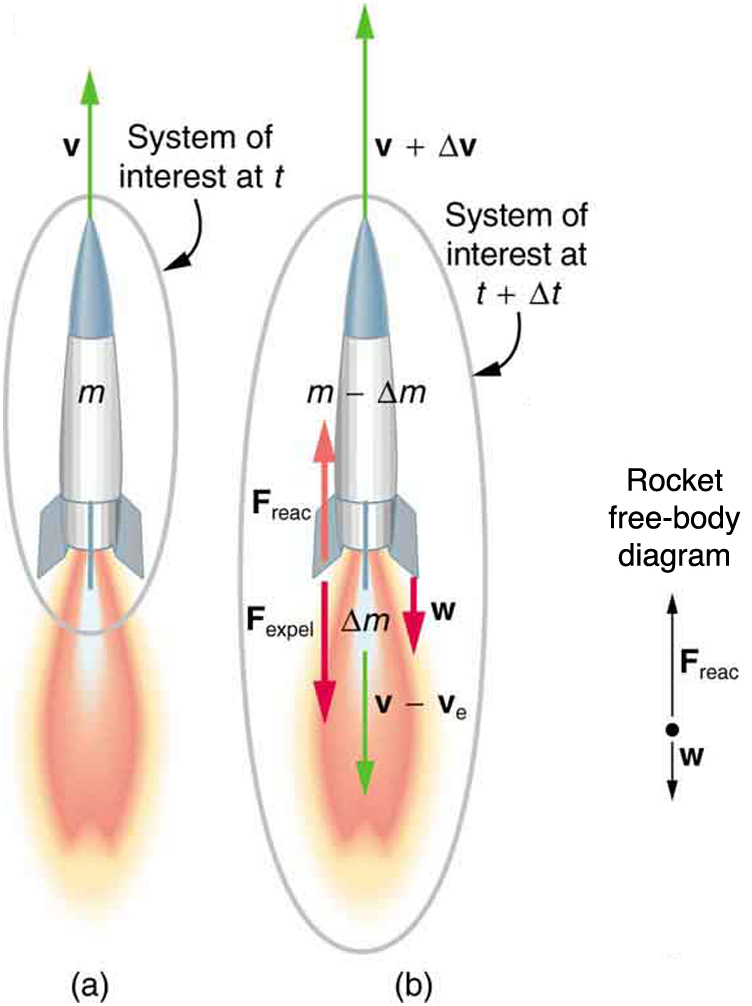
This diagram illustrates the process. At time , the system is the rocket plus its fuel, with mass and velocity . A short time later, at , the rocket has expelled a small amount of mass (the exhaust gas) at a high velocity. The rocket itself now has less mass () and its velocity has increased to . The forward force is the reaction to the force used to expel the gas, .
Conservation of Momentum
Newton's Third Law can also be described using the concept of conservation of momentum. Momentum is the product of an object's mass and its velocity (). In any "closed system"—one with no external forces acting on it—the total momentum must remain constant.
Imagine our rocket sitting on the launchpad. The rocket and its unburnt fuel form a closed system. Its velocity is zero, so its total momentum is zero. To maintain this zero total momentum, when the engine fires and throws mass (exhaust gas) with negative momentum (downward), the rocket must gain an equal amount of positive momentum (upward).
This video provides an excellent visual explanation of this concept and introduces a crucial distinction.
The very basic principles behind rocket engines!
This video from the channel PhysicsIsFun breaks down rocket propulsion into the core principle of momentum conservation.
Please watch two key segments: First, watch from the beginning to understand the system and momentum. Pay close attention to the explanation of how momentum is conserved for the rocket-fuel system. Next, skip ahead to see the difference between a single push and a sustained force. The demonstration of continuous momentum transfer is a powerful illustration of how a real rocket engine produces a constant thrust, not just a single "kick."
The key takeaway is that thrust isn't from a single explosion; it's generated by the continuous expulsion of mass. This steady stream of exhaust gas continuously transfers momentum to the rocket, resulting in a sustained acceleration.
Inside the Rocket Engine
So, we know that a rocket engine's job is to continuously expel mass at high velocity. But how does it do that? The process happens inside the rocket motor, which consists of several key components.
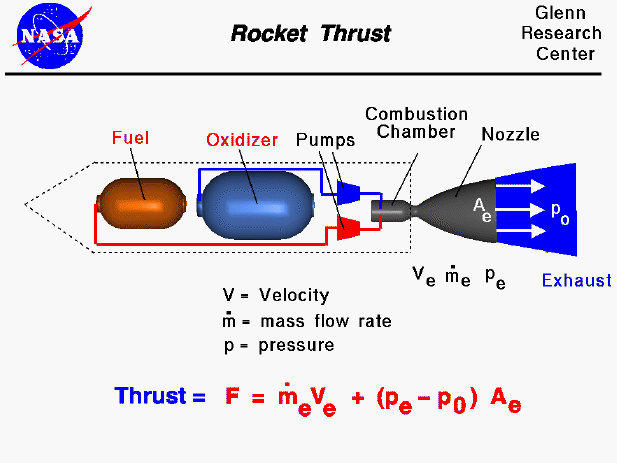
The process unfolds in a few steps, which are explained beautifully in the following video.
This video from LabRat Scientific provides a detailed but clear look at the internal workings of a rocket motor.
Watch these three segments to understand the mechanism of thrust generation: Pressure Forces: This part explains how combustion creates high pressure inside the motor. Critically, it shows how the opening at the back creates an unbalanced force that pushes the rocket forward. Combustion: This segment details what's being burned. It highlights that rocket propellant contains both fuel and its own oxidizer, which is why it can burn in the vacuum of space. The Rocket Nozzle: The shape of the nozzle is critical. This part explains how its convergent-divergent design accelerates the exhaust gases from subsonic to supersonic speeds, maximizing their exit velocity and, therefore, the rocket's thrust.
Let's summarize the mechanical process:
- Combustion: Solid or liquid propellants (fuel + oxidizer) are burned in the combustion chamber, turning into extremely hot, high-pressure gas.
- Pressure Imbalance: This gas pushes in all directions. The pressure pushing on the front wall of the chamber is not balanced by any pressure on the rear, because the rear is open. This pressure difference results in a net forward force on the rocket structure.
- Acceleration: The only way for the gas to escape is through the nozzle. The special "convergent-divergent" shape of the nozzle is designed to accelerate this gas to the highest possible speed (often several kilometers per second).
Since thrust is a result of expelling mass, a higher mass flow rate or a higher exhaust velocity will result in greater thrust. The nozzle's job is to maximize that exhaust velocity.
The following reading reinforces these ideas, tying together the engine's components with the physical principle of thrust.
This NASA resource provides a concise summary of how a rocket engine functions and presents the thrust equation we will be exploring in the next lesson.
For this lesson, focus on the text, not the equation. Read the paragraphs from the beginning and also the part explaining why rockets work in space. These sections confirm that thrust is produced according to Newton's third law and that carrying an onboard oxidizer is the key to operating in a vacuum.
Conclusion
In this lesson, you've learned the fundamental principle behind rocket propulsion. We've moved beyond the physics of passive objects and started exploring the forces that create motion.
Here are the key takeaways:
- A rocket generates thrust by expelling mass (exhaust gas) at high velocity.
- This process is a direct application of Newton's Third Law (action-reaction) and the principle of conservation of momentum.
- The rocket engine accomplishes this by burning propellants (fuel and an oxidizer) to create high-pressure gas in a combustion chamber.
- The pressure imbalance inside the chamber creates a net forward force on the rocket.
- A specially shaped nozzle accelerates the exhaust gas to supersonic speeds, maximizing the momentum of the expelled mass and thus maximizing thrust.
- Because rockets carry their own oxidizer, they do not need atmospheric air and function perfectly in the vacuum of space.
You now have the conceptual foundation of rocket propulsion. In our next lesson, we will translate this concept into a mathematical model. You'll learn how to calculate thrust based on exhaust velocity and mass flow rate, which will allow us to finally add the thrust force to our Python simulation and get our rocket off the virtual launchpad.