In our last lesson, we established the core principle of rocket propulsion: a rocket moves forward by throwing mass backward at high speed, a perfect demonstration of Newton's Third Law and the conservation of momentum. We explored the inner workings of an engine, from combustion to the nozzle's role in accelerating exhaust gas.
Now, we will move from this conceptual understanding to a quantitative one. The goal of this lesson is to develop the mathematical model for rocket thrust, connecting it directly to two key parameters: exhaust velocity and mass flow rate. This equation is the heart of our propulsion model and will be the first major force we add to our simulation to get our rocket off the ground.
From Momentum to Force
In the previous lesson, we saw that thrust is the reaction force generated by continuously expelling mass. We can derive a formula for this force by revisiting Newton's Second Law, but in its more fundamental form, which relates force to the rate of change of momentum ().
When a rocket expels gas, it is changing its mass. This continuous change of mass at a certain velocity results in a force. The following video provides a clear and intuitive derivation of the resulting equation.
Rocket Propulsion Physics & Mass Flow Rate - Newton's 3rd Law of Motion
This video from The Organic Chemistry Tutor provides a straightforward derivation of the thrust force from the principles of momentum.
Please watch these two key segments: Start with the derivation from Newton's second law. Notice how force, which you know as F=ma, can also be expressed as the rate of change of momentum. The key insight here is that momentum can be changed by altering velocity or by altering mass. Next, watch the worked example of a rocket calculation. This applies the formula to find the thrust force given a mass ejection rate and exhaust velocity.
As the video explains, the force generated by a fluid (like our exhaust gas) can be expressed as:
In the context of rocketry, we refine the terms:
- becomes the mass flow rate, symbolized as . It represents how much mass (propellant) the engine consumes and expels per second, measured in kg/s.
- becomes the exhaust velocity, symbolized as . This is the speed of the exhaust gases relative to the rocket, measured in m/s.
This gives us the fundamental equation for the momentum component of thrust:
This equation tells us that to get more thrust, an engine must either expel mass at a faster rate () or expel it at a higher velocity ().
For a more rigorous look at this derivation using calculus, which you might find interesting as it builds directly on the conservation of momentum principle we discussed previously, the video from Physics Ninja provides an excellent step-by-step walkthrough from 00:01:29 to 00:09:34. This is optional but recommended if you enjoy seeing the mathematical underpinnings in full detail.
The Complete Picture: Momentum and Pressure
The momentum thrust, , is the largest and most important part of the total thrust, but it isn't the whole story. There is a second component related to pressure.
The hot gas leaves the nozzle at a specific pressure, . This gas pushes against the surrounding, or ambient, air, which is at pressure . This pressure difference, acting over the nozzle's exit area , creates an additional force called pressure thrust.
The complete thrust equation combines both momentum and pressure components.
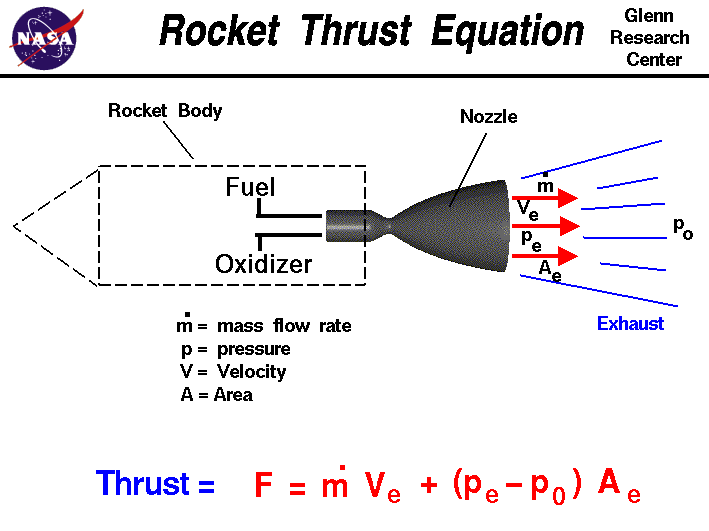
The full equation is:
Let's break down the pressure term:
- If the nozzle exit pressure is greater than the ambient pressure (), the pressure term is positive and adds to the total thrust. This is called an "underexpanded" nozzle, typical at high altitudes where ambient pressure is low.
- If the exit pressure is less than the ambient pressure (), the pressure term is negative, and the higher ambient pressure "pinches" the exhaust, slightly reducing thrust. This is an "overexpanded" nozzle, which can happen if a vacuum-optimized engine is fired at sea level.
- If , the nozzle is "perfectly expanded" for that altitude, and the pressure thrust is zero.
For many simulations, especially for model rockets flying at low altitudes, the pressure thrust component is small and can be ignored for simplicity. In these cases, we rely solely on .
You can review a formal definition of the thrust equation in the following resource.
Nozzle Flow — proptools 0.0.0 documentation
This document provides a technical look at nozzle performance calculations. We are interested in its formal definition of thrust.
Please navigate to the section titled Thrust. Read the short paragraph and the first equation presented, which formally defines the thrust force with both momentum and pressure terms. Note that it uses p_a for ambient pressure, which is the same as p_0 in our notation.
A Practical Measure of Efficiency: Specific Impulse ()
While exhaust velocity is a fundamental physical property, engineers often use a practical performance metric called Specific Impulse, or . It's a measure of how efficiently an engine uses propellant.
Specific impulse is defined as the thrust generated per unit of propellant weight flow rate. Its unit is seconds. A higher means the engine can generate more thrust for a longer time with the same amount of fuel—it's more "fuel-efficient."

The formula for Specific Impulse is:
where is the acceleration due to gravity at sea level ().
We can rearrange this to find thrust if we know the engine's and mass flow rate:
Specific impulse is directly related to exhaust velocity. By comparing the two formulas for thrust, you can see that is a measure of the "effective exhaust velocity" (), which accounts for both the momentum and pressure components of thrust. For a perfectly expanded nozzle, the relationship is simple:
This means a high specific impulse corresponds directly to a high exhaust velocity.
From Theory to Code
Now, let's connect this back to our goal: building a Python simulation. For a model rocket, we won't be calculating nozzle pressures from scratch. Instead, we'll use data from the motor's manufacturer.
A typical model rocket motor specification sheet provides values like:
- Total Impulse (N·s): The total thrust integrated over the burn time.
- Burn Time (s): How long the motor fires.
- Propellant Mass (kg): The total mass of the fuel and oxidizer.
From these, we can calculate the average values needed for our simulation, assuming they are constant during the burn.
Making a simple flight simulation for model rockets in Python
This article provides a great example of how to set up the initial parameters for a model rocket simulation in Python.
Read the section from the beginning down to the calculation of averageThrust and massFlowRate. Focus on how these two simple lines of code translate the motor's specifications into the key variables we've just discussed: averageThrust = totalImpulse / burnTime massFlowRate = propellantMass / burnTime These calculations are the first step in turning the physics of thrust into practical code for our simulation.
This practical approach allows us to model a real-world motor's performance without getting lost in the complex physics of combustion and nozzle dynamics. For our simulation, we will define a thrust value that is constant during the motor's burn and zero afterward.
Conclusion
In this lesson, you've translated the concept of propulsion into a concrete mathematical model. This is a critical step that moves us from descriptive physics to predictive simulation.
Here are the main takeaways:
- The primary source of rocket thrust is momentum thrust, given by the equation , where is the mass flow rate and is the exhaust velocity.
- A secondary component, pressure thrust, arises from the pressure difference between the nozzle exit and the ambient air. The full equation is .
- Specific Impulse () is a key performance metric that measures an engine's fuel efficiency and is directly related to the exhaust velocity.
- For simulation purposes, we can calculate an average thrust and mass flow rate from manufacturer data, providing a practical way to model the engine's performance.
You are now equipped with the equation for the primary force that will lift our rocket. In the next lesson, we will address a direct consequence of this process: the rocket's changing mass. We will implement a time-varying mass for the rocket as it consumes propellant, making our model even more realistic.