Welcome to the final lesson in our introductory module on the foundations of nanoscience. In our last session, we focused on the "how" of nanoparticle analysis, learning to interpret data from key characterization techniques like DLS and TEM. You now have the tools to understand reports on nanoparticle size, shape, and stability.
Today, we will build directly on that knowledge by exploring the "what"—the defining features of the most common nanoparticles you will encounter in dermatological research and product development. This lesson directly addresses the learning outcome of describing common organic and inorganic nanoparticles. By the end, you will be able to identify and differentiate between liposomes, polymeric nanoparticles, dendrimers, and key inorganic particles like gold, silver, zinc oxide, and titanium dioxide. This knowledge forms the final pillar of our foundation, preparing us to move into the specific design of nanocarriers for drug delivery.
A Map of the Nanoparticle World
Before we examine individual particles, it's helpful to have a high-level classification. Nanoparticles are generally grouped by their core composition.
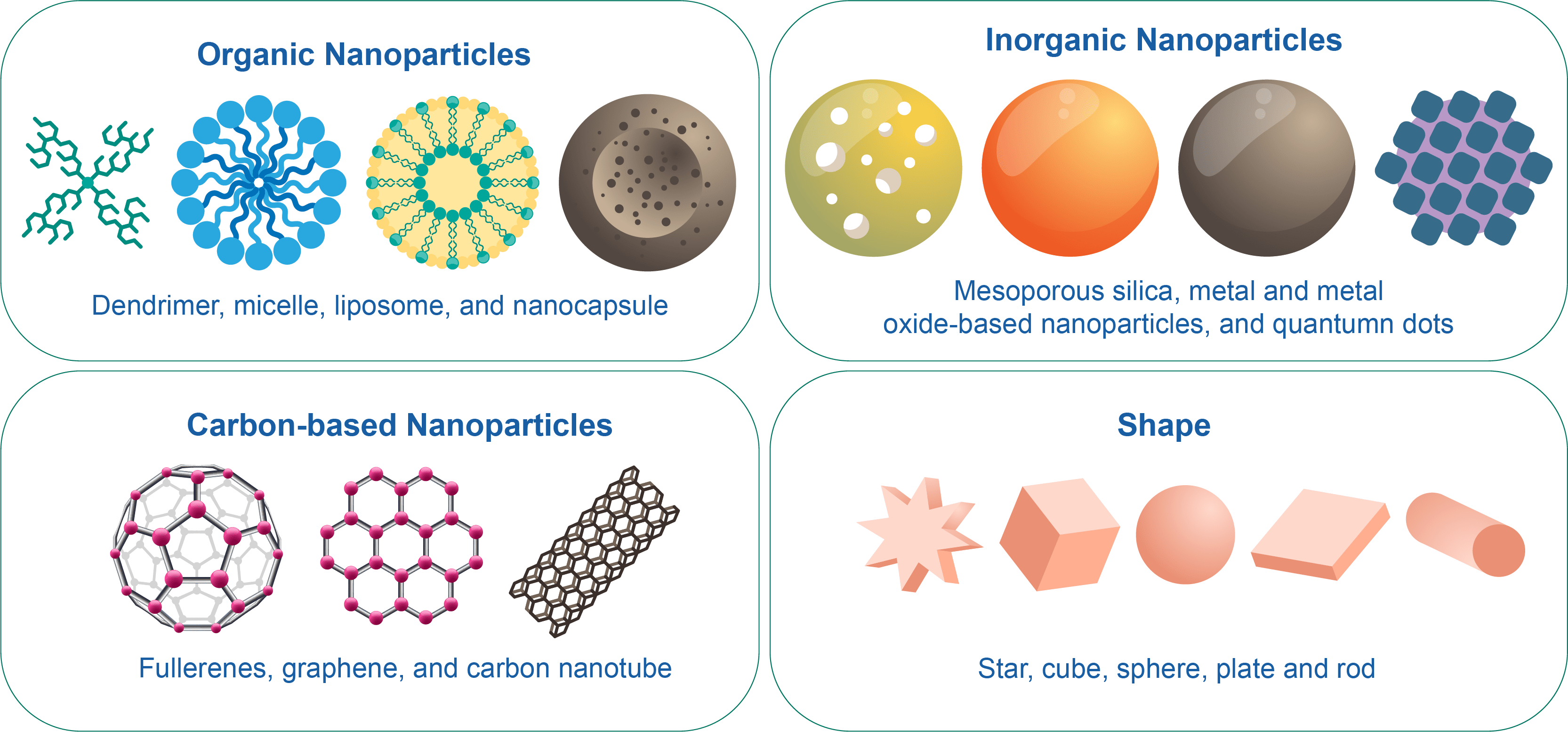
As you can see, the main categories are:
- Organic Nanoparticles: These are built from carbon-based molecules like lipids and polymers. Their key advantages often include biocompatibility and biodegradability, making them ideal candidates for drug delivery vehicles.
- Inorganic Nanoparticles: These are derived from non-carbon materials, such as metals (gold, silver) or metal oxides (zinc oxide). Their utility often comes from their intrinsic physical properties, such as optical, antimicrobial, or catalytic activity.
- Carbon-based Nanoparticles: This is a unique class that includes structures made purely of carbon, like fullerenes and carbon nanotubes.
For the purpose of nanodermatology, we will focus on the most prevalent organic and inorganic types.
Organic Nanoparticles: The Delivery Specialists
Organic nanoparticles are the workhorses of nanomedicine, primarily designed to encapsulate, protect, and deliver therapeutic agents.
1. Liposomes and Lipid Nanoparticles (LNPs)
Liposomes are arguably the most well-established and clinically translated nanocarriers. Your medical background gives you an intuitive grasp of their structure: they are essentially artificial cells, microscopic vesicles composed of one or more concentric phospholipid bilayers enclosing an aqueous core. This amphiphilic nature is their defining feature, allowing them to encapsulate both water-soluble (hydrophilic) drugs in their core and fat-soluble (hydrophobic) drugs within the lipid bilayer itself.
The term Lipid Nanoparticle (LNP) is a broader category that includes liposomes but also other lipid-based structures. Their recent prominence in mRNA vaccines has made them a household name. This short video provides an excellent contemporary overview of LNP composition and function.
What are Lipid Nanoparticles (LNP)?
This video from Dr. Rob Swanda clearly explains why LNPs are needed and breaks down their typical four-component lipid structure.
Please watch from the beginning to the end of the composition explanation. Pay close attention to the role of the four lipid types: Ionizable Lipids: The key for encapsulating negatively charged cargo like nucleic acids. Cholesterol: For membrane stability. Structural Lipids: To help form the particle structure. PEG Lipids: To create a "stealth" coating that prevents aggregation and reduces immune recognition.
The resource below, which focuses on cosmetic applications, provides further context on the use of liposomes and related lipid particles in dermatology.
Nano Beauty 2.0: Exploring Nanotechnology in Cosmetic Delivery ...
This review article situates various nanoparticles within the context of cosmetic and dermatological science.
First, read the descriptions for Liposomes, Ethosomes, Niosomes, and Solid Lipid Nanoparticles. This will introduce you to the broader family of lipid- and surfactant-based vesicles. Then, review the Table 1 entries for these particles to understand their specific advantages and limitations. Notice the recurring theme: a trade-off between penetration depth, stability, and potential for skin irritation.
As you can see, the basic liposomal structure can be modified to create a family of related carriers (ethosomes, solid lipid nanoparticles, etc.), each with slightly different properties tailored for specific applications. We will explore these specialized types in great detail in our next module.
2. Polymeric Nanoparticles (PNPs)
Instead of lipids, these nanoparticles are formed from biocompatible and biodegradable polymers. A common example you will see in literature is PLGA (poly(lactic-co-glycolic acid)), a polymer approved by the FDA for various medical applications due to its excellent safety profile.
The defining structural feature of PNPs is their architecture, which primarily falls into two categories:
- Nanospheres: A solid matrix system where the drug is uniformly dissolved or dispersed throughout the polymer network.
- Nanocapsules: A reservoir system consisting of an oily or aqueous core that contains the drug, enclosed by a thin polymer shell.
This structural difference dictates how a drug is loaded and, more importantly, how it is released. Nanospheres typically exhibit a more sustained, diffusion-controlled release, while nanocapsules can provide a more rapid initial release or protect a fragile core payload.
To connect this back to our previous lessons, let's look at how researchers describe the synthesis and characterization of these particles in a research paper.
Dendrimer, Liposomes, Carbon Nanotubes and PLGA Nanoparticles
This paper compares several nanocarriers. We will use it to see a practical example of PLGA nanoparticle synthesis and characterization.
First, in the "MATERIALS AND METHODS" section, read the short paragraph describing the preparation of PLGA nanoparticles. This shows the "bottom-up" solvent-evaporation technique. Next, jump to the "DISCUSSION" section and read the paragraph analyzing the PLGA NP characterization results. Note how the authors report the size (178 nm), PDI (narrow), and zeta potential (–11.8 mV) to validate their formulation—exactly the parameters you learned to interpret in the last lesson.
3. Dendrimers
Dendrimers are distinct from the other organic nanoparticles we've discussed. Their defining feature is their highly branched, "tree-like" (from the Greek dendron) three-dimensional architecture. They are not self-assembled but are built meticulously, layer by layer, in a process that adds repeating branched units around a central core.
This precise, stepwise synthesis results in several unique characteristics:
- Monodispersity: Unlike liposomes or PNPs, which always have a size distribution (measured by PDI), a population of dendrimers of a specific "generation" (number of layers) is almost perfectly uniform in size and molecular weight.
- High Surface Functionality: The surface of a dendrimer is covered with a large, well-defined number of chemical end-groups. These can be easily functionalized with targeting ligands, imaging agents, or drugs.
- Internal Voids: The internal structure contains void spaces that can be used to physically entrap smaller drug molecules.
This combination of features makes them powerful candidates for precision drug delivery and diagnostics.
Classification of Nanoparticles #nanotechnology #nanoscience
This video provides a concise visual introduction to several nanoparticle types.
Please watch the segment on organic nanoparticles. It offers a clear animated depiction of the branched structure of dendrimers, contrasting them with liposomes and micelles.
Inorganic Nanoparticles: Functional Materials
Inorganic nanoparticles are typically used not for what they can carry, but for their own inherent physical and chemical properties.
1. Gold (AuNPs) and Silver (AgNPs)
Gold and silver nanoparticles are among the most studied inorganic nanomaterials.
- Silver Nanoparticles (AgNPs) are defined by their potent, broad-spectrum antimicrobial activity. As a physician, you are familiar with the use of silver in wound dressings (e.g., Acticoat, Aquacel Ag). Nanosilver enhances this effect due to its massive surface area, allowing for greater release of silver ions (Ag+), which disrupt bacterial cell membranes and metabolic processes. This makes AgNPs highly relevant for treating infected wounds, acne, and preventing biofilm formation.
- Gold Nanoparticles (AuNPs) are prized for their unique optical properties and chemical stability. They exhibit a phenomenon called surface plasmon resonance, which we touched on in an earlier lesson. This allows them to strongly absorb light at a specific wavelength and convert it into heat. This property is the basis for photothermal therapy (PTT), an emerging strategy for ablating cancer cells, including melanoma, which we will explore in a future module. They are also investigated for anti-aging effects due to their potential to influence collagen production.
2. Zinc Oxide (ZnO) and Titanium Dioxide (TiO₂)
For a dermatologist, these are perhaps the most commercially important nanoparticles. ZnO and TiO₂ are physical UV filters, also known as mineral sunscreens.
Their defining feature in nanomedicine is the resolution of a classic formulation problem. In their bulk, microparticle form, these minerals are effective at blocking and scattering UV radiation, but they appear as a thick, opaque white paste on the skin. By reducing the particle size to the nanoscale (typically <100 nm), they become transparent to visible light while maintaining or even enhancing their efficacy in blocking harmful UVA and UVB radiation. This has revolutionized the cosmetic acceptability of mineral sunscreens.
This article provides an excellent summary of the role of these and other inorganic particles in cosmetics.
Nano Beauty 2.0: Exploring Nanotechnology in Cosmetic Delivery ...
This article again provides a concise, dermatology-focused summary.
Read the section on Inorganic Nanoparticles. Focus on the descriptions of Gold/Silver NPs and especially TiO₂/Zinc Oxide NPs. Then, review the Table 1 entries for these particles to compare their advantages and limitations. Note the mention of potential toxicity, a critical consideration that we will dedicate an entire module to later in the course.
Conclusion
In this lesson, we have surveyed the landscape of common nanoparticles relevant to dermatology, moving from broad classifications to the specific defining features of individual types.
Here are your key takeaways:
- Organic Nanoparticles (Liposomes, PNPs, Dendrimers): These are primarily valued as drug delivery vehicles. Their defining features relate to their composition (lipids, polymers), structure (bilayers, matrix/reservoir systems, branched architecture), and capacity for encapsulation.
- Inorganic Nanoparticles (Au, Ag, ZnO, TiO₂): These are primarily valued as functional materials. Their defining features are their intrinsic properties: antimicrobial (silver), optical/photothermal (gold), and UV-blocking (zinc/titanium oxides).
- Structure Dictates Function: Whether it's a liposome's bilayer for carrying drugs, a dendrimer's branches for precise targeting, or a ZnO nanoparticle's size for transparent UV protection, the specific physicochemical characteristics of each particle type determine its application.
You have now completed the foundational module of this course. You have a solid grasp of the nanoscale, the unique properties that emerge at this scale, how nanoparticles are classified and characterized, and the defining features of the most important players.
In our next lesson, we will begin Module 2 by taking a much deeper look at the undisputed star of clinical nanomedicine: the liposome. We will explore its self-assembly process, drug-loading mechanisms, and the various specialized forms that have been engineered to overcome biological barriers.