Welcome to the next lesson in our exploration of nanotechnology. In the previous lessons, we've defined what a nanoparticle is, examined its unique physical and chemical properties, and learned how its surface can be engineered to perform specific tasks within the body. We saw how functionalization can turn a simple particle into a "stealth" vehicle or a "magic bullet."
Today, we shift our focus from the surface to the core. This lesson will answer two fundamental questions: What are nanoparticles made of, and how are they created? We will first classify nanoparticles based on their chemical composition, distinguishing between organic, inorganic, and carbon-based materials. Then, we will explore the two major philosophies for fabricating these materials: the "top-down" and "bottom-up" synthesis approaches.
Understanding these concepts is crucial. The choice of core material dictates a nanoparticle's intrinsic properties—like biodegradability, stability, or optical behavior—while the synthesis method determines its quality, uniformity, and scalability. For a clinician, this knowledge forms the basis for understanding why a certain nanoparticle is chosen for a specific dermatological application, be it a biodegradable polymer for drug delivery or a stable metal oxide for a sunscreen.
1. Classification by Composition: The Building Blocks
The first way we can categorize the vast world of nanomaterials is by what they're made of. This is arguably the most important classification, as the composition defines the fundamental character of the nanoparticle. We can group most nanomaterials relevant to medicine into three main families: organic, inorganic, and carbon-based, with a fourth category, hybrid, that combines them.
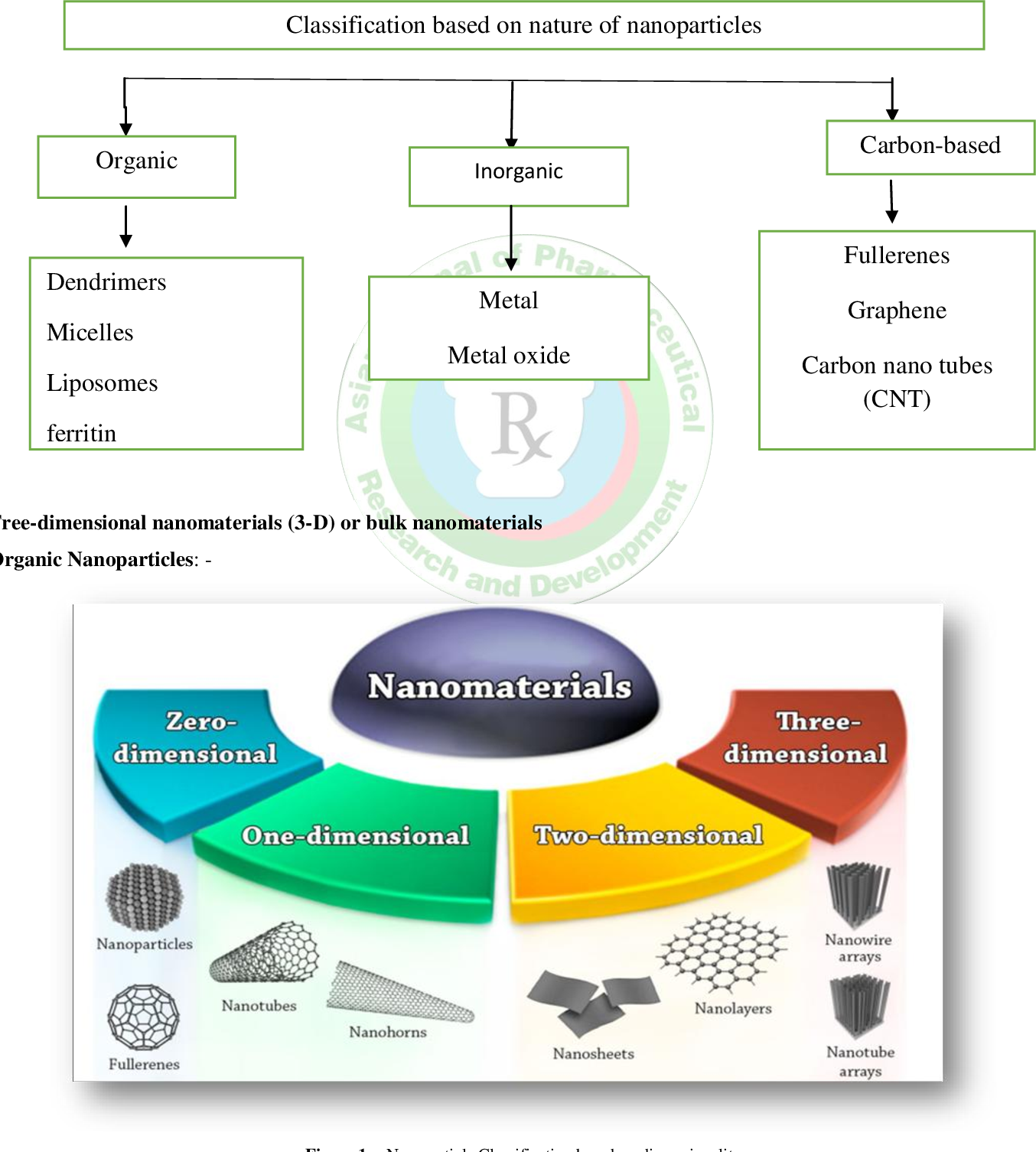
A good overview of these categories can be found in the following review article.
Nanoparticle and Nanostructure Synthesis and Controlled Growth ...
This review provides a clear and concise breakdown of nanomaterial classification based on chemical composition.
Please read section 2.4, "Nanomaterial Classification in the Function of Their Chemical Composition." Focus on the descriptions for: Carbon-based NMs, noting examples like fullerenes and graphene. Organic NMs, paying attention to familiar examples like liposomes and micelles. Inorganic NMs, focusing on the types of materials (metals, metal oxides) and their reactive nature. Hybrid NMs, understanding them as combinations of the other classes.
Let's summarize and contextualize these categories from a biomedical perspective.
-
Organic Nanoparticles: These are materials built primarily from carbon-containing molecules, often polymers or lipids.
- Examples: Liposomes, polymeric nanoparticles (e.g., PLGA), dendrimers, and micelles.
- Key Clinical Feature: Many are biodegradable and biocompatible. Your experience with absorbable sutures made from polymers like polyglycolic acid is a macroscopic parallel. In the nano-world, this means the body can often break down and clear these carriers after they've delivered their payload, minimizing long-term toxicity concerns. This makes them ideal candidates for drug delivery systems.
-
Inorganic Nanoparticles: These are derived from non-carbon-based materials.
- Examples: Gold (Au), Silver (Ag), Zinc Oxide (ZnO), Titanium Dioxide (TiO₂), and semiconductor quantum dots (e.g., CdSe).
- Key Clinical Feature: They are typically not biodegradable but are often very stable and possess unique optical or electronic properties. Gold and silver nanoparticles exhibit strong color due to surface plasmon resonance, a property used in diagnostic tests (like some rapid pregnancy tests). The UV-blocking capability of ZnO and TiO₂ nanoparticles is the cornerstone of modern mineral sunscreens, a direct application in your field of aesthetic and clinical dermatology.
-
Carbon-Based Nanoparticles: This special class consists of pure carbon allotropes, where carbon atoms are arranged in unique geometric structures.
- Examples: Fullerenes ("buckyballs"), carbon nanotubes (CNTs), and graphene.
- Key Clinical Feature: They possess exceptional mechanical strength and electrical conductivity. While their use in approved dermatological therapies is still limited, they are heavily researched for applications like reinforcing materials in tissue engineering scaffolds or as components in advanced biosensors.
-
Hybrid Nanoparticles: These materials combine elements from the different classes to leverage the advantages of each. A common example is an inorganic core (like iron oxide for magnetic properties) coated with a shell of organic polymer (like PEG for stealth properties). This directly relates to our previous lesson on surface functionalization.
For a dynamic summary of these categories, the following video provides a clear visual walkthrough.
Classification of Nanoparticles #nanotechnology #nanoscience
This video, from the channel Activate Chemistry, offers a concise visual explanation of the main nanoparticle classes based on composition.
Watch the segment from the beginning of the section on organic nanoparticles until the end of the section on inorganic nanoparticles. This covers the main examples and properties for both categories. Following that, you can watch the overview of carbon-based nanoparticles to see visual representations of fullerenes, graphene, and nanotubes.
2. Synthesis Approaches: Sculptors vs. Architects
Now that we know what nanoparticles are made of, how do we make them? There are two overarching philosophies for nanoparticle fabrication: top-down and bottom-up.

You can think of this as the difference between a sculptor and an architect.
- A sculptor starts with a large block of marble and carves away material to create a statue. This is the top-down approach.
- An architect designs a building by specifying how individual bricks, beams, and panels should be assembled. This is the bottom-up approach.
Let's examine these two strategies.
A review on nanoparticles: characteristics, synthesis, applications ...
This review provides an excellent introduction to synthesis methods, clearly distinguishing between the two main approaches and listing key techniques for each.
First, read the introductory section 5. Approaches for the synthesis of metal NPs to get the overall framework. Then, read about the top-down approach in section 5.1, and browse the names of the techniques listed (e.g., mechanical milling, laser ablation, sputtering). Finally, read the introduction to the bottom-up approach in section 5.2 and browse the names of its associated chemical techniques (e.g., CVD, sol-gel, co-precipitation).
Top-Down Approach: From Bulk to Nano
In top-down synthesis, we start with a macroscopic piece of material and use physical processes to break it down into nanoscale particles.
- Common Methods:
- Mechanical Milling/Ball Milling: The bulk material is placed in a container with hard grinding balls. The container is shaken or rotated vigorously, and the repeated collisions break the material into smaller and smaller pieces.
- Laser Ablation: A high-energy laser beam is focused on a target material, causing a small portion of it to vaporize into a plasma plume. As this plume cools, the atoms condense to form nanoparticles.
- Characteristics:
- Conceptually simple and often suitable for large-scale production.
- However, the process can introduce impurities from the grinding media and create crystal defects on the nanoparticle surface.
- It offers limited control over particle shape and often results in a wide range of sizes (polydispersity).
Bottom-Up Approach: From Atoms to Nano
In bottom-up synthesis, we do the opposite: we start with atomic or molecular precursors in a liquid or gas phase and use chemical reactions to assemble them into a nanoparticle. This is the dominant approach for creating the highly uniform and functionalized nanoparticles used in medicine.
-
The Core Process: Nucleation and Growth
The foundation of most bottom-up methods is a two-step process. Imagine adding a reducing agent to a solution of dissolved gold salt (gold ions).- Nucleation: The reducing agent donates electrons to the gold ions, turning them into neutral gold atoms. When enough of these atoms find each other, they spontaneously form a tiny, stable seed crystal called a nucleus.
- Growth: Once nuclei are formed, it becomes more energetically favorable for subsequent gold atoms to deposit onto the surface of these existing nuclei rather than forming new ones. The nuclei grow into larger nanoparticles.
The key to making uniform particles is to separate these two stages. An ideal synthesis involves a short, rapid burst of nucleation to create many seeds at once, followed by a slower, controlled growth phase where all seeds grow at the same rate. This results in a population of particles that are all nearly the same size (monodisperse).
-
Common Methods:
- Chemical Reduction: This is the classic method described above, widely used for making metallic nanoparticles like gold and silver.
- Sol-Gel: Involves the conversion of molecular precursors (e.g., silicon alkoxides) into a colloidal solution (a "sol") that then gels to form a network structure.
- Green Synthesis: A modern, eco-friendly variant of the bottom-up approach that uses biological entities like plant extracts or microorganisms as the source of reducing and stabilizing agents.
The following video provides an excellent visual explanation of these synthesis methods, particularly the crucial concepts of nucleation and growth in bottom-up chemical synthesis.
Synthesis of nanomaterials by Physical and Chemical Methods
This lecture from the Biomedical Nanotechnology channel clearly explains and animates the key synthesis processes.
Please watch the following segments: Top-Down Methods: This part visually demonstrates mechanical milling and laser ablation. Chemical Synthesis Basics: This is a critical section. It introduces the three components of chemical synthesis (metal salt, reducing agent, capping agent) and explains the fundamental principles of nucleation and growth. Size Control and Stabilization: This part explains how controlling nucleation/growth rates allows for tuning particle size and how stabilizing agents work.
Conclusion
This lesson has equipped you with the final pieces of foundational knowledge on nanomaterials. We have established a framework for classifying them and understood the fundamental strategies used to create them.
Key takeaways from today's lesson are:
- Classification by Composition: Nanoparticles are broadly grouped into organic (e.g., liposomes, polymers; often biodegradable), inorganic (e.g., gold, ZnO; stable with unique optical properties), and carbon-based (e.g., graphene; high strength) categories. Hybrid materials combine these types.
- Synthesis Philosophies: Nanoparticles are made via two main routes. The top-down approach is like sculpting, breaking down bulk material. The bottom-up approach is like architecture, building up from atoms or molecules.
- Top-Down vs. Bottom-Up: Top-down methods like milling are often simple but less precise. Bottom-up chemical methods, governed by nucleation and growth, offer superior control over size and shape, which is critical for high-performance medical applications.
You can now recognize a nanoparticle not just by its size or surface coating, but by its core material and the way it was likely fabricated. This completes our first module on the foundations of nanoscience.
In our next lesson, we will begin Module 2, "Nanocarrier Design for Drug Delivery," and apply these foundational concepts to the first and most well-known class of medical nanoparticles: liposomes. We will examine their structure, how they self-assemble, and the mechanisms by which they are loaded with therapeutic agents.