Hello! In our last lesson, you became a meticulous inspector, proofreading your draft to eliminate any distracting errors. Your writing is now polished and ready for an audience. But what happens when that audience responds? And how can you, in turn, become a valuable reader for other writers?
Today, we shift our focus from self-editing to peer feedback. Our goal is to learn how to formulate specific, actionable feedback on another piece of writing. This is a critical skill for any writer. Analyzing what works (or doesn't) in someone else's text is one of the best ways to sharpen your own analytical abilities. It's also fundamental to participating in the kind of creative and intellectual conversations you're interested in, whether in a writer's group or in the comments section of a video essay.
1. The Goal of Feedback: Construction, Not Demolition
The word "criticism" often sounds negative, but in a writing context, its goal is purely constructive. We're not here to tear a writer down; we're here to provide information that helps them see their work more clearly and achieve their own goals for the piece.
However, a lot of feedback fails. It's either too vague to be useful ("I didn't like it") or so blunt that it puts the writer on the defensive, shutting down their willingness to learn.
The secret to giving great feedback | The Way We Work, a TED series
To understand why this happens, let's start with a short TED video, 'The secret to giving great feedback.' It explains the neuroscience behind why most feedback is ineffective and introduces a brain-friendly, structured approach.
Watch from the beginning until 04:31. Pay close attention to the concept of 'blur words' and the four-part formula for giving a difficult message.
As the video explains, our brains are wired to detect social threats. Vague or harsh feedback can trigger the amygdala, making the recipient defensive rather than receptive. The key is to be clear, specific, and collaborative.
2. Frameworks for Actionable Feedback
Giving good feedback is a skill, not just an instinct. Having a structure helps ensure your comments are helpful. For someone with your background in mathematics and computer science, you might think of this like creating a good bug report: it needs to identify the issue, explain its impact, and suggest a path toward a solution.
Let's look at a framework designed specifically for written work.
5 effective constructive feedback examples
The article '5 effective constructive feedback examples' from Turnitin provides an excellent, practical structure for giving feedback on writing. We'll focus on the core principles.
Please read the sections 'How to give constructive feedback?' and 'What are some constructive feedback examples?'. Focus on understanding the three components of the 'Where to next?' feedback model: Issue, Relevance, and Action.
Synthesizing the Models
From the video and the article, we can pull together two powerful, complementary frameworks:
1. The "Issue + Relevance + Action" Model (from Turnitin)
This is a fantastic structure for a single piece of feedback:
- Issue: Describe the specific observation. Avoid "blur words."
- Instead of: "Your argument is confusing."
- Try: "In the second paragraph, you state that free will is an illusion, but in the fourth, you argue that we should take moral responsibility for our choices."
- Relevance: Explain the impact this has on you as a reader. Why does it matter?
- Example: "This apparent contradiction took me out of the essay because I wasn't sure which point was central to your argument."
- Action: Offer a concrete, forward-looking suggestion or question.
- Example: "Could you clarify the relationship between these two ideas? Perhaps by explaining how moral responsibility can exist in a deterministic world?"
2. The "TAG" Model (from McGill University)
This is a simple, memorable acronym for structuring an overall review session. It reminds you to be balanced and encouraging.
- Tell something good. (Start by genuinely highlighting a strength).
- Ask a question. (Prompts the writer to think more deeply).
- Give a concrete suggestion. (This is where the "Issue + Relevance + Action" model fits perfectly).
3. The Do's and Don'ts of Peer Critique
Now let's translate these frameworks into a practical set of rules for giving feedback on creative and philosophical writing.
How To Critique Other Writers + How To Handle Criticism
This short video, 'How To Critique Other Writers,' by Nour Zikra offers clear, direct advice on the etiquette of giving feedback. It complements the structural advice we've just covered.
Watch from 00:27 to 02:49. Notice how the advice emphasizes specificity, positive language, and offering helpful suggestions.
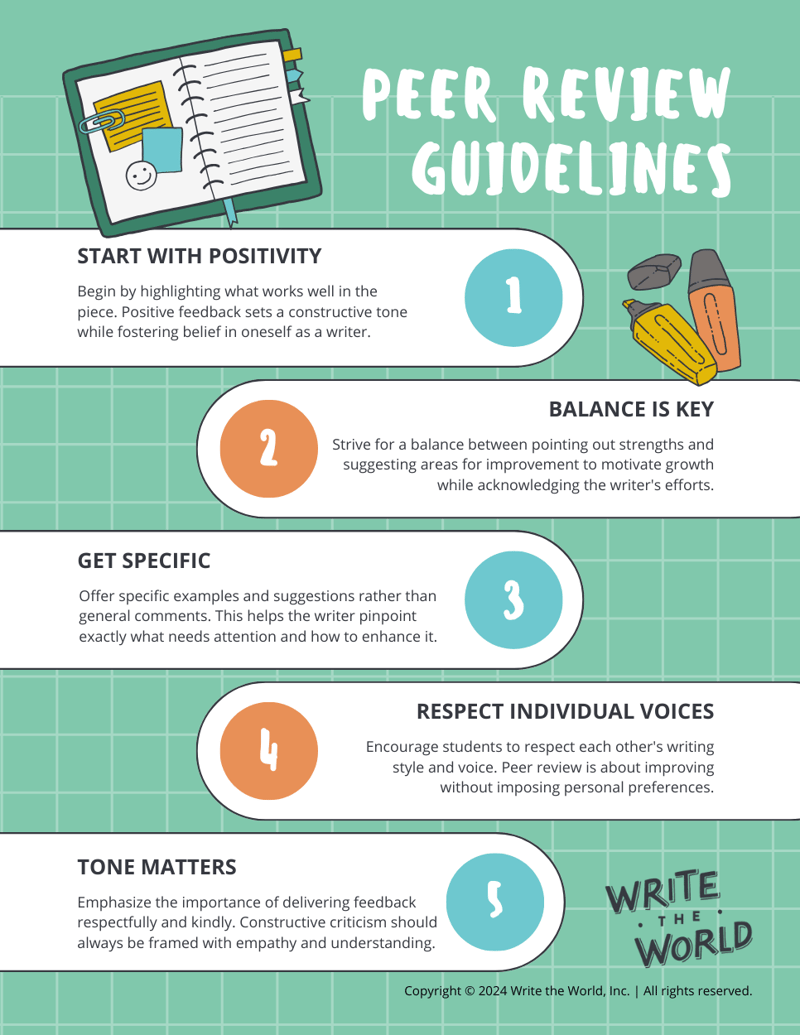
Based on all our resources, here is a consolidated checklist:
The Do's:
- ✅ Start with the Positive: Always begin by pointing out what the writer did well. "I really enjoyed the metaphor of consciousness as a ripple in a pond; it was a powerful opening image."
- ✅ Be Hyper-Specific: Point to exact words, sentences, or paragraphs. "The transition from your point about cosmic history to the anecdote about your cat felt a bit sudden."
- ✅ Focus on the Writing, Not the Writer: Critique the text, not the person. "This sentence is unclear" is better than "You're not making any sense."
- ✅ Explain the "Why": Describe the effect the writing had on you as a reader. "Because the conclusion was just one sentence, it felt abrupt and left me wanting to hear your final thoughts."
- ✅ Ask Questions: Frame feedback as a query to open a discussion. "What's the main feeling you want the reader to take away from this paragraph?"
The Don'ts:
- ❌ Don't Use Vague "Blur Words": Avoid unhelpful comments like "It was confusing," "I didn't like it," or "Make it flow better."
- ❌ Don't Rewrite It For Them: Offer suggestions, but don't impose your own style. The goal is to help them improve their writing, not turn it into your writing.
- ❌ Don't Just Point Out Flaws: A laundry list of negatives is discouraging. Use the "sandwich" method: praise, critique, praise.
- ❌ Don't Focus Only on Typos: While pointing out a recurring error is helpful, the most valuable feedback addresses bigger issues like structure, clarity, argument, and voice.
Test your understanding!
Imagine a friend wrote this sentence in an essay: "The philosophical implications are profound and they change everything about our perspective."
Which of the following feedback comments is most actionable and constructive?
- "This sentence is too vague."
- "I don't get what you mean here. It doesn't seem profound to me."
- "When you use general phrases like 'profound' and 'change everything,' it doesn't give me a clear picture of the specific implications you're thinking of. Could you give a concrete example of a perspective that is changed, and how?"
Show answer
Comment #3 is the best.
- Comment #1 identifies the problem (vagueness) but offers no path forward. It's an Issue without Relevance or Action.
- Comment #2 is unhelpful and dismissive. It focuses on the reader's personal reaction without explaining why and closes down the conversation.
- Comment #3 follows the "Issue + Relevance + Action" model perfectly.
- Issue: "When you use general phrases like 'profound' and 'change everything'..."
- Relevance: "...it doesn't give me a clear picture..."
- Action: "Could you give a concrete example...?"
It's specific, explains the impact on the reader, and opens a door for the writer to improve the sentence.
Your Task: Provide Constructive Feedback
Now it's your turn to be the reviewer. Below is a short draft of a philosophical reflection. Your task is to read it carefully and provide 2-3 pieces of specific, actionable feedback.
Estimated Time: 20 minutes
The Text: "Stardust Queries"
We often hear the phrase that we are the universe experiencing itself. It’s a nice thought. It connects our small lives to the grand, cosmic scale of supernovas and galaxies. When I look at my hand, I see atoms forged in a star billions of years ago. That’s pretty cool.
But what does it really mean? If the universe is experiencing itself through me, it must be pretty bored right now. It's experiencing me trying to write this paragraph, which is not exactly a black hole collision. It's also experiencing my cat napping on the chair. I think the idea is just a way to feel less small. People don’t like feeling insignificant.
Maybe the point isn't about the universe having some grand consciousness. Maybe it's just a factual statement. The same matter that makes up nebulae also makes up our brains. It’s a closed system. The atoms just get rearranged. So when we feel awe looking at the night sky, it's just one arrangement of atoms (us) observing another arrangement of atoms (stars). This is less romantic, but it’s more honest. It’s still weird, though. The whole thing is weird.
Instructions:
- Read and Reflect (5 mins): Read the piece once to understand the main idea and tone. Then, re-read it to identify 1-2 things you think are working well (strengths) and 2-3 areas that could be improved (e.g., clarity, structure, word choice, conclusion).
- Formulate Feedback (15 mins): Write out your feedback.
- Start by mentioning a specific strength.
- For each area of improvement, write a comment using the "Issue + Relevance + Action" structure.
- Ensure your tone is supportive and your suggestions are framed as questions or possibilities.
Conclusion
Mastering the art of giving feedback is a huge step in your development as a writer and thinker. It forces you to articulate why a piece of writing succeeds or fails, moving you from a passive reader to an active analyst.
Key Takeaways:
- Constructive feedback is specific, supportive, and aimed at helping the writer improve.
- Vague or overly harsh feedback is counterproductive because it triggers defensiveness.
- Using frameworks like "Issue + Relevance + Action" or "TAG" helps ensure your feedback is clear, balanced, and actionable.
- The best feedback opens a conversation rather than delivering a verdict.
A Look Ahead:
Giving feedback is only half of the equation. In our next lesson, we will explore the other side: how to incorporate constructive feedback from others to improve your own writing. You'll learn how to listen to criticism, decide which advice to take, and use it to elevate your work to the next level.