Welcome back! Over the last two lessons, we’ve taken your writing from a rough idea through two major stages of revision. First, you were the architect, focusing on "macro" revision to ensure a solid structure and clear argument. Then, you became the interior designer, using "micro" revision to polish your word choice, rhythm, and voice.
Today, we tackle the final, crucial step in the writing process: proofreading. This is the last quality-control inspection before your work is ready for an audience. Our goal is to proofread a final draft for grammatical errors, typos, and awkward phrasing.
Think of it this way: revision is about making your writing good; proofreading is about making it correct. For the sharp, professional style you admire in writers like exurb1a, this final polish is non-negotiable. A brilliant idea can be easily undermined by distracting mistakes.
1. The Proofreading Mindset: Inspector, Not Creator
The most important part of proofreading is shifting your mindset. You are no longer the author creating and shaping ideas. You are now a meticulous inspector, whose only job is to find and fix surface-level errors.
- Revision is for changing meaning. (e.g., "Is this argument persuasive? Does this paragraph belong here?")
- Proofreading is for correcting mistakes. (e.g., "Is this word spelled correctly? Is there a comma missing?")
To do this effectively, you need to trick your brain into seeing what's actually on the page, not what you think is there. Because you wrote the text, your brain will automatically fill in missing words and correct errors as you read. Our task is to bypass this auto-correct feature.
2. How to Proofread: Strategies for Seeing Freshly
Let's start with the practical techniques for proofreading. These methods are all designed to break your familiarity with the text and force you to see it with fresh eyes.
How to proofread your writing: 10 top tips
The video 'How to proofread your writing: 10 top tips' from Denise Cowle Editorial provides an excellent overview of these strategies. It's a toolkit of simple, actionable methods.
Watch the entire video (it's just over 5 minutes). As you watch, make a mental note of at least two techniques you've never tried before.
As the video demonstrates, effective proofreading is a deliberate, almost mechanical process. Here are some of the most powerful strategies, which you can see summarized in the infographic below:
- Change the Medium: Reading on paper is different from reading on a screen. Simply printing your work can reveal errors you previously missed.
- Change the Appearance: Alter the font, text size, or even the background color. This makes the text look unfamiliar and helps you spot mistakes.
- Isolate the Text: Use a ruler or a blank piece of paper to cover the lines below the one you are reading. This forces you to slow down and focus on one line at a time.
- Read it Aloud: You did this during micro-revision to check for flow, but it's also a superb proofreading tool. You'll hear awkward phrasing and typos that your eyes might skim over. Using a text-to-speech function is a great alternative.
- Read it Backwards: Read your text word-by-word from the last word to the first. This removes all semantic context and forces your brain to look at each word individually, making it fantastic for catching spelling errors and doubled words.
- Hunt for One Error Type at a Time: Don't try to find everything at once. Do one pass just for commas, another for spelling, and another for apostrophes. This is similar to debugging code by looking for a specific type of bug.

3. What to Look For: Your Proofreading Checklist
Now that you have the techniques, you need to know what to hunt for. While a full grammar course is beyond this lesson, we can create a high-priority checklist of common errors. Given your background in math and computer science, you can think of these as common syntax errors in the English language.
The Purdue OWL (Online Writing Lab) is one of the most trusted writing resources available. We'll use their guide 'Proofreading for Errors' to build our checklist. It's a reliable reference for the most frequent mistakes.
Read the following sections from the Purdue OWL page: Start with the 'Spelling' section to understand why spell-check isn't enough. Read the 'Run-on Sentences' section. Read the 'Comma Splices' section. Finish with the 'Apostrophes' section. Focus on the definitions and the 'before-and-after' examples for each.
Based on that reading and other common issues, here is a starter checklist for your proofreading passes:
The Proofreader's "Most Wanted" List:
-
Typos and Homonyms:
- The Spell-Check Trap: Spell-check won't catch correctly spelled words used in the wrong context.
- Watch for:
its(possessive) vs.it's(it is);your(possessive) vs.you're(you are);their(possessive) vs.they're(they are) vs.there(location);than(comparison) vs.then(time).
-
Punctuation Errors:
- Comma Splices: Two complete sentences incorrectly joined by only a comma.
- Incorrect: The experiment was a success, the data proved the hypothesis.
- Correct: The experiment was a success; the data proved the hypothesis. OR The experiment was a success. The data proved the hypothesis.
- Apostrophe Errors: Using apostrophes for plurals (a common mistake).
- Incorrect: The student's handed in their essay's.
- Correct: The students handed in their essays.
- Missing Commas in Lists (Oxford Comma): For clarity, always put a comma before the 'and' in a list of three or more items. It prevents ambiguity.
- Ambiguous: I'd like to thank my parents, Ayn Rand and God.
- Clear: I'd like to thank my parents, Ayn Rand, and God.
- Comma Splices: Two complete sentences incorrectly joined by only a comma.
-
Sentence Structure Errors:
- Run-on Sentences: Two or more complete sentences fused together with no punctuation.
- Incorrect: He loved chess it was a game of pure logic.
- Correct: He loved chess. It was a game of pure logic.
- Sentence Fragments: Incomplete sentences masquerading as full ones.
- Incorrect: Because he had an interest in philosophy.
- Correct: He read many books because he had an interest in philosophy.
- Run-on Sentences: Two or more complete sentences fused together with no punctuation.
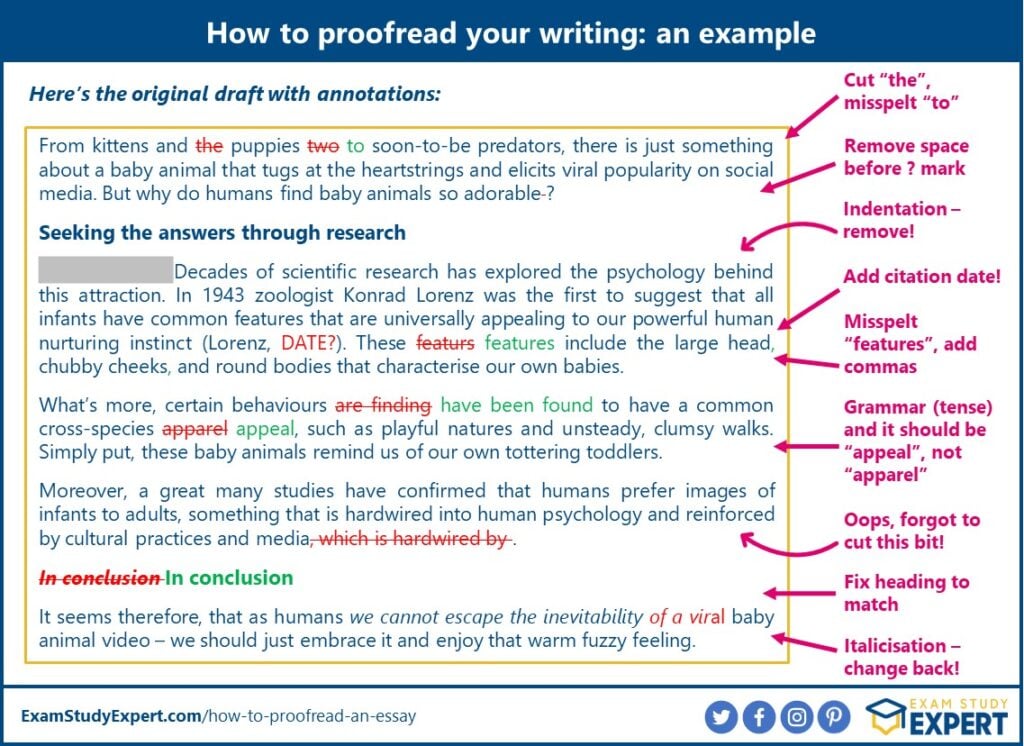
This image shows what a marked-up, proofread document can look like. Notice how the corrections focus on small but important details.
Test your understanding!
Proofread the following sentence. It contains at least three errors from our checklist.
Its a common problem for writer's, they're creative ideas are often undermined by simple typo's.
Show answer
Here is the corrected sentence:
It's a common problem for writers; their creative ideas are often undermined by simple typos.
- Error 1 (Homonym): "Its" was corrected to "It's" (short for "It is").
- Error 2 (Apostrophe): "writer's" was a possessive, but the context required the plural "writers". The same applies to "typo's", corrected to "typos".
- Error 3 (Comma Splice): The comma incorrectly joined two complete sentences. It was replaced with a semicolon (
;), which can correctly link two closely related independent clauses. A period would also have been correct. - Error 4 (Homonym): "they're" (they are) was corrected to the possessive "their".
Your Task: Proofread Your Final Draft
Now it's time to apply these techniques to the draft you've been refining. You are the final gatekeeper of quality.
Estimated Time: 20 minutes
Instructions:
- Open Your Draft: Use the version you polished in our last lesson on micro-revision.
- Choose Your Weapons (5 mins): Select at least two of the proofreading strategies from Part 2 that you don't normally use. For example:
- Change the font of the entire document to something unfamiliar, like Courier.
- Read the entire text backward, word by word.
- Use your computer's text-to-speech feature to have it read to you.
- Hunt for Errors (15 mins): Perform at least two separate passes over your document.
- Pass 1 (Punctuation & Grammar): Read through slowly, looking specifically for comma splices, run-on sentences, and apostrophe errors.
- Pass 2 (Spelling & Typos): Read through again, looking specifically for typos and homonym mix-ups (
its/it's,your/you're,their/they're/there).
- Correct as you go. Unlike revision, where you might make notes, here you should fix the errors as you find them. Your goal is to produce a completely clean final version.
Conclusion
Congratulations, you've completed the entire writing and revision process! You now have a framework for taking an idea from a rough concept to a polished, professional piece of writing.
Key Takeaways:
- Proofreading is the final, analytical stage of editing, distinct from the creative act of revision.
- To proofread effectively, you must use strategies to see your text with fresh eyes (e.g., reading aloud, changing the font, reading backward).
- A systematic approach, using a checklist for common errors like comma splices, homonym confusion, and apostrophe misuse, is more effective than trying to catch everything at once.
A Look Ahead:
Your draft is now ready for an audience. But what happens when that audience gives you feedback? And how can you give helpful feedback to others? In our next lesson, we will shift perspective and learn how to formulate specific, actionable feedback on another piece of writing. This will not only make you a better editor of your own work but also a valuable contributor to any creative or academic community.