Hello! Welcome back to our second lesson.
In our last session, we focused on conciseness—clearing away the clutter by eliminating unnecessary words. You practiced using strong verbs, employing the active voice, and cutting redundant phrases to make your sentences more direct and impactful.
Today, we build on that foundation by shifting our focus from the quantity of words to their quality. Our goal is to rewrite vague or unclear sentences to be precise and explicit. While conciseness clears the path, precision is what makes the journey memorable. For the kind of creative and philosophical writing you admire, which blends big ideas with sharp observations, this skill is non-negotiable. It's the difference between telling your reader that a character is "sad" and making them feel that sadness through vivid, concrete details.
From Abstract Ideas to Concrete Images
The first step toward precision is learning to distinguish between abstract and concrete language. Abstract words name concepts, emotions, and qualities (e.g., freedom, happiness, beauty), while concrete words refer to things we can experience with our senses (e.g., a key turning in a lock, the smell of rain on hot asphalt, the Mona Lisa).
Vague writing often leans too heavily on the abstract. To write with clarity, you must learn to translate abstract ideas into concrete, sensory details.
Specificity and Concrete Language | how to write vividly
This video from the ShaelinWrites channel, titled 'Specificity and Concrete Language', is an excellent guide to this concept. It clearly breaks down the difference between vague, abstract, and concrete language.
Please watch from the beginning (around 00:53) up to 06:20. Pay close attention to: The definition of vague language (words like 'some,' 'thing'). The definition of abstract language (ideas, emotions, concepts). The definition of concrete language (anything experienced with the five senses).
As the video explains, telling a reader "the painting is beautiful" is abstract and subjective. It tells, but it doesn't show. Describing it as "an oil painting of a maple tree, its leaves rendered in strokes of brilliant red and gold" is concrete. It allows the reader to see the painting for themselves and conclude that it is beautiful.
Going a Layer Deeper: The Power of Specific Nouns
Precision isn't just about avoiding abstract words; it's also about choosing the most specific word possible, even when you're already in the concrete realm. This is where your writing can gain unique texture and personality.
- "She drove a car" is concrete.
- "She drove a beat-up sedan" is more specific.
- "She drove a rust-pocked 1998 Honda Civic that sputtered every time it came to a stop" is not just specific; it tells a story about the character and her circumstances.
This next segment from the same video demonstrates how drilling down into specifics can enrich your writing and even reveal character.
Specificity and Concrete Language | how to write vividly
Let's continue with the ShaelinWrites video to see how to apply this principle of 'going a layer deeper.'
Watch from 06:20 to 10:41. Notice how changing 'a platter of cheese' to 'a wheel of Brie' or 'she worked as a doctor' to 'she worked as an anesthesiologist' adds layers of meaning and characterization.
Test your understanding!
Rewrite the following vague sentences to be more specific and concrete. There's no single right answer; the goal is to practice adding detail.
- The room was messy.
- The food was good.
- He was worried about the future.
Show answer
Here are some possible revisions. Your sentences will be different, but they should aim for a similar level of concrete detail.
- Revision: Unread textbooks formed precarious towers on the desk, and clothes were strewn across the floor, half-buried in a pile of empty chip bags.
- Revision: The curry was rich and fragrant with cardamom, the heat of the chili building slowly on the back of the tongue.
- Revision: He stared at the stack of university acceptance letters on the table, his heart hammering against his ribs as he pictured himself in a city hundreds of kilometers from home.
A Field Guide to Common Clarity Killers
Besides using general or abstract nouns, several other common habits can make your sentences vague and weak. Let's identify a few so you can spot them in your own writing.
1. Vague Pronouns
Pronouns like it, this, that, and which can cause confusion if it's not perfectly clear what noun they refer to.
Vague: The server crashed the database, which caused a major outage. (What caused the outage? The crash or the whole database?)
Clear: A major outage occurred because the server crashed the database.
The following guide, written for a technical audience, explains this principle with the kind of precision that should resonate with your background in STEM.
What does writing clearly and concisely mean?
Let's read a short section from a Stanford University style guide on eliminating vague pronouns. This will give you a clear, rule-based approach to fixing this issue.
Please read the short section titled 'Eliminate vague pronoun references!' It gives a straightforward rule: follow 'this' with a noun, or replace 'it' with a noun.
Now, try to apply this rule.
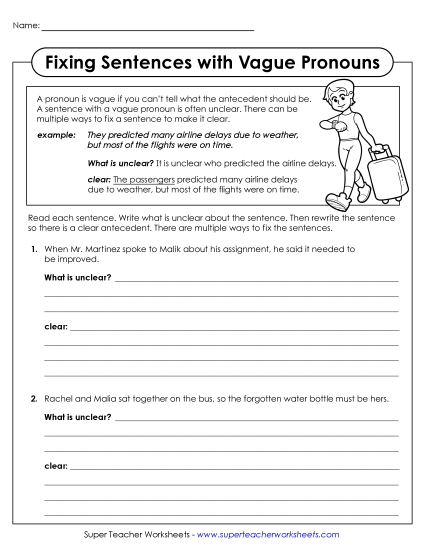
Take a moment to rewrite the two practice sentences on this worksheet in your notes.
Show potential answers
Sentence 1: "Please take the cupcake out of the box and set it on the table." (What is "it"? The cupcake or the box?)
- Clearer: "Please take the cupcake out of the box and set the cupcake on the table."
Sentence 2: "Mom was talking to Mrs. Jones about her new purple car." (Whose car is it? Mom's or Mrs. Jones's?)
- Clearer: "Mom was talking to Mrs. Jones about Mrs. Jones's new purple car." (Or "...about Mom's new purple car.")
2. Hedging and Weasel Words
Words like seemed, apparently, kind of, almost, and roughly can signal a lack of confidence and make your prose fuzzy. As the author, you are the authority. State what happens directly.
Vague: The building seemed to be about 10 stories tall.
Precise: The building was ten stories tall.
Unless the character's uncertainty is the entire point, it's almost always better to be definite.
Most Common Writing Mistakes: Why Vague Writing Is Weak Writing
This article from Helping Writers Become Authors explains why these 'hedging' words weaken your writing and provides a useful list of culprits.
Read the sections 'How to Fix Vague Writing' and '10 Words That Signal Vague Writing'. The list of ten words is a great takeaway to keep in mind during your own revisions.
3. Nominalizations
A nominalization is what happens when you turn a verb (an action) into a noun (a thing). For example, changing "evaluate" to "evaluation," or "decide" to "decision." This often forces you to add weak verbs like "is" or "make," sapping your sentences of energy and clarity.
Vague (with nominalization): We need to make a determination about the cause.
Precise (with verb): We need to determine the cause.
Given your background in math and science, think of this as simplifying an expression. You're looking for the most direct and efficient way to state the relationship between elements.
What does writing clearly and concisely mean?
Let's return to the Stanford style guide to see a technical breakdown of nominalizations and how to fix them.
Read the section 'Monitor and reduce nominalizations.' Focus on the 'before' and 'after' examples to see how replacing the noun with a verb makes the sentence much clearer.
Workshop: Transforming a Paragraph
Now, let's see the cumulative effect of all these principles. The following video segment takes a terribly vague paragraph and revises it twice, with each step adding immense clarity, detail, and emotional depth. This is the "woven" practice you prefer, showing the theory in immediate action.
Specificity and Concrete Language | how to write vividly
This final clip from the ShaelinWrites video is the most powerful demonstration of what we've learned today. You'll see a paragraph evolve from weak and vague to strong and vivid.
Watch the extended example from 11:14 to 17:15. As you watch the three versions, ask yourself: What specific details were added in the 'middle ground' version? How does the 'final version' use concrete sensory details and specific actions to show the relationship between the sisters, rather than just telling us about it?
Your Turn to Revise
Here is a short, vague paragraph. Your task is to rewrite it in your notes, applying the principles of specificity and clarity we've discussed today. Don't just swap words—reimagine the scene. Show, don't tell.
The student felt nervous before the test. He did some things to prepare. The room was uncomfortable. When he got the paper, it seemed hard. In the end, he thought it went okay.
Take about 10-15 minutes on this. Aim to replace every vague statement with a concrete detail or a specific action.
Conclusion
Fantastic work today. You've moved from the writer's first job (cutting what's not needed) to their second, more nuanced job: choosing the perfect word for what's left.
Here are the key takeaways:
- Translate the abstract into the concrete: Instead of naming an emotion like "happiness," describe the physical actions and sensations that embody it.
- Drill down on your nouns: Don't settle for "a tree" when you can specify "a banyan tree with aerial roots snaking toward the earth."
- Be an authority: Eliminate hedging words like "seemed" or "kind of."
- Watch for clarity killers: Ensure your pronouns have clear antecedents and use strong verbs instead of clunky nominalizations.
In our next lesson, we will zoom out from the sentence level to the paragraph. You'll learn how to construct a paragraph with a clear topic sentence and a logical internal progression, ensuring that your newly precise sentences work together to build a coherent and compelling point.