Hello! Welcome to our third lesson.
In our last session, we sharpened our focus to the sentence level, learning how to make our writing precise and explicit by using concrete language and specific details. We practiced transforming vague ideas into vivid images.
Today, we're zooming out from the individual sentence to the paragraph. A paragraph is the fundamental unit of thought in an essay or script. Just as atoms combine to form molecules, your precise sentences must combine to form coherent, logical paragraphs. Our goal is to construct a paragraph with a clear topic sentence and logical internal progression. Mastering this is crucial for guiding a reader through your ideas, which is the essence of good articulation—one of your primary goals.
The Anatomy of a Paragraph
At its core, a paragraph is a collection of sentences that all relate to a single idea. The reader expects each paragraph to be a self-contained unit, exploring one point before moving to the next. This structure is what makes a complex argument readable.
To understand the conventional structure of a paragraph, let's start with a foundational guide.
Paragraphs & Topic Sentences: Writing Guides
The Writing Tutorial Services at Indiana University provide a clear and concise guide called 'Paragraphs & Topic Sentences'. This resource lays out the essential definitions we'll build upon today.
Please read the first three parts of this guide: the main introduction, the section on 'TOPIC SENTENCES', and the section on 'PARAGRAPH STRUCTURE'. Focus on how a topic sentence acts as the 'controlling idea' of a paragraph.
As the guide explains, a standard paragraph has three parts:
- Introduction: Contains the topic sentence, which states the main idea.
- Body: Develops and supports that idea with examples, evidence, or analysis.
- Conclusion: Summarizes the point or provides a transition to the next paragraph.
The topic sentence is the most important part. It's a promise to your reader about what the paragraph will cover.
The Topic Sentence: A Promise and a Hook
While a topic sentence must be clear, it doesn't have to be boring. Think of it as the introduction to a mini-essay. Its job is not only to state the topic but also to engage the reader and make them want to know more. This is especially true for the creative, philosophical writing you're aiming for.
This video, although focused on "mini-essays," offers excellent strategies for crafting compelling openings that work perfectly for topic sentences.
In this video, 'How to Write a Mini-Essay' by Odysseas, the section on introductions provides fantastic insight into how to create a strong opening. We can apply these same principles to our topic sentences.
Watch from 08:57 to 13:56. Pay attention to the four techniques for creating a hook: The bold statement. Emotional language. An open question. Starting in the middle of a story. Think about how each of these could be used to write an engaging topic sentence for a paragraph.
For example, instead of a dry topic sentence like:
The concept of infinity is difficult for the human mind to grasp.
You could use one of the video's techniques:
- Bold Statement: The human mind is a finite tool incapable of truly comprehending the infinite.
- Open Question: What happens when a finite mind tries to grasp an infinite concept?
Both versions state the topic, but the revised ones do so with a distinct voice and a hook that pulls the reader in.
The Body: Building a Logical Path
Once you've made your promise with a topic sentence, the body of the paragraph must deliver on it. This is where "logical internal progression" comes in. Your sentences can't just be a random collection of thoughts on the topic; they must follow a clear path.
Two key principles for creating this path are cohesion and coherence.
Make Your Writing Flow | Ideas: Cohesion, Coherence, and Organization
The video 'Make Your Writing Flow' by Writing with Andrew offers a superb explanation of these two ideas. Understanding them will help you see not just what to do, but why it works.
Watch from 03:18 to 11:35. This covers the principles of cohesion and coherence. Cohesion (Old-before-New): Notice the TV show recap analogy. This is about connecting each sentence to the one before it, giving your reader a smooth path. Coherence (One Idea): This is about ensuring every sentence in the paragraph serves the single purpose established by your topic sentence.
In essence:
- Coherence means all sentences belong in the paragraph.
- Cohesion means the sentences are linked together smoothly.
Test your understanding!
Imagine you're writing a paragraph with the topic sentence: "Chess is more a science than a sport."
Which of the following sentences would violate the principle of coherence?
A. The game's reliance on pattern recognition and calculation mirrors the scientific method.
B. Great chess players, much like great physicists, dedicate their lives to studying established theory.
C. Playing chess online has become incredibly popular in recent years, with millions of games played daily.
D. Every match is an experiment, where hypotheses (opening moves) are tested and refuted.
Show answer
Sentence C violates coherence. While true, it's about the popularity of chess, not its scientific nature. Sentences A, B, and D all directly support the topic sentence's argument.
A Simple Model for Paragraph Structure
For a logical mind, having a repeatable algorithm can be helpful. Many writers use simple acronyms to structure their paragraphs. One of the most common and effective is T.E.E.L. (or its close cousin, P.E.E.L.).
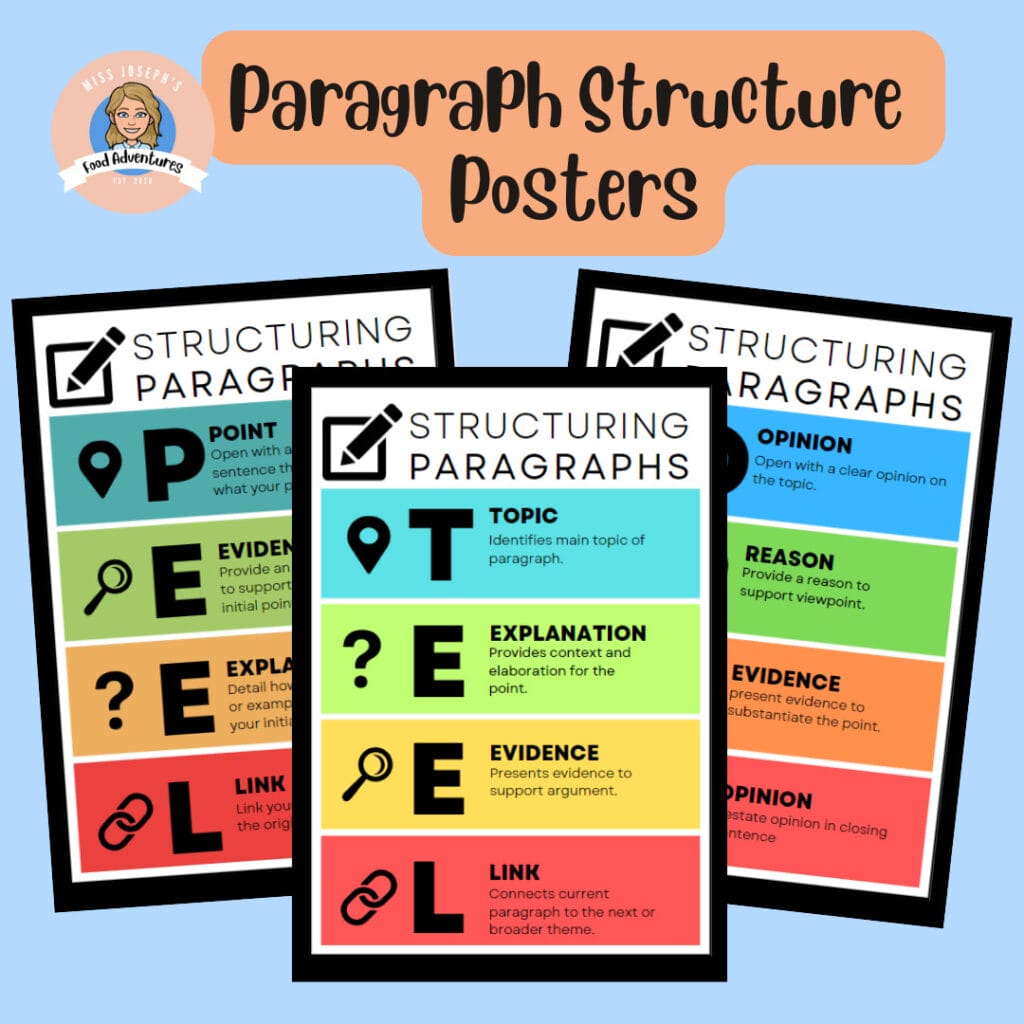
The T.E.E.L. structure works like this:
- Topic Sentence: State your main point or claim.
- Explanation / Evidence: Explain your point in more detail. Provide evidence, examples, or data to support it. You can have several sentences for this step.
- Link: Conclude the paragraph by linking the evidence back to your topic sentence or transitioning to the next paragraph.
This structure ensures you not only make a point but also prove it and tie it all together.
Workshop: Let's Build a Paragraph
Now it's time to put these pieces together.
Topic: "Is true creativity possible for an Artificial Intelligence?"
Your task is to write a single paragraph that argues one side of this question. Don't worry about writing a full essay; just focus on making this one paragraph as strong as possible.
Instructions (15 minutes):
- Choose your stance: Will you argue that AI can be creative, or that it cannot?
- Craft your Topic Sentence: Use one of the techniques from the Odysseas video to create an engaging opening. Make a clear promise to the reader.
- Build the Body: Write 3-5 sentences that provide Explanation and Evidence for your topic sentence.
- Think about coherence: Does every sentence support your main point?
- Think about cohesion: Do the sentences flow logically? Try using the "old-before-new" principle.
- Write the Link sentence: Conclude by summarizing your point or reinforcing your main idea.
Take about 15 minutes to write your paragraph in your notes.
Conclusion
Well done. Today we've built the framework for constructing clear and logical paragraphs, moving from the precision of sentences to the architecture of thought.
Here are the key takeaways:
- A paragraph is a unified block of text focused on a single controlling idea.
- The topic sentence acts as a promise to the reader, stating the paragraph's main point in an engaging way.
- The body of the paragraph must have logical internal progression, achieved through coherence (all sentences are relevant) and cohesion (sentences connect smoothly).
- The T.E.E.L. model (Topic, Explain/Evidence, Link) provides a simple and effective structure for building a sound paragraph.
In our next lesson, we'll focus on the "glue" that holds sentences and paragraphs together. We will explore how to use transitional phrases to create smooth connections, making your writing flow even more effortlessly from one idea to the next.