Hallo! Welcome back.
In our last two lessons, you built a strong foundation by learning the German alphabet and mastering the tricky sounds of the umlauts (ä, ö, ü) and the Eszett (ß). Now, we'll put all that knowledge to work.
Today's lesson will teach you how to decode and pronounce the most common letter combinations in German. By the end of our session, you will be able to apply basic German pronunciation rules to read unfamiliar words aloud, focusing on combinations like ch, sch, ei, ie, and eu. Mastering these patterns is the key that unlocks your ability to read and speak German with much greater confidence.
Let's get started.
1. Common Vowel Combinations (Diphthongs)
In German, when certain vowels appear together, they create a single, new sound called a diphthong. Unlike in English, these German diphthongs are very consistent in their pronunciation. Once you learn the rule, you can apply it every time.
We'll watch a video that explains these sounds clearly.
German Pronunciation for Beginners A1 | Aussprache Basics A1
The video "German Pronunciation for Beginners A1" by YourGermanTeacher provides an excellent overview of these vowel combinations. We'll start with the most common ones.
Please watch from 00:38 to 02:54. Pay attention to the pronunciation of 'ie', 'ei', 'au', and 'eu'.
Let's break down these sounds one by one:
- ie: This combination is pronounced like a long "ee" in English, as in "see" or "feet".
- Examples: sie (she/they), vier (four), Liebe (love).
- ei: This is pronounced like the English word "eye" or the vowel sound in "my". A good way to remember this is that the sound is like the name of the second letter in the pair (the 'i').
- Examples: mein (my), Ei (egg), heißen (to be called).
- au: This sounds like the "ow" in "how" or "now".
- Examples: Haus (house), Auto (car), blau (blue).
- eu and äu: Both of these combinations make the same sound, which is like the "oy" in "boy" or "toy".
- Examples: heute (today), neu (new), Europa (Europe), Häuser (houses).
For a quick reference and more examples, the following article is very helpful.
The article "German Diphthongs" from lets-learn-german.com offers a concise written summary of these vowel sounds.
Read the first part of the article under the heading "German diphthongs pronunciation guide". Focus on the sections for EI, IE, AU, EU, and ÄU. Read the example words aloud.
2. Key Consonant Combinations
Next, let's tackle some common consonant combinations. These also have very consistent rules that will help you pronounce new words correctly.
The 'sch' Sound
This one is straightforward. The combination sch is pronounced exactly like the "sh" sound in English words like "shoe" or "shop".
- Examples: Schule (school), Deutsch (German), schön (beautiful).
The 'sp' and 'st' Sounds
Here is a very common and important rule:
When sp or st appear at the beginning of a word or syllable, the 's' is pronounced like 'sch' (the "sh" sound).
- sp sounds like "shp": sprechen (to speak), Sport (sport).
- st sounds like "sht": Straße (street), Student (student).
If 'sp' or 'st' appear in the middle or at the end of a word, the 's' is pronounced as a normal 's'. For example, lustig (funny).
Let's return to our video to hear these sounds in action.
German Pronunciation for Beginners A1 | Aussprache Basics A1
Let's continue with the "German Pronunciation for Beginners A1" video to cover these consonant clusters.
First, watch the short segment on 'sch' from 04:32 to 04:59. Then, watch the explanation for 'sp' and 'st' from 07:00 to 08:52.
The 'ch' Sound: Two Personalities
The 'ch' combination is one of the trickiest in German because it has two distinct pronunciations depending on the letters that come before it.
-
The "Hard" CH (ach-Laut)
This sound is made at the back of your throat. It's similar to the sound in the Scottish word "Loch". You use this sound when 'ch' follows the vowels a, o, u, or the diphthong au.- Examples: machen (to make), Buch (book), auch (also), hoch (high).
-
The "Soft" CH (ich-Laut)
This is a much softer sound, made at the front of your mouth. It's similar to the 'h' sound in the English word "huge". You make this sound by raising the middle of your tongue towards the roof of your mouth and pushing air through. You use this sound after the vowels e, i, ä, ö, ü, all diphthongs except 'au' (ei, eu, äu), and all consonants.- Examples: ich (I), sprechen (to speak), Bücher (books), Milch (milk), euch (you all).
Let's watch the final segment of the video for a demonstration of these two 'ch' sounds.
German Pronunciation for Beginners A1 | Aussprache Basics A1
This last clip from the "German Pronunciation for Beginners A1" video explains the difference between the hard and soft 'ch' sounds.
Watch from 04:59 to 06:41. Try to imitate both the 'ach-Laut' in machen and the 'ich-Laut' in ich.
3. Summary and Practice
You've now covered the most important pronunciation patterns for a beginner. The image below provides a fantastic summary of everything we've discussed.
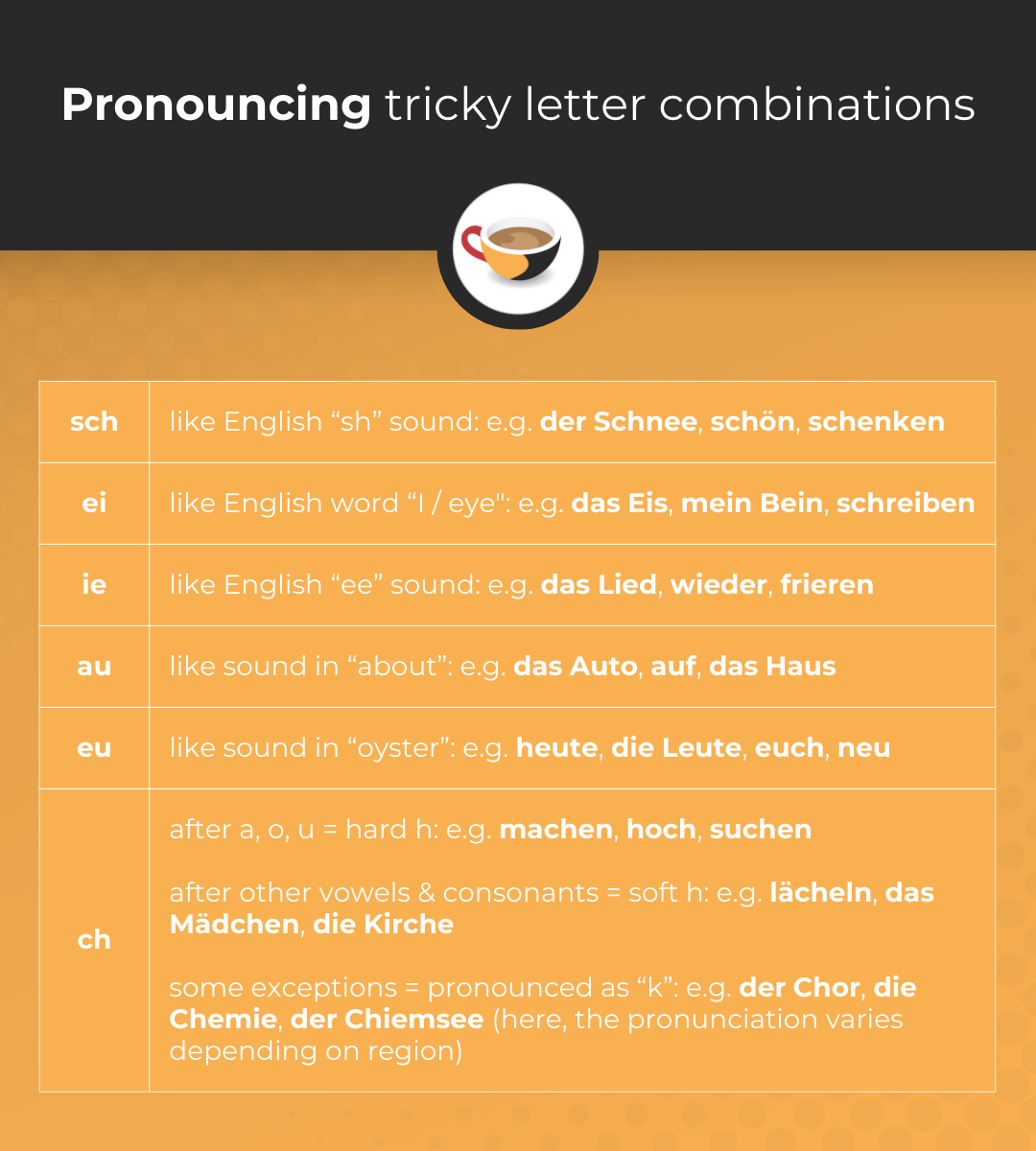
Now, it's time to practice. Read the following list of words aloud. Try to identify the rule for each highlighted combination before you speak. Don't worry about memorizing the meanings yet; just focus on the sounds.
- Deutsch (German) - 'eu' and 'tsch'
- sprechen (to speak) - 'sp' and soft 'ch'
- heute (today) - 'eu'
- Freund (friend) - 'eu'
- Eis (ice/ice cream) - 'ei'
- sieben (seven) - 'ie'
- auch (also/too) - hard 'ch'
- ich (I) - soft 'ch'
- Buch (book) - hard 'ch'
- Bücher (books) - 'ü' (from last lesson) and soft 'ch'
- Straße (street) - 'ß' (from last lesson) and 'st'
- schreiben (to write) - 'sch' and 'ei'
- vielleicht (perhaps) - 'ie' and 'ei' (a great challenge!)
Practice saying these words a few times. Listening to yourself is a great way to improve.
Lesson Summary
Great job! You've just learned the fundamental patterns that govern German pronunciation. With these rules, you can now approach most new words and have a very good idea of how they should sound.
Here are the key takeaways:
- Diphthongs are consistent:
- ie sounds like "ee" (sieben).
- ei sounds like "eye" (Ei).
- au sounds like "ow" (Haus).
- eu / äu sound like "oy" (heute).
- Consonant clusters have specific rules:
- sch is always "sh" (Schule).
- sp and st at the start of a word/syllable are "shp" and "sht" (sprechen, Straße).
- ch has two sounds: a hard ach-Laut (after a, o, u, au) and a soft ich-Laut (after most other letters).
In our next lesson, we will finally start speaking! You will learn how to greet someone and say goodbye using common German phrases. You'll get to apply all the pronunciation skills you've worked so hard on in a real, conversational context.