Introduction
Hallo! In our previous lessons, we built a solid foundation for your German journey by mastering the alphabet and the pronunciation of key letter combinations. You learned how to decode sounds like ei, ie, ch, and sch, which is a crucial skill for reading and speaking.
Today, we'll put that pronunciation practice to immediate use. This lesson is all about your first conversation: you will learn how to greet someone and say goodbye using common German phrases. We'll cover the most important expressions like Hallo, Guten Tag, and Tschüss, and you'll also learn the crucial difference between formal and informal situations. By the end of this lesson, you'll be able to start and end a simple interaction in German.
1. Basic German Greetings
In German, as in English, some greetings are informal while others are more formal. The most common and versatile greeting is Hallo.
- Hallo is the equivalent of "hello" and is widely used in almost any situation, from greeting friends to sales assistants in a shop.
The standard formal greeting is Guten Tag.
- Guten Tag literally means "good day." It's a polite and safe choice when you're meeting someone for the first time, addressing an older person, or in any professional context.
Let's hear these greetings and see how they are used.
Learn German | Greetings | German for beginners | A1 - Lesson 1
This video from the 'Learn German' channel clearly pronounces and explains the most common greetings.
Watch the clip from 00:41 to 01:04. Pay close attention to the pronunciation of 'Hallo' (remember the 'a' sound we discussed) and 'Guten Tag'.
As you can see, the choice of greeting depends on the context, a theme we will see throughout our lessons.
2. Greetings for Different Times of Day
Just like in English, German has specific greetings for the morning and evening.
- Guten Morgen! - Good morning! (Used until around 11 a.m.)
- Guten Abend! - Good evening! (Used from around 6 p.m. onwards)
- Gute Nacht! - Good night! This one is a bit different. It's typically used only when you or someone else is going to bed, so it functions more as a farewell than a greeting.
The comic below nicely illustrates these time-specific greetings.
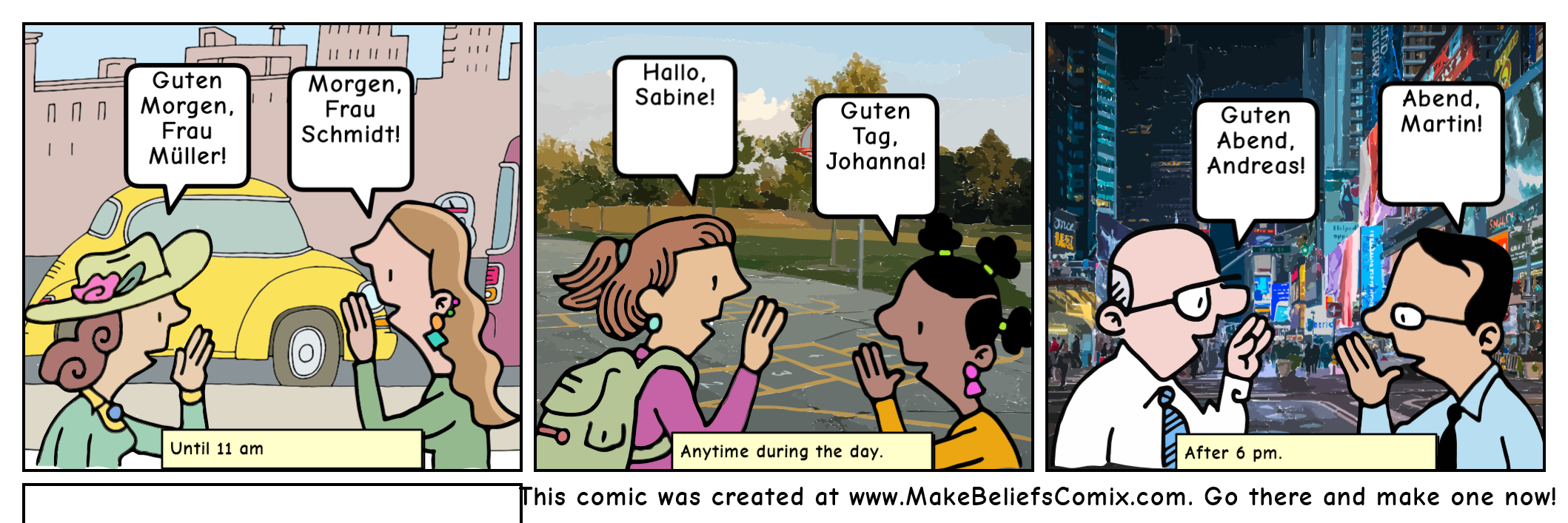
Now, let's hear these phrases pronounced correctly.
Learn German | Greetings | German for beginners | A1 - Lesson 1
Let's return to the 'Learn German' video to hear the time-specific greetings.
Watch the section from 01:04 to 01:29. Listen carefully and repeat each phrase: 'Guten Morgen', 'Guten Abend', and 'Gute Nacht'.
In informal situations, you will often hear these shortened to just Morgen!, Tag!, or 'n Abend!.
3. Saying Goodbye
Now that you can say hello, let's learn how to say goodbye. The two most important farewells are Tschüss and Auf Wiedersehen.
- Tschüss (Bye): This is the informal, all-purpose farewell. You can use it with friends, family, and in many everyday situations like leaving a shop. Notice the ü sound and the sharp 's' sound at the end.
- Auf Wiedersehen (Goodbye): This is the formal farewell. It literally means "until we see again" (wieder = again, sehen = to see). This is the phrase you would use in professional settings or with people you address formally. Notice the ie diphthong we practiced.
There are also a few other common ways to say goodbye informally:
- Bis bald! - See you soon!
- Bis später! - See you later!
Learn Basic German Greetings & Farewells in Slow German | Super Easy German 274
The 'Easy German' channel shows these phrases used in natural-sounding phone calls. This will help you get a feel for the rhythm of the language.
Watch two short clips. First, from 00:56 to 01:17, to hear the informal 'Hallo' and 'Tschüss'. Then, watch from 02:27 to 03:00 to hear the formal 'Guten Tag' and 'Auf Wiedersehen', as well as the special case 'Auf Wiederhören' used for phone calls ('hören' = to hear).
4. Practice Dialogues
Let's see these greetings and farewells in action. The resource below presents two short dialogues—one formal and one informal. This is a perfect way to see how the phrases fit together in a conversation.
The webpage from GermanPod101 provides clear examples of formal and informal dialogues. It's a great summary of what we've learned.
Read both the 'Dialogue - Formal German' and 'Dialogue - Informal German' sections. Try reading each dialogue out loud to practice your pronunciation.
Notice how the formal dialogue uses last names (Herr Jäger, Frau Höhne) and Auf Wiedersehen, while the informal one uses first names (Thomas, Lisa) and Tschüss.
5. Exercises
You've learned the key phrases, now it's time to practice them. Your preference for a mix of grammar and conversation, along with exercises, is key to reinforcing what you've learned.
The worksheet below contains several activities to help you master these greetings.

Please complete the exercises on the worksheet.
- Activity 1 is a good warm-up, matching German to English.
- Activity 4 will challenge you to translate from English to German.
- Activity 6 is excellent practice for choosing the right greeting for a specific situation.
Take your time and try to complete all the activities. This is a crucial step in moving the knowledge from passive understanding to active use.
Conclusion
Well done! You have successfully learned the essential building blocks for starting and ending a conversation in German.
Here are the key takeaways from this lesson:
- Core Greetings: Hallo (informal) and Guten Tag (formal) are your most important greetings.
- Time-Specific Greetings: Use Guten Morgen in the morning and Guten Abend in the evening.
- Core Farewells: Use Tschüss in informal contexts and Auf Wiedersehen in formal ones. Other useful phrases are Bis bald (see you soon) and Bis später (see you later).
- Context is Key: The choice between formal and informal language is a very important concept in German.
In our next lesson, we will combine everything you've learned about pronunciation and greetings. You will practice your skills by reading aloud a short German dialogue, which will help you build fluency and confidence.