Hallo! Welcome back.
In our last two lessons, we built a solid foundation for the dative case. First, you learned why we use it (for indirect objects, with specific verbs, and with certain prepositions). Then, you learned how to use it by declining articles (der -> dem) and pronouns (er -> ihm).
Today, we'll put that knowledge into practice by focusing on that third trigger: dative prepositions. Your goal for this lesson is to confidently use the most common prepositions that always take the dative case: aus, bei, mit, nach, von, and zu. We'll learn their meanings and use them in sentences, which will make the dative declensions you just memorized start to feel second nature.
The Golden Rule: The Preposition is King
Before we dive in, let's establish one of the most important rules in German grammar. As the resource from Easy Deutsch (LINK) makes clear: if a preposition is present, the preposition determines the case. It doesn't matter if the verb normally takes the accusative or if the noun is a direct or indirect object. The preposition is in charge.
Since the prepositions we're learning today always take the dative, you can be 100% certain that the noun or pronoun following them will be in the dative case.
Here is a helpful chart that gives you an overview of German prepositions. For today's lesson, we are focusing on the blue "Dative" section.
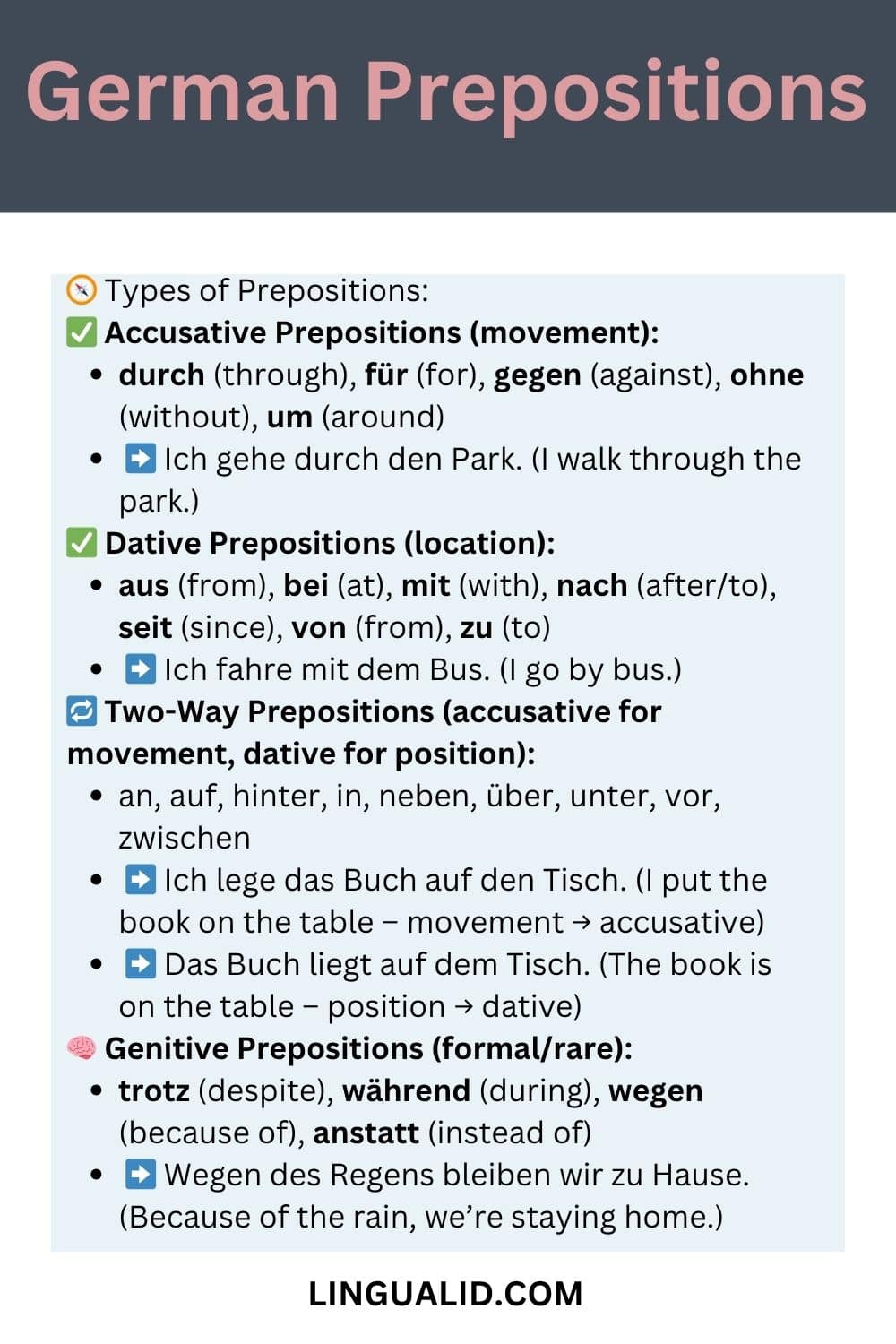
Exploring the Dative Prepositions
The best way to learn these prepositions is to see them in action. We will use a video that explains each one and provides clear examples. I'll break it down for you, and we'll focus on the prepositions from our learning outcome.
Learn German | German Grammar | Dative prepositions | Präpositionen im Dativ | A1
The video 'Learn German | German Grammar | Dative prepositions' from the Learn German channel will be our main guide. It clearly explains the meaning and usage of each preposition.
First, watch this brief introduction from 02:07 to 02:45 to see the list of dative prepositions we'll be covering.
Now, let's go through the most important ones, one by one.
1. aus (from, out of)
This preposition is primarily used to talk about origin.
- Origin (from a place): Use
austo say where you are from (city, country). This should feel familiar from when you learned to introduce yourself (Ich komme aus...). - Movement (out of a space): It also means "out of," describing movement from an enclosed space.
Learn German | German Grammar | Dative prepositions | Präpositionen im Dativ | A1
Let's watch the section on 'aus'.
Watch from 06:09 to 07:14. Notice the examples for origin ('aus England') and movement out of something ('aus der Flasche').
Examples:
Sie kommt **aus der Schweiz**.(She comes from Switzerland.) ->die Schweiz(fem.) becomesder Schweiz.Er nimmt ein Bier **aus dem Kühlschrank**.(He takes a beer out of the refrigerator.) ->der Kühlschrank(masc.) becomesdem Kühlschrank.
2. mit (with, by)
Mit is straightforward, as its main meaning "with" is a direct parallel to English. It's also used to describe the means of transport.
- Accompaniment (with): To say you are with someone or something.
- Transportation (by): To describe how you travel.
Learn German | German Grammar | Dative prepositions | Präpositionen im Dativ | A1
Now for 'mit'. Pay attention to how it's used for both people and vehicles.
Watch from 04:33 to 05:53. Note the examples 'mit Zucker' (with sugar) and 'mit dem Bus' (by bus).
Examples:
Ich gehe **mit meinen Freunden** ins Kino.(I'm going to the cinema with my friends.) ->meine Freunde(pl.) becomesmeinen Freunden(remember the plural dative-nending!).Fahren Sie **mit dem Zug** oder **mit dem Auto**?(Are you traveling by train or by car?) ->der Zuganddas Autoboth becomedem....
3. nach (after, to)
Nach has two primary, distinct meanings.
- Time (after): Used to talk about time, like "after work" or "ten past nine".
- Destination (to): Used for going to cities, states, and countries that do not have an article (e.g.,
Deutschland,Berlin,Spanien). It's also used in the common phrasenach Hause(going home).
Learn German | German Grammar | Dative prepositions | Präpositionen im Dativ | A1
Let's look at 'nach'. The distinction between 'nach' and 'zu' for 'to' is important.
Watch from 08:33 to 09:18. The video shows 'nach' for time ('nach sechs') and for travel to a country ('nach Spanien').
Examples:
**Nach der Arbeit** gehe ich ins Fitnessstudio.(After work, I go to the gym.) ->die Arbeit(fem.) becomesder Arbeit.Im Sommer fliegen wir **nach Italien**.(In the summer, we are flying to Italy.)
4. von (from, of)
Von can indicate a starting point or, colloquially, possession.
- Origin/Source (from): Indicates where something starts or comes from (e.g., "from the station," "from the doctor").
- Possession (of): Often used in spoken German instead of the genitive case to show possession ("the car of my father").
- Contraction:
von + dem = vom.
Learn German | German Grammar | Dative prepositions | Präpositionen im Dativ | A1
Next up is 'von'. Look for the contraction 'vom'.
Watch from 02:51 to 04:33. This part covers origin ('von der Arbeit'), possession ('von meinem Vater'), and the contraction 'vom'.
Examples:
Ich komme gerade **vom Arzt**.(I'm just coming from the doctor.) ->von dem Arzt.Das ist das Geschenk **von meiner Tante**.(That is the present from my aunt.) ->meine Tante(fem.) becomesmeiner Tante.
5. zu (to, at)
Zu is another versatile preposition for "to." While nach is for cities/countries, zu is used for going to people, businesses, and specific locations within a town.
- Destination (to):
zuis your go-to preposition for "to" when talking about people (zu dir) or places (zur Post,zum Bahnhof). - Contractions:
zufrequently combines with articles:zu + dem = zum(for masculine/neuter nouns)zu + der = zur(for feminine nouns)
Learn German | German Grammar | Dative prepositions | Präpositionen im Dativ | A1
Finally, let's cover 'zu' and its important contractions.
Watch from 10:37 to 11:54. This section explains how to use 'zu' and its contractions 'zum' ('zum Arzt') and 'zur' ('zur Schule').
Examples:
Heute Abend gehe ich **zu einem Freund**.(Tonight I'm going to a friend's place.) ->ein Freund(masc.) becomeseinem Freund.Wie komme ich **zum Bahnhof**?(How do I get to the train station?) ->zu dem Bahnhof.Wir gehen **zur Bäckerei**.(We are going to the bakery.) ->zu der Bäckerei.
For a complete text reference with more examples for each of these prepositions, you can consult the following article. It's a great resource to bookmark for review.
How to use German dative prepositions? - Mango Languages
This article from Mango Languages, 'How to use German dative prepositions?', provides excellent written explanations and example sentences for each preposition we've discussed.
Read the sections for 'Aus', 'Bei', 'Mit', 'Nach', 'Von', and 'Zu'. You don't need to memorize everything, but use it to solidify your understanding and see more examples.
Practice Time
Let's put this all together. Fill in the blanks with the correct preposition (aus, bei, mit, nach, von, zu) and the correct dative form of the article.
- Maria fährt _______ _______ (
dem) Auto _______ _______ (der) Arbeit.
(Maria drives by car to work.) - Peter kommt _______ _______ (
dem) Supermarkt und geht dann _______ Hause.
(Peter is coming from the supermarket and then goes home.) - Ich trinke einen Kaffee _______ _______ (
einem) Freund.
(I'm drinking a coffee with a friend.) - Woher kommst du? Ich komme _______ _______ (
der) Türkei.
(Where are you from? I am from Turkey.) - Wann fahrt ihr _______ Berlin?
(When are you all traveling to Berlin?) - Er wohnt _______ _______ (
seinen) Eltern.
(He lives with his parents.)
Check your answers
- Maria fährt mit dem Auto zur Arbeit. (
zur=zu der) - Peter kommt vom Supermarkt und geht dann nach Hause. (
vom=von dem) - Ich trinke einen Kaffee mit einem Freund.
- Woher kommst du? Ich komme aus der Türkei. (Countries with articles like 'die Türkei' use 'aus' for origin).
- Wann fahrt ihr nach Berlin? (Cities use 'nach').
- Er wohnt bei seinen Eltern.
Conclusion
Great job! You have now learned the meanings and uses of the most common dative-only prepositions. This is a huge step in making your German sound more natural and grammatically correct.
Key Takeaways:
- The "preposition is king": If a dative preposition is used, the following noun is always in the dative case.
- Core meanings:
- aus: from a place (origin), out of
- bei: at, with (a person/company)
- mit: with (someone), by (vehicle)
- nach: after (time), to (cities/countries)
- von: from (a starting point), of
- zu: to (people/places)
- Contractions are common: Remember
zum(zu dem),zur(zu der),vom(von dem), andbeim(bei dem).
Preview of the Next Lesson:
You've just mastered the prepositions that always use the dative. But what about prepositions that can change their mind? In our next lesson, we will tackle two-way prepositions – a group that can take either the dative or the accusative case depending on whether you are talking about a static location or movement to a destination. This is a classic challenge in German, and you are now ready for it