Hallo! Welcome back to your German course.
In our last lesson, we focused on prepositions that are always loyal to the dative case, like mit, nach, and zu. You learned that when these prepositions appear, the noun that follows must be in the dative case—no exceptions.
Today, we move on to a more flexible, and very important, group of prepositions called Wechselpräpositionen, or two-way prepositions. These are prepositions of place that can be followed by either the accusative or the dative case. Your goal for this lesson is to identify these prepositions and, most importantly, to learn the simple but powerful rule that determines which case to use. Mastering this is a key step toward describing locations and movements accurately in German.
Introducing the Two-Way Prepositions
There are nine common two-way prepositions. They all describe a spatial relationship between objects.
- an (on/at a vertical surface)
- auf (on a horizontal surface)
- hinter (behind)
- in (in, into)
- neben (next to, beside)
- über (over, above)
- unter (under, below)
- vor (in front of)
- zwischen (between)
So, how do we decide whether to use the accusative or the dative case after them? The choice depends entirely on the answer to one question: Is there movement from one point to another?
The Golden Rule: Location vs. Motion
The core concept is simple and logical. To decide which case to use, you just need to determine if you're talking about a static position or movement towards a destination.
-
Static Location (Dative): If you are describing a fixed position or movement within a single location, you use the dative case. The question you can ask is Wo? (Where?).
-
Motion/Direction (Accusative): If you are describing movement from point A to point B—a change of location—you use the accusative case. The question you can ask is Wohin? (Where to?).
Let's watch a short video that introduces this fundamental rule very clearly.
Wechselpräpositionen Dativ und Akkusativ | German Two-Way Prepositions
The video 'Wechselpräpositionen Dativ und Akkusativ' from YourGermanTeacher provides an excellent introduction to this concept. Pay close attention to the distinction between 'Wo?' for dative and 'Wohin?' for accusative.
Watch the segment from 00:46 to 02:18. The presenter uses a pen to visually demonstrate the difference between a static location (dative) and movement (accusative).
This visual chart provides a great overview, showing the prepositions we learned last lesson (dative-only), some accusative-only prepositions (which we'll cover later), and our new two-way prepositions in the middle.
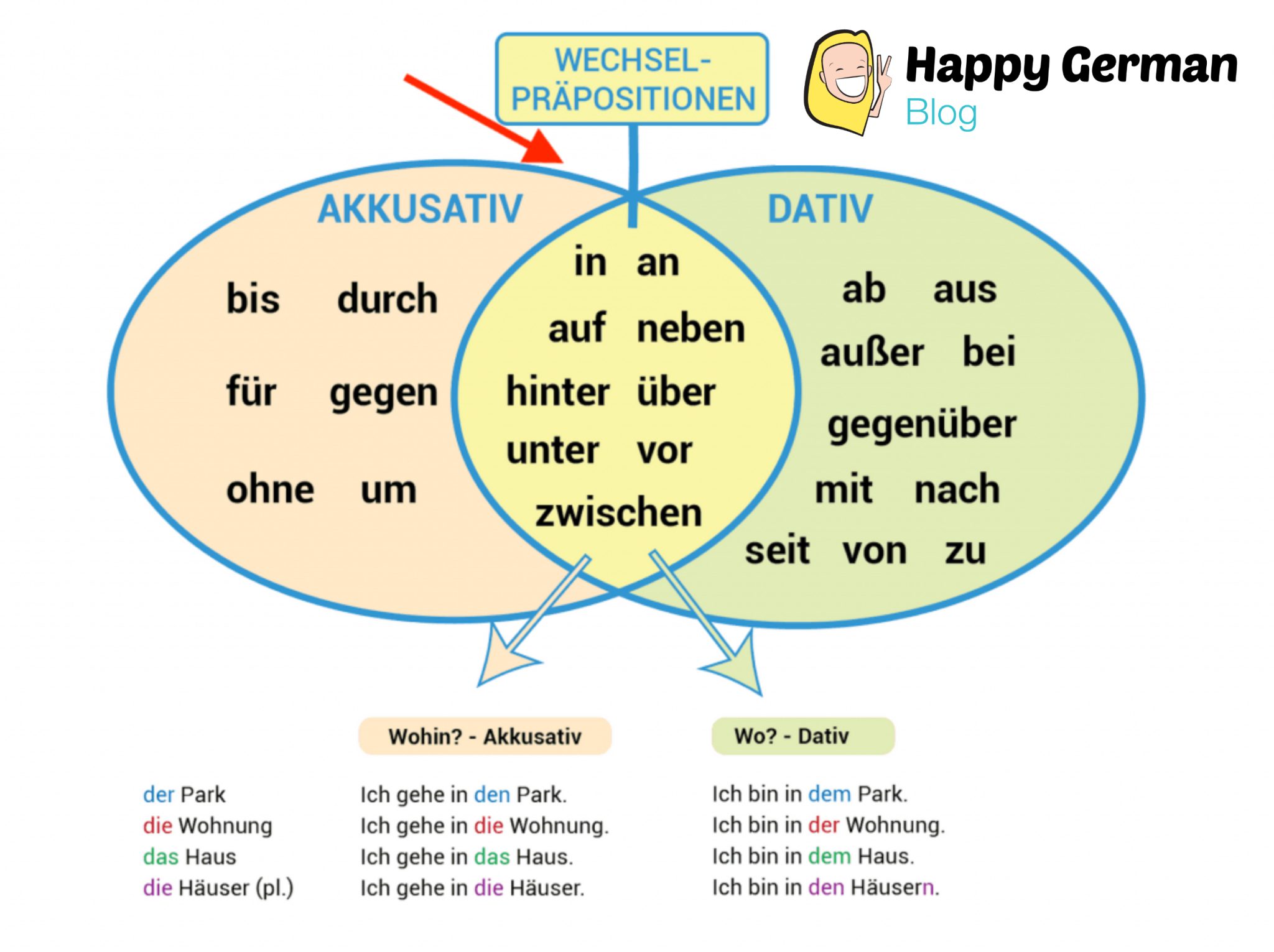
For a written explanation to reinforce this rule, the article this diagram comes from is very helpful.
The German Dative Case: Your Ultimate Guide
The article 'The German Dative Case: Your Ultimate Guide' from Happy German explains this rule clearly in writing.
Read the section titled 'The Dative Case With Two-Way Prepositions (Wechselpräpositionen)'. Focus on the explanation of 'wo?' vs. 'wohin?' and the examples provided.
Two-Way Prepositions in Action
Let's see this rule applied to some of the most common prepositions. We'll use the same video, as its visual examples make the concept very easy to grasp.
1. auf (on top of)
- Accusative (Motion):
Ich stelle die Tasse **auf den Tisch**.(I place the cup onto the table.)- Wohin stelle ich die Tasse? -> Onto the table.
der Tisch(masc.) becomesden Tisch.
- Wohin stelle ich die Tasse? -> Onto the table.
- Dative (Location):
Die Tasse steht **auf dem Tisch**.(The cup is standing on the table.)- Wo steht die Tasse? -> On the table.
der Tisch(masc.) becomesdem Tisch.
- Wo steht die Tasse? -> On the table.
Wechselpräpositionen Dativ und Akkusativ | German Two-Way Prepositions
Watch how the preposition 'auf' is used in both cases.
Watch the clip from 02:18 to 03:21. Notice the different verbs used: 'stellen' (to place) implies motion, while 'stehen' (to stand) implies location.
2. in (in, into)
The preposition in is so common that it frequently contracts with the definite article.
-
in + das = ins(accusative, neuter) -
in + dem = im(dative, masculine/neuter) -
Accusative (Motion):
Ich lege die Kreditkarte **in das** Portemonnaie.(I put the credit card into the wallet.)- Wohin lege ich die Karte? -> Into the wallet. This can be shortened to:
...**ins** Portemonnaie.
- Wohin lege ich die Karte? -> Into the wallet. This can be shortened to:
-
Dative (Location):
Die Kreditkarte ist **in dem** Portemonnaie.(The credit card is in the wallet.)- Wo ist die Karte? -> In the wallet. This can be shortened to:
...**im** Portemonnaie.
- Wo ist die Karte? -> In the wallet. This can be shortened to:
Wechselpräpositionen Dativ und Akkusativ | German Two-Way Prepositions
Now let's look at 'in', paying attention to the contractions 'ins' and 'im'.
Watch from 08:33 to 09:29. The video clearly demonstrates the action of putting something in (accusative) versus it already being in (dative).
3. an (on, at a vertical surface)
an is used for contact with vertical surfaces like walls, or for being right at the edge of something, like a window.
- Accusative (Motion):
Sie klebt das Foto **an die Wand**.(She sticks the photo onto the wall.)- Wohin klebt sie das Foto? -> Onto the wall.
die Wand(fem.) staysdie Wandin accusative.
- Wohin klebt sie das Foto? -> Onto the wall.
- Dative (Location):
Das Foto klebt **an der Wand**.(The photo is stuck on the wall.)- Wo klebt das Foto? -> On the wall.
die Wand(fem.) becomesder Wandin dative.
- Wo klebt das Foto? -> On the wall.
Wechselpräpositionen Dativ und Akkusativ | German Two-Way Prepositions
Finally, let's see an example with 'an'.
Watch from 09:45 to 10:20. This demonstrates the difference between moving an object to the wall versus it being stationary on the wall.
A Helpful Clue: Static vs. Motion Verbs
As you may have noticed in the examples, the verb often gives you a big clue about whether to use the dative or accusative.
| Verbs of Motion (usually take Accusative) | Verbs of Location (usually take Dative) |
|---|---|
| legen (to lay, place horizontally) | liegen (to lie, be horizontal) |
| stellen (to place, set upright) | stehen (to stand, be upright) |
| setzen (to set, place someone/oneself) | sitzen (to sit) |
| hängen (to hang something up) | hängen (to be hanging) |
The verb hängen is special as it can be used for both motion and location. The case of the following prepositional phrase clarifies the meaning.
The video we've been using has a great summary table of these verbs.
Wechselpräpositionen Dativ und Akkusativ | German Two-Way Prepositions
This final clip from the video summarizes the key verbs associated with motion and location.
Watch from 10:54 to 11:21. This table is a very useful tool to help you choose the correct case.
Practice Time
Let's test your understanding. For each sentence, decide if it's describing a location (Wo?) or motion (Wohin?) and fill in the blank with the correct dative or accusative article.
- Die Katze ist auf ___ (
der) Tisch. (The cat is on the table.) - Ich lege das Buch auf ___ (
der) Tisch. (I lay the book onto the table.) - Der Hund liegt unter ___ (
der) Stuhl. (The dog is lying under the chair.) - Ich setze mich auf ___ (
der) Stuhl. (I sit down on the chair.) - Die Lampe hängt über ___ (
der) Tisch. (The lamp is hanging above the table.) - Das Bild hängt an ___ (
die) Wand. (The picture is hanging on the wall.) - Er stellt das Auto in ___ (
die) Garage. (He parks the car in the garage.)
Check your answers
- dem (Location:
Wo ist die Katze?) - den (Motion:
Wohin lege ich das Buch?) - dem (Location:
Wo liegt der Hund?) - den (Motion:
Wohin setze ich mich?) - dem (Location:
Wo hängt die Lampe?) - der (Location:
Wo hängt das Bild?) - die (Motion:
Wohin stellt er das Auto?)
These exercises are adapted from the A1.2 Level Exercises on Olesentuition (LINK).
Conclusion
Excellent work today. You have just learned one of the most fundamental and frequently used rules in German grammar.
Key Takeaways:
- There are nine common two-way prepositions:
an, auf, hinter, in, neben, über, unter, vor, zwischen. - The case they take depends on whether they express static location or directed motion.
- The Golden Rule:
- Question Wo? (Where?) → Dative case (for static location).
- Question Wohin? (Where to?) → Accusative case (for motion towards a destination).
- Verbs like
liegen/stehenoften signal a dative context, whilelegen/stellensignal an accusative one.
Preview of the Next Lesson:
You now know the rule for two-way prepositions. In our next lesson, we will focus entirely on applying it. You will practice constructing sentences to describe where things are in a room and where you are putting them, making you much more confident in using these prepositions in everyday conversation.