Hello! Welcome to your first lesson on the fundamentals of wine.
I'm excited to guide you on this journey. Given your background in the sciences, I think you'll find the structured, almost chemical, nature of wine tasting both fascinating and logical.
This first lesson is all about building a shared language. Before we can explore the famous wine regions of France or the vineyards of California, we need to establish a core vocabulary to describe what's actually in the glass. It’s the essential foundation for everything that follows.
Today, we will focus on the five foundational characteristics of wine: dryness (or sweetness), acidity, tannin, fruitiness, and body. By the end of this 60-minute lesson, you'll be able to describe a wine using these key sensory terms, which will be your toolkit for understanding your own preferences and navigating the world of wine.
1. Sweetness vs. Dryness
The first thing you'll often notice in a wine is its level of sweetness. In wine terminology, the opposite of "sweet" is "dry."
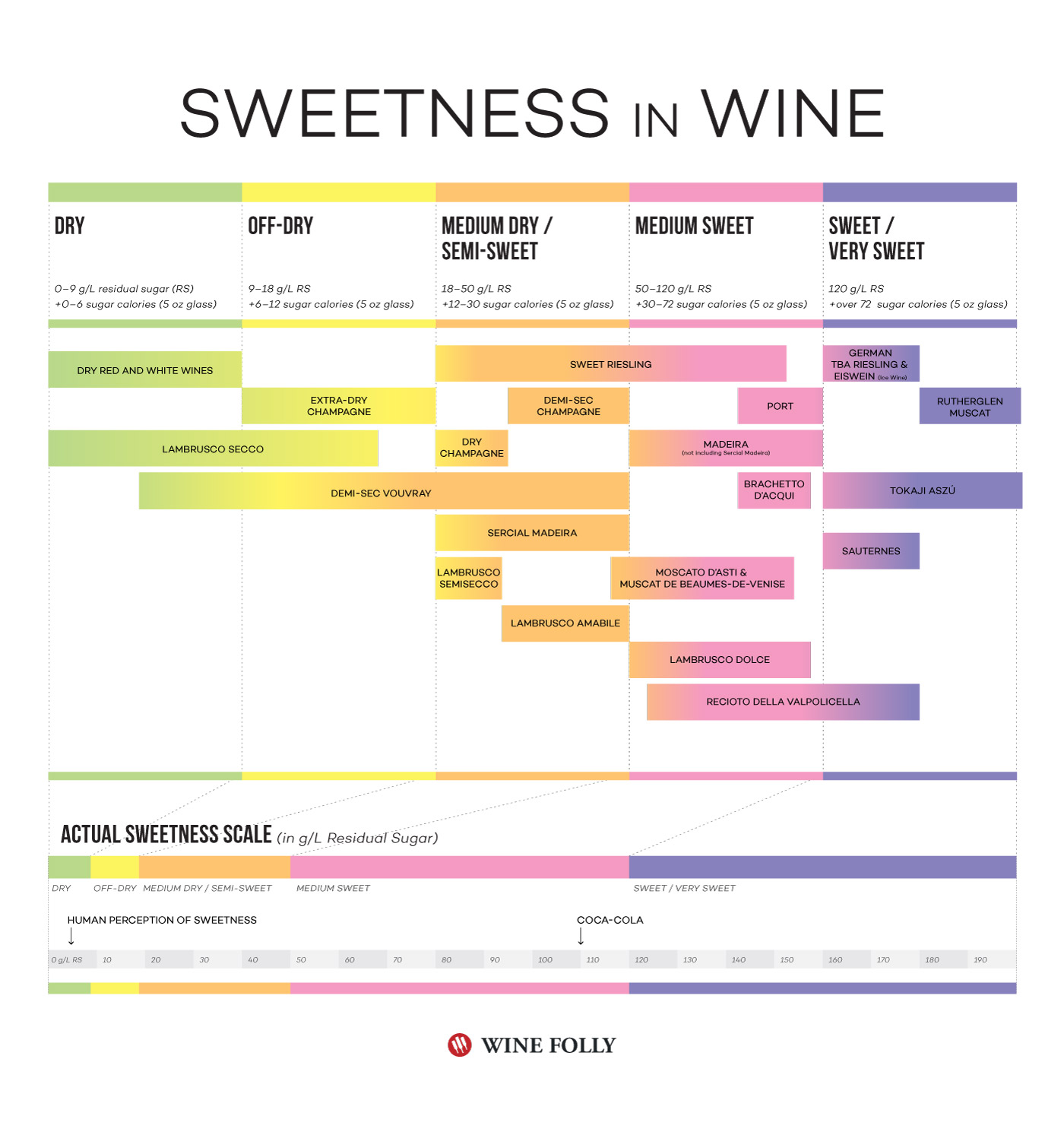
A wine is "dry" when the yeast has converted all or nearly all of the grape sugar into alcohol during fermentation. A "sweet" wine, by contrast, has noticeable sugar remaining. This leftover sugar is called residual sugar (RS).
Your biochemistry background gives you a head start here: you're already familiar with fermentation as a metabolic process. In winemaking, it's the simple conversion of sugar + yeast → alcohol + CO₂. The winemaker can stop this process early to leave more sugar in the wine, creating an "off-dry" or "sweet" style.
Most of the world's red and many white table wines are technically dry. However, a wine can be dry yet taste "fruity," which can sometimes be mistaken for sweetness. We'll touch on that distinction in a moment.
To get a clear picture of this spectrum, take a look at the "Wine Sweetness Chart" below. It provides a quantitative look at residual sugar levels (in grams per liter) across different wine styles, which should appeal to your analytical mindset.
For a more detailed explanation, the following video provides a great overview of sweetness and the other core components we'll be discussing.
The 5 Essential Components of Wine: A Beginner's Guide
Let's start with a clear, concise overview of the five essential components of wine. This video from Fill of Pinot provides excellent definitions and analogies for each.
Please watch the section on 'Sweetness' from the beginning until 01:44. Pay attention to the definition of residual sugar and the visual cue of 'legs' or 'tears' in the glass.
2. Acidity
Acidity is what gives wine its tart, zesty, and refreshing quality. Think of the mouth-watering sensation you get from biting into a crisp green apple or squeezing a lemon into water. In wine, acidity provides balance, prevents it from tasting "flabby" or flat, and is a key preservative that allows wines to age.
From a chemical standpoint, acidity is measured in pH. Wines typically have a pH between 3 and 4, making them more acidic than water (pH 7). White wines and wines from cooler climates generally have higher acidity (lower pH) than red wines and wines from warmer climates.
The 5 Essential Components of Wine: A Beginner's Guide
Now, let's continue with the same video to understand acidity.
Watch the segment on 'Acidity' from 01:44 to 02:46. Notice the descriptors used, such as 'crisp,' 'bright,' and 'racy.'
3. Tannin
Tannin is a characteristic primarily found in red wines, though some white wines can have it, especially if they are aged in oak barrels. It doesn't have a taste so much as a texture: it's the astringent, mouth-drying sensation that makes your gums and tongue feel a bit rough, similar to drinking a very strong black tea.
Tannins are naturally occurring polyphenols found in the skins, seeds, and stems of grapes. Since red wine is fermented with its skins to extract color, it also extracts tannins. These compounds are antioxidants and contribute to the wine's structure and ability to age, softening over time.
Your work in health and biosciences might make the topic of polyphenols familiar. In wine, they are a crucial structural component that also has implications for pairing with food, especially proteins like steak.
To learn how to identify this sensation, the next video offers a simple and effective at-home experiment.
Red Wine Vocabulary | Wine Folly
This video from Wine Folly focuses on red wine vocabulary but provides excellent, practical ways to taste each characteristic. The explanation of tannin is particularly useful.
Watch the section on 'Tannin' from 02:13 to 03:00. The analogy of a wet black tea bag is a perfect way to isolate the sensation of tannin.
4. Body
Body refers to the perceived weight and texture of the wine in your mouth. It’s a combination of several factors, including alcohol level, sugar, and tannin.
A useful analogy is to think about milk:
- Light-bodied wines feel delicate, like skim milk.
- Medium-bodied wines have a bit more presence, like 2% milk.
- Full-bodied wines feel heavy and rich, like whole milk or even cream.
Alcohol is a major contributor to a wine's body. Higher alcohol wines (e.g., 14% ABV or more) tend to feel fuller and more viscous than lower alcohol wines.
The 5 Essential Components of Wine: A Beginner's Guide
Let's return to the 'Fill of Pinot' video for a final definition.
Watch the segments on 'Alcohol' and 'Body' from 04:14 to 06:12. This will clarify how alcohol contributes to body and solidify the concept using the milk analogy.
5. Fruitiness and Other Aromas
While the previous four traits describe the wine's structure, the aromas and flavors are its personality. "Fruitiness" refers to the presence of fruit notes. These can range widely:
- Red Fruits: Strawberry, cherry, raspberry (common in lighter red wines).
- Black Fruits: Blackberry, blackcurrant, plum (common in fuller-bodied red wines).
- Citrus & Tree Fruits: Lemon, lime, apple, pear (common in white wines).
- Tropical Fruits: Pineapple, mango, passionfruit (common in white wines from warmer climates).
It's important to distinguish fruit-forward from sweet. A dry wine can be very fruit-forward, meaning the aromas are dominated by ripe, juicy fruit notes, but it may have no residual sugar.
Beyond fruit, wines can have a vast array of other notes, often grouped into categories like earthy (mushrooms, soil), herbaceous (grass, mint), spicy (pepper, clove), or notes from oak aging (vanilla, cedar).
36 Common Wine Descriptions & Wine Tasting Terms
To expand your vocabulary, this article from Wine Country provides a great list of common tasting terms. It clearly defines the structural elements we've discussed and introduces key flavor descriptors.
Please read the sections 'The Main Elements of Wine' and 'Common Wine Tasting Terms.' Focus on the definitions for 'Fruit-forward,' 'Earthy,' 'Savory,' and 'Herbaceous.' This will help you move beyond just identifying fruit to describing a wine's complete flavor profile.
Putting It All Together: A Thought Experiment
Let's apply this new vocabulary. Imagine you are tasting two different wines.
Wine 1: A sommelier describes it as a light-bodied white wine with high, zesty acidity. It is bone dry, has no tannin, and has flavors of grapefruit and fresh-cut grass.
Wine 2: A wine label describes this as a full-bodied red wine with high tannins and medium acidity. It is dry and features flavors of black cherry, tobacco, and vanilla.
Based on these descriptions:
- Which wine would feel heavier and richer in your mouth?
- Which wine would create a mouth-drying sensation?
- Which wine would be more tart and refreshing?
This exercise demonstrates how these five characteristics create a unique profile for every wine. The answer, of course, is that Wine 2 would feel heavier and create a drying sensation, while Wine 1 would be more tart and refreshing.
Conclusion
In this lesson, we've established the foundational vocabulary for tasting and describing wine. You now have a framework for analyzing a wine based on its five key characteristics:
- Dryness/Sweetness: The level of residual sugar, from bone dry to sweet.
- Acidity: The tart, mouth-watering quality that gives wine freshness.
- Tannin: The astringent, textural component, primarily in red wines.
- Body: The perceived weight and texture, from light to full.
- Fruitiness & Flavors: The aromas and tastes that define the wine's character.
The next time you enjoy a glass of wine, try to identify each of these elements. This practice is the single best way to sharpen your palate and discover what you truly enjoy.
Preview of the next lesson: Now that we know how to describe wine, our next lesson will explore why wines taste the way they do. We will delve into the key factors that influence a wine's style: climate, soil (the famous concept of terroir), and the specific choices a winemaker makes.