Welcome to the twelfth and final module of our course. Over the past several weeks, we have explored the strategic interactions within vee relationships using the lens of game theory, and then examined the structural properties and diffusion dynamics of these relationships using network theory. In our last lesson, we saw how network structure could explain phenomena like cascading relationship failures. Now, we will begin to formally integrate these two powerful frameworks.
This lesson marks the first step in that integration. We will move beyond treating partners as either passive nodes in a network or as strategic agents in an unstructured environment. Instead, we will see them as they truly are: strategic players whose decisions and outcomes are fundamentally shaped by the network they inhabit. Our objective is to formulate a game played on a vee network where payoffs depend on both individual actions and network position. This foundational skill will allow us to build more sophisticated and realistic models of relationship dynamics.
What is a "Game on a Network"?
At its core, a game on a network is a strategic interaction where a player's payoff is directly influenced by the actions of those they are connected to—their "neighbors." The network is no longer just a backdrop; it is an integral part of the game's structure, defining who affects whom.
To formalize this, let's turn to a foundational text on the topic.
This chapter by Matthew Jackson and Yves Zenou provides the essential definitions for modeling games on networks. Your background in formal modeling will make these definitions intuitive.
First, read the introduction to grasp the core concept. Next, please read the section "Background Definitions". Focus on the subsection Games on Networks. Pay close attention to how the payoff function for player i is denoted as u_i : A \times G(N) \to \mathbb{R}, explicitly including the network g \in G(N) as an argument. The key insight is formalized in the paragraph that follows: "a given player’s payoff depends... only on those to whom the player is linked in the network."
As the reading makes clear, the network's adjacency matrix, which we can call , becomes a crucial component of the payoff function . For a player , their payoff depends on their own action and the actions of their neighbors, , where is the set of 's neighbors in network .
In our recurring example of a polyandrous vee (Hinge, Partner 1, Partner 2), the network graph is simple:
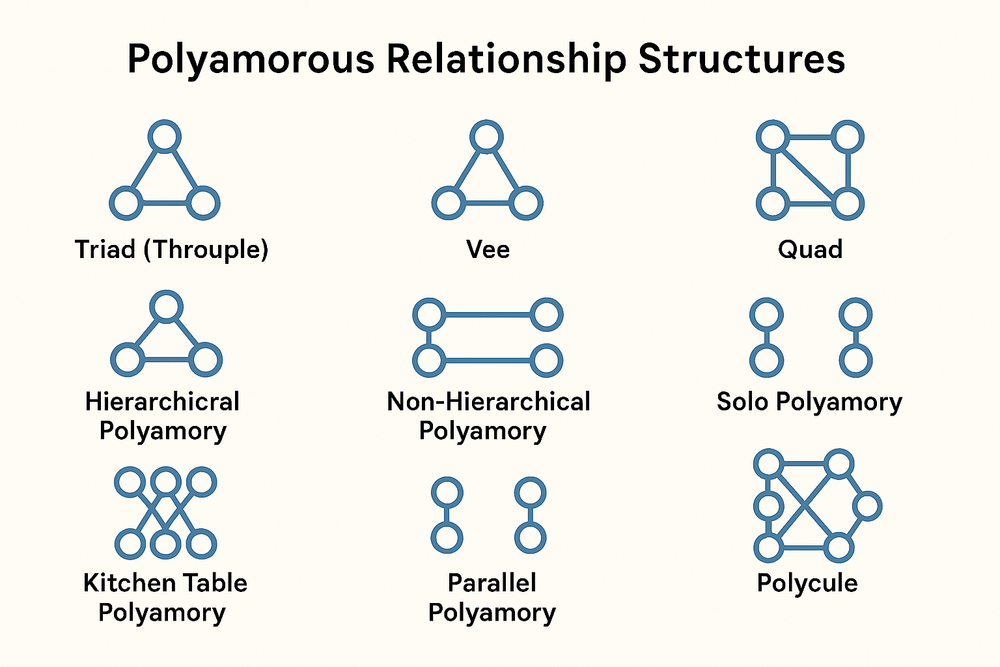
For this vee, the neighborhood sets are:
This structural asymmetry is the key. The hinge is influenced by (and influences) both partners, while each partner is directly influenced only by the hinge.
Formulating Payoff Functions
How can we translate this into a concrete payoff function? The structure depends on the nature of the strategic interaction. Let's explore a common and powerful formulation based on strategic complementarities, where a player's incentive to take an action increases with the number of their neighbors who also take that action.
This section presents a specific mathematical form for a game with continuous actions and strategic complements. This provides a concrete template for how a payoff function can explicitly incorporate network links.
Please read the subsection The Benchmark Quadratic Model. Focus on the structure of the utility function in Equation (3).
The payoff function presented in the reading is:
Let's break this down in the context of a vee relationship:
- is a continuous action, representing the level of effort player invests in a shared activity (e.g., planning dates, emotional labor, financial contribution).
- represents the personal benefit and cost of that effort. This is a standard quadratic form where utility is maximized at .
- is the crucial network term. It captures the strategic complementarity. The term from the adjacency matrix acts as a switch: if and are linked (), their efforts multiply; otherwise (), they don't. The parameter scales the strength of this peer effect.
Let's write this out for Partner 1 (P1) in the vee:
Since P1 is connected to H but not P2, and . The function simplifies to:
For the Hinge (H), who is connected to both P1 and P2, the payoff function is different:
This simplifies to:
Here, the network structure directly creates different strategic situations. P1's optimal effort depends only on H's effort. In contrast, H's optimal effort depends on the sum of the efforts from P1 and P2. The hinge's central position makes them a focal point for the system's strategic complementarities.
Contests, Externalities, and Network Position
Another powerful way to model games on networks is to consider contests with network externalities. In this framing, players invest resources to win a prize, but a player's payoff also depends on who wins if they themselves lose. This is exceptionally well-suited for modeling relationship dynamics where feelings like jealousy and compersion are present.
Contests with Network Externalities: Theory & Evidence
This paper develops a formal model of a contest where a player who loses may still receive a positive or negative payoff (an externality) if the winner is one of their neighbors in the network. This is a perfect application for our vee scenario.
First, read the Introduction to understand the motivation behind identity-dependent externalities (IDEs). Next, read the section "Theoretical Framework," focusing on subsection 2.1 Preliminaries. Your goal is to understand the components of the expected payoff function in Equation [3].
The model in the paper defines the expected payoff for player as:
Let's adapt this to a vee, where H, P1, and P2 are in a contest. The "prize" could be having one's preference chosen for a major decision (e.g., where to live).
- is the effort or resources player expends to win.
- is the probability player wins (e.g., a Tullock contest success function, as used in the paper).
- The term captures the network externality. Player receives an additional payoff if one of their neighbors (where ) wins.
The parameter is key:
- If : This represents a positive externality, like compersion. "I didn't get my way, but I'm happy my partner did."
- If : This represents a negative externality, like jealousy or envy. "I'm upset that they won instead of me."
Let's write the expected payoff for P1 in the vee:
Since and , this simplifies to:
P1's payoff is their direct chance of winning, minus their cost, plus a potential externality only if H wins.
Now consider the hinge's payoff:
Since and , this becomes:
The hinge's payoff structure is fundamentally different. They experience an externality if either P1 or P2 wins. This perfectly captures the hinge's unique structural position. Their central role means they are affected by the outcomes of all other players in the system, whereas the non-hinge partners are only affected by the hinge's outcome. Formulating the game this way makes the strategic implications of the network topology explicit and analyzable.
Conclusion
In this lesson, we have laid the groundwork for our integrative analysis by formally defining what it means to play a game on a network. We have established that the core principle is making player payoffs an explicit function of the network structure, typically through interactions with immediate neighbors.
Key Takeaways:
- A "game on a network" is a formal model where a player's payoff function depends on their own action , the network graph , and the actions of their neighbors .
- The vee structure (H-P1, H-P2) creates an inherent asymmetry: the hinge's neighborhood includes both partners, while each partner's neighborhood includes only the hinge.
- We can formulate specific payoff functions to model different dynamics. For instance, a quadratic payoff function can capture strategic complementarities, while a contest model with network externalities can capture feelings like compersion () or jealousy ().
- The key to formulating such a game is to define the players, the network graph, the action sets, and a payoff function for each player that explicitly references their connectivity (e.g., using the adjacency matrix ).
We now have a method for describing how network position shapes strategic incentives. In our next lesson, we will use this foundation to analyze the consequences, focusing on how the hinge's strategic choices create "network externalities" that influence the behavior and outcomes of the non-hinge partners.