Welcome to the final lesson of this module on information and influence diffusion. In our previous discussion, we analyzed how stable judgments like trust and distrust propagate through a vee network, using frameworks like Structural Balance Theory and algorithmic propagation models. We saw how the relationships a hinge partner holds can create a "pressure" for a positive or negative relationship to form between the non-hinge partners.
Today, we take this one step further to address a critical question: what happens when a relationship doesn't just change in quality, but breaks entirely? We will explore how the dissolution of one relationship can trigger a chain reaction, leading to further breakdowns. Our learning outcome is to model these cascading failures in network terms, giving you a powerful framework for analyzing the systemic stability of a vee or any polyamorous structure.
The Contagion of Relationship Dissolution
The idea that a relationship breakdown can be "contagious" is not just a metaphor; it is a well-documented social phenomenon. Much like a virus or a piece of news, the "state" of being divorced can spread through a social network.
A landmark study based on the Framingham Heart Study provided compelling evidence for this. Let's look at a visualization from that research.
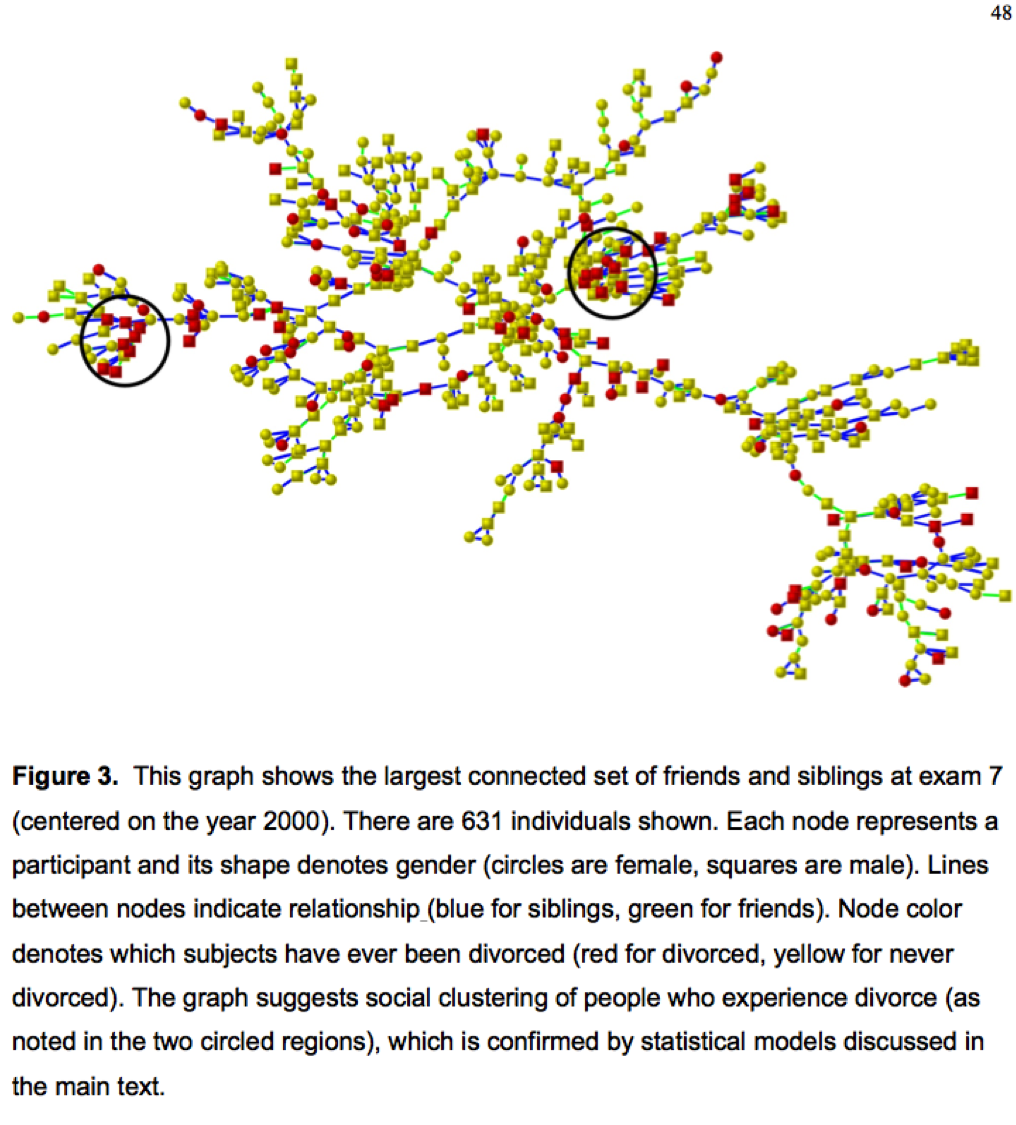
This clustering hints at a deeper process. The researchers found that the effect isn't just about being directly connected to someone who gets divorced.
Social Network Effects on Divorce in a Longitudinal Sample
This paper provides the empirical foundation for our lesson, demonstrating that relationship dissolution can be modeled as a contagion process. Your background in causal analysis will be valuable in appreciating how the authors attempt to distinguish correlation from causation.
First, read the Abstract to get a high-level summary of the key findings. Next, read the two introductory paragraphs that follow, starting from "Here, we examine..." to understand the central research question about the person-to-person-to-person spread of divorce. Finally, jump to the "RESULTS" section and read the subsection Network Clusters of Divorce. This part quantifies the "cascade," showing how the likelihood of divorce increases if a friend (one degree of separation) or a friend's friend (two degrees of separation) gets divorced.
As you read, the key finding is that a person's risk of divorce increases by 75% if a direct friend gets divorced. Remarkably, the risk is still 33% higher even if a friend's friend gets divorced. This is a cascade in action: an event at one point in the network propagates and has effects two steps away. The study also notes that this influence doesn't weaken with geographic distance, suggesting it's a social or psychological contagion, not one based on shared local circumstances. This provides a strong empirical justification for viewing relationship breakdowns as a network phenomenon.
Modeling the Cascade
Observing that failures cascade is one thing; modeling the mechanism is another. To do this, we can draw from the rich field of network diffusion. Your background in operations research and simulation will be useful here, as these models are fundamentally algorithmic.
A cascade is a process where a small initial shock can trigger a large-scale change across a network. Two primary models are used to capture this dynamic: the Linear Threshold Model and the Independent Cascade Model.
Maximizing Cascades in Social Networks: An Overview
This paper provides a concise overview of the foundational mathematical models for cascades. While the context is viral marketing, the underlying logic is perfectly adaptable to our interest in cascading relationship failures.
Please read the section titled "Modeling Cascades". Focus on understanding the distinct logic of the two models presented: Linear Threshold Model: This model is based on a "breaking point" logic. Pay attention to the concept of a node's threshold (\theta_v) and the influence weights from its neighbors (b_{w,v}). Independent Cascade Model: This model is probabilistic. Note how an activated node gets a single chance to influence its neighbors with a specific probability (p_{v,w}).
Let's translate these models into the context of a vee relationship (P1-H-P2). Imagine the initial "shock" is the dissolution of the H-P1 relationship. We want to model if this triggers the failure of the H-P2 relationship.
1. The Linear Threshold Model: The "Breaking Point"
In this model, each person in the relationship has a certain resilience or tolerance for stress—their threshold. A relationship failure is an "active" state that exerts influence or stress on connected nodes.
- Nodes: The individuals P1, P2, and H. For our purposes, we might even think of the H-P2 dyad as a node that can "fail."
- Threshold (): This represents the breaking point for a person or a relationship. For instance, P2's threshold might be determined by their emotional resilience, their satisfaction in the relationship with H, and their outside support systems. A low threshold means they are more vulnerable to stress.
- Influence Weight (): This quantifies how much stress one person's state imposes on another. The failure of the H-P1 relationship puts stress on H. H might become emotionally withdrawn, financially strained, or less available. The weight of this influence on P2 depends on how much P2's well-being is tied to H's stability.
Vee Scenario:
The H-P1 relationship fails. This "activates" H with a state of distress. This distress now influences the H-P2 relationship. Let's say the influence weight is . If this stress, perhaps combined with other pre-existing stressors (e.g., work pressure, personal insecurities), exceeds the threshold for the H-P2 relationship, it will also fail.
In our case, if , the cascade occurs.
2. The Independent Cascade Model: A Probabilistic Chain Reaction
This model frames the cascade as a game of chance. When one relationship fails, it creates a probabilistic risk for adjacent relationships.
- Nodes: P1, P2, H.
- Activation Probability (): When the H-P1 relationship fails, there is a probability that this event will trigger the failure of the H-P2 relationship.
Vee Scenario:
The H-P1 relationship dissolves. This event now "flips a coin" for the H-P2 relationship. The probability on that coin is not random; it's a function of the vee's characteristics:
- Emotional interdependence: How much does H's happiness depend on P1, and how does that affect H's behavior towards P2?
- Shared resources: If the H-P1 breakup causes logistical or financial chaos for H, what is the probability this instability makes the H-P2 relationship untenable?
- Communication patterns: How does H communicate the breakup to P2? A poorly handled disclosure could dramatically increase the probability of a cascade.
This model is simpler to conceptualize but powerful for simulations, a tool you're familiar with from your work in stochastic queueing. By running many simulations with a given probability , you could estimate the overall resilience of a particular vee structure.
Simple vs. Complex Contagion
The models above assume a fairly straightforward transmission. However, relationship decisions are often more complicated. The concept of complex contagion is useful here.
This short video explains the difference between simple and complex contagion. This distinction is crucial for understanding why some relationship stressors are easily managed while others lead to cascading failures.
Please watch the segment on complex contagion. Notice how it requires multiple sources of exposure or a threshold of influence to be met before a node changes state.
A simple contagion is like catching a cold; one exposure might be enough. Hearing that a distant acquaintance got divorced might be a simple contagion of an idea, but it's unlikely to end your own marriage.
A complex contagion is required for adopting costly or risky behaviors. Ending a serious relationship is a significant, costly decision. Therefore, it's more likely to be a complex contagion. In the context of a vee, the failure of H-P1 might not be enough on its own. The cascade might only occur if that stress is combined with other factors:
- Pre-existing dissatisfaction in the H-P2 relationship.
- Influence from P2's own friends who are also unhappy in their relationships.
- An external life crisis (e.g., job loss) that reduces P2's overall resilience.
This aligns perfectly with the Linear Threshold model, where the threshold is only surpassed by the sum of influences from multiple sources. A relationship breakdown, therefore, is rarely caused by a single shock; it's the result of accumulated stress exceeding a person's or a system's capacity to cope.
Conclusion
In this lesson, we have moved from the propagation of information and trust to the propagation of failure itself. By modeling relationship breakdowns as network cascades, we gain a systemic perspective on relationship stability.
Key Takeaways:
- Relationship dissolution is not always an isolated event; it can be contagious, spreading through social networks in a cascading failure.
- The Linear Threshold Model helps us understand this as a process of accumulating stress. A relationship fails when the total stress from its social environment exceeds its intrinsic resilience or "breaking point."
- The Independent Cascade Model offers a probabilistic view, where the failure of one relationship creates a quantifiable risk of triggering the failure of others.
- Breakdowns of significant relationships are best understood as complex contagions, typically requiring multiple converging sources of stress to overcome an individual's or a relationship's stability threshold.
We have treated these cascade dynamics as a somewhat automatic network process. However, partners are not passive nodes; they are strategic actors who anticipate and react to these risks. This sets the stage perfectly for our final module, where we will integrate the network dynamics we've been studying with the game-theoretic frameworks from the first half of the course.
In the next lesson, we will begin our integrative analysis by formulating a game played on a vee network, where payoffs depend explicitly on both individual actions and network position.