Welcome to the first lesson of your course on applying game theory and network theory to polyandrous vee relationships. Given your background in operations research and your goal of analyzing these specific relationship dynamics, our starting point will be to build a foundational model. This lesson addresses the first learning outcome: modeling a polyandrous vee as a three-player game with distinct roles. We will translate the abstract structure of a vee into the formal components of a game, establishing the 'players' and the 'rules of engagement'. This initial framework will serve as the bedrock for all subsequent analyses of strategy, bargaining, and stability.
1. Defining the Vee: A Structure of Asymmetry
Before we can model a vee relationship as a game, we must first have a precise, operational definition of its structure. A vee is fundamentally different from other polyamorous configurations, such as a triad.
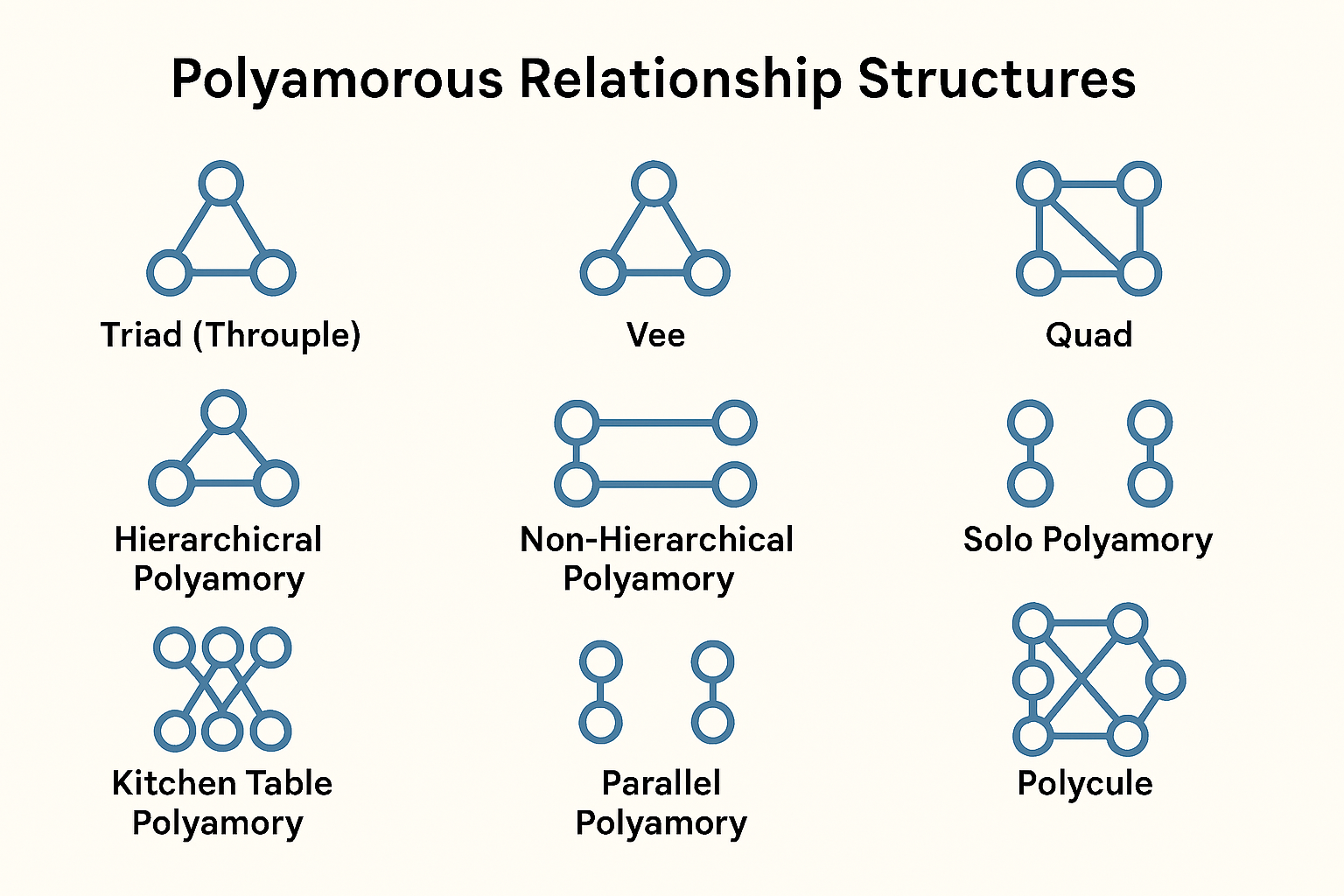
The key feature of the vee is its asymmetry. One person, the hinge, is in two distinct dyadic relationships with two other people, often called the arms or non-hinge partners. Crucially, the arms are not in a romantic or sexual relationship with each other. All interaction and resource flow between the arms is mediated by the hinge.
To explore this concept in more detail, let's turn to a resource that frames this structure in terms of resource allocation, a perspective that should be familiar from your work in efficiency and operations research.
polyamory vee relationship type resource allocation ∗ relationship
This article provides a stark, logistical definition of the vee relationship, which is an ideal starting point for a game-theoretic model. It moves beyond romantic ideals to focus on the structural realities of managing finite resources.
Please read the first two main sections. Start with the concept definition to get a clear sense of the asymmetrical structure. Then, continue to the next section, The Hinge as a Bottleneck, which elaborates on the hinge's unique role as the central administrator and "single point of failure."
As the reading emphasizes, the hinge is not just a participant but a "centralized resource bottleneck" and the "sole conduit" for relational flows. The arms, in turn, are positioned as the recipients of the hinge's allocated resources—be it time, emotional energy, or capital. This naturally creates three distinct roles, which is the first step toward building our game model.
2. From Relationship Structure to Game Form
Now, let's translate this structure into the formal language of game theory. A game is defined by its players, the actions they can take, and their preferences over the possible outcomes.
The players are clear:
- Player 1: The Hinge Partner
- Player 2: Arm A (Non-Hinge Partner 1)
- Player 3: Arm B (Non-Hinge Partner 2)
The challenge lies in capturing the distinct roles and the sequential, contingent nature of their interactions. A simple, simultaneous-move game where all three players choose an action at the same time wouldn't capture the reality of a vee. For example, one arm's request for the hinge's time often precipitates a series of decisions and reactions from the other two players.
A more suitable framework is a sequential game that models this dynamic. A model from international relations theory, the "Double Deterrence Game," provides a surprisingly effective analogue. In this model, a "Defender" faces potential challenges from two independent "Challengers."
We can map our vee players to these roles:
- Hinge Partner ↔ Defender: Manages the status quo and responds to demands on their resources.
- Arm A ↔ Challenger 1: The primary or immediate "challenger" who might make a demand (e.g., request a weekend trip, ask for more emotional support).
- Arm B ↔ Challenger 2: The secondary "challenger" whose actions are contingent on the interaction between the Hinge and Arm A. They might make their own demand if they see the Hinge accommodating Arm A, or they might remain silent.
This mapping allows us to use a pre-existing formal structure to analyze the vee. Let's examine the specifics of this game form.
[PDF] Two Against One: Deterrence in the Triad
This paper provides a formal model for a three-player sequential game. We will use its structure as a template for our vee game. Your background in stochastic processes and algorithms will help you appreciate the sequential decision-making represented in the game tree.
Please read the section titled Game Form. Focus on the description of the game's sequence and the game tree shown in Figure 1. Pay close attention to the roles of the Defender, Challenger 1, and Challenger 2, and the decision nodes where each player makes a choice.
The game form described in the paper captures the key dynamics:
- Initiation: One arm (Challenger 1) decides whether to make a demand or maintain the status quo.
- Hinge's Response: The hinge (Defender) must decide whether to comply with the demand or defy it.
- Contingent Action: The outcome and the subsequent actions depend on the hinge's choice. Crucially, the other arm's (Challenger 2's) decision to act or not is influenced by the preceding events.
This structure is fundamentally asymmetric. Unlike a symmetric game where players have the same actions and payoffs, here the roles and decision points are distinct.

In our vee model, Arm A cannot make a demand on Arm B; they can only make a demand on the Hinge. This structural constraint is the defining feature of the game.
3. Player "Types": Modeling Preferences and Tendencies
The roles define what a player can do and when. But why they choose a particular action depends on their preferences. Game theory accounts for this by defining player "types," which are essentially different preference orderings over the possible outcomes.
A hinge might be "staunch," preferring to risk conflict rather than capitulate to what they see as an excessive demand. Another hinge might be "submissive," prioritizing harmony and complying to avoid friction. Similarly, an arm might be "determined," willing to press a demand even if it causes conflict, or "hesitant," preferring to back down.
The "Two Against One" paper formalizes these intuitive concepts.
[PDF] Two Against One: Deterrence in the Triad
This part of the paper defines the possible outcomes and, most importantly, classifies the players into different "types" based on their preferences over those outcomes. This is a crucial step in building a realistic model, as it acknowledges that not all individuals in the same role will behave identically.
Please read the following subsections in Section 2, "Outcomes and Preferences": Defender's Preferences: Note the four types (Staunch, Semi-Staunch, Submissive, Semi-Submissive) and how their preference rankings differ. Challenger 1's Preferences: Understand the distinction between Determined, Hesitant, and Cautious challengers. Challenger 2's Preferences: See how the second challenger can be Persistent, Restrained, or Reluctant. Don't worry about memorizing every preference order. The goal is to grasp the concept that we can model different psychological tendencies or strategic stances as distinct player types within our game.
By defining these types, we move from a generic model to one that can be tailored to a specific vee relationship. If you know the general disposition of the individuals involved, you can select the corresponding player types to predict likely dynamics and stable outcomes. This approach, where you model uncertainty about player characteristics, is a cornerstone of Bayesian game theory, which we will explore in detail in Module 4.
Conclusion
In this lesson, we have laid the formal groundwork for analyzing vee relationships. We established that a polyandrous vee can be modeled as a three-player sequential game with distinct, asymmetrical roles: a central Hinge (Defender) and two non-hinge partners or Arms (Challengers).
The key takeaways are:
- Structural Asymmetry: The vee's defining feature is that the Hinge mediates all interactions and resource flows between the two Arms.
- Mapping to a Game Model: We can map the vee's participants to the roles in a "Defender vs. Two Challengers" game, capturing the sequential and contingent nature of their interactions.
- Distinct Roles and Types: The Hinge's role is functionally different from the Arms'. Within these roles, we can further define player "types" (e.g., Staunch, Determined, Hesitant) based on their underlying preferences, allowing for more nuanced analysis.
We have successfully built the "game board." In the next lesson, we will begin to play the game by identifying and comparing the specific strategy spaces available to the hinge versus the non-hinge partners. This will involve defining the concrete actions each player can take at their respective decision points in the game.