Welcome to the third module of our course. In the previous module, we focused on how to divide resources or make collective decisions in a single instance, exploring concepts of fairness like the Nash Bargaining Solution and different philosophical allocation rules. However, relationships are rarely a single interaction. They are an ongoing sequence of decisions, compromises, and responses.
This module, "Long-Term Relationships: Repeated Games and Trust," shifts our perspective from one-shot encounters to the dynamics of long-term interaction. The simple fact that you will see someone again tomorrow fundamentally changes the strategic landscape. In this lesson, we will begin this exploration by tackling a cornerstone result in game theory. Your learning outcome is to apply the folk theorem to identify the range of sustainable cooperative outcomes in an ongoing vee relationship. This powerful theorem helps explain how and when cooperation can survive over the long haul, even when short-term selfishness is tempting.
From One-Shot Encounters to Ongoing Relationships
In our previous discussions, we analyzed games as if they were played only once. In a one-shot Prisoner's Dilemma, for example, mutual defection is the dominant strategy and the only Nash equilibrium. But what happens if the players know they will play the same game again tomorrow, and the day after, and so on? This is the domain of repeated games.
A repeated game is defined by a few key components, which should feel familiar from your background in stochastic processes and decision theory.
Cooperation in Repeated Games, Communities, and ...
These lecture notes from MIT provide a concise, formal introduction to the model of repeated games.
Please read the introductory sections "Modeling Trust and Cooperation: Repeated Games" and "Repeated Games: Model" on pages 2-3. Focus on the definitions of the stage game, the time horizon (T), and the discount factor (\delta).
As the notes explain, the core idea is that a "stage game" (like a time-allocation dilemma in a vee) is played over and over. A player's total payoff is the discounted sum of their payoffs from each round. The discount factor, , is a crucial parameter. It captures several intuitive ideas:
- Patience: How much you value future happiness compared to today's. A high means you are patient.
- Relationship Stability: The probability that the relationship will continue into the next period. A of 0.95 could imply a 95% chance the relationship continues each month, and thus a 5% chance it ends.
- Interest Rates: In a financial context, it's directly related to the interest rate used to calculate the present value of future earnings.
A critical distinction arises between a game with a finite, known end and one that is infinite or has an indefinite end.
The Problem with a Known Endpoint
Imagine a vee relationship that all three members know will end on a specific date (e.g., the day one partner moves away permanently). In the very last interaction before that date, there is no "future" to worry about. The game effectively becomes a one-shot game. In that last round, each person has an incentive to act in their own short-term interest (to "defect").
Now, consider the second-to-last round. Since everyone knows that in the last round everyone will defect anyway, there is no future cooperation to incentivize good behavior now. So, everyone defects in the second-to-last round as well. This logic, known as backward induction, unravels all the way to the beginning. If the endpoint is known, cooperation is notoriously difficult to sustain. The MIT notes you just reviewed walk through this for the Prisoner's Dilemma on page 4.
The Shadow of the Future: Sustaining Cooperation
For a long-term relationship with no definite endpoint, backward induction doesn't work. This is where things get interesting. The possibility of future reward and punishment—the "shadow of the future"—can discipline behavior today.
A common way to model this is with a trigger strategy. This video gives a clear explanation of two famous examples: grim trigger and tit-for-tat.
This video introduces trigger strategies and calculates the conditions under which cooperation can be sustained in a repeated Prisoner's Dilemma.
First, watch the explanation of two key strategies: grim trigger and tit-for-tat. Then, pay close attention to the section from the mathematical analysis, where the presenter compares the payoff from defecting now versus cooperating forever.
The key insight from the video's analysis is that cooperation can be a stable equilibrium outcome if players are patient enough. The one-time gain from defecting must be less than the long-term, discounted value of future cooperation. In formal terms, a strategy like "grim trigger" (cooperate until your partner defects, then defect forever) can support mutual cooperation if the discount factor is high enough.
This sets the stage for one of the most significant ideas in the study of repeated interactions: the Folk Theorem.
The Folk Theorem: The Universe of Possible Outcomes
The analysis of the grim trigger strategy shows that we can sustain one cooperative outcome. But what about other outcomes? What is the full range of possibilities? The Folk Theorem provides a sweeping and powerful answer.
In essence, the Folk Theorem states that in an infinitely repeated game, if players are sufficiently patient (i.e., their discount factor is close to 1), then any feasible payoff profile that is individually rational can be sustained as a subgame-perfect Nash equilibrium.
This is a dense statement, so let's break it down.
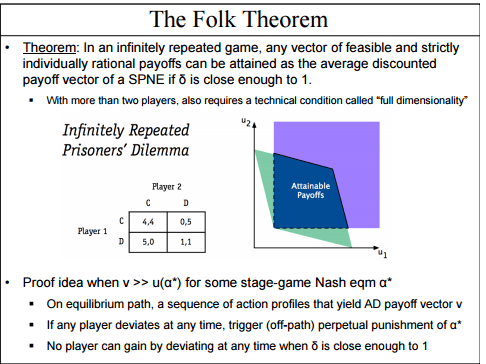
The Wikipedia article provides clear, non-technical definitions for the two key conditions of the Folk Theorem.
Please read the section "Setup and definitions". Focus on understanding the two properties: Individual rationality and Feasibility.
Let's apply these concepts to our vee relationship (Hinge, P1, P2):
-
Individual Rationality: An outcome is individually rational if it gives each person a payoff that is at least as good as their minmax payoff. The minmax payoff is the worst-possible payoff a player can be forced to accept, assuming the other players team up to punish them. It's their security baseline. In a vee, what is the minimum level of satisfaction P1 could guarantee for themself, even if H and P2 were actively trying to make them miserable (within the confines of the relationship)? Any sustainable long-term agreement must offer P1 at least this much. The same holds for P2 and H.
-
Feasibility: An outcome is feasible if its payoffs can be represented as a weighted average (a convex combination) of the payoffs of the possible outcomes in the single-stage game. Essentially, this means the outcome is physically possible to achieve over time. For example, you can achieve an average payoff by alternating between two outcomes: spending half the time at (Outcome A) and half the time at (Outcome B).
The Folk Theorem's stunning conclusion is that any outcome that meets these two simple conditions—it's possible, and it's better for everyone than their worst-case scenario—can be made into a stable, long-term equilibrium with the right strategy and enough patience.
Applying the Folk Theorem to a Vee Relationship
So, what does this mean for a vee? It means the members are not doomed to repeat the short-sighted, self-interested equilibrium of a one-shot game. A vast world of cooperative arrangements becomes possible.
Let's imagine a stage game concerning the Hinge's time allocation. "Cooperate" (C) could be adhering to a mutually agreed-upon schedule, while "Defect" (D) could be breaking that agreement for a selfish reason.
- One-Shot Game: In a single instance, the Hinge might be tempted to defect and do what they want, even if it disappoints a partner.
- Repeated Game (The Folk Theorem Lens): The Folk Theorem tells us that as long as the relationship is expected to continue (high ) and all three members value its continuation, they can sustain almost any arrangement they design, provided it's better for everyone than their minmax outcome.
Examples of sustainable outcomes in a vee:
- An egalitarian outcome where time and resources are split to ensure everyone's satisfaction level is roughly equal.
- A utilitarian outcome where resources are directed to whoever gets the most "joy" out of them, maximizing total group happiness.
- A proportional outcome where attention is allocated based on each person's contributions or needs that week.
All of these, which we discussed as one-shot allocation rules in the last module, can be sustained as long-term equilibria under the Folk Theorem. The mechanism is a shared understanding, enforced by a trigger strategy: "We all stick to our agreed-upon schedule. If anyone unilaterally violates it, the deal is off, and we revert to a punishing state of non-cooperation." This state of non-cooperation is so undesirable that it makes sticking to the agreement the rational choice.
The structure of the vee adds an interesting layer.

In a vee, the Hinge (Player 2, Bob) is playing two simultaneous repeated games. A defection by the Hinge against P1 (Alice) might not just trigger punishment from P1. It could also be seen by P2 (Charlie) as a signal of the Hinge's unreliability, causing P2 to alter their own behavior toward the Hinge. This "crosstalk" can make the threat of punishment even more potent and further stabilize cooperation.
Conclusion
In this lesson, we made the crucial leap from single interactions to long-term relationships. We saw that the logic of cooperation is transformed when there is a "shadow of the future."
Key Takeaways:
- Relationships with no clear end date can be modeled as infinitely repeated games, where the discount factor () captures patience and the perceived stability of the relationship.
- Cooperation can be sustained by trigger strategies, where players reward cooperation with continued cooperation and punish defection with a return to a non-cooperative state.
- The Folk Theorem provides a powerful generalization: if players are patient enough, any feasible outcome that is better for everyone than their worst-case security level (their minmax payoff) can be a stable long-term equilibrium.
- For a vee relationship, this means the members are not stuck in a single, suboptimal pattern. They have the ability to design and sustain a wide variety of cooperative arrangements, from egalitarian to utilitarian, as long as they all value the future of the relationship.
The Folk Theorem is an existence theorem—it tells us what can be achieved, but not necessarily how or which equilibrium will be chosen. In our next lesson, we will get more specific. We'll dive deeper into the mechanics of popular strategies like tit-for-tat and grim trigger and analyze how they perform in maintaining agreements within a vee. We'll also begin to consider what happens when actions aren't perfectly clear, introducing the problem of imperfect monitoring.