Following our exploration of the vast possibilities for cooperation opened up by the Folk Theorem, we now turn to a more pragmatic and challenging aspect of long-term relationships. The models we discussed previously, including the trigger strategies, largely assumed that everyone has a crystal-clear view of each other's actions. But reality is rarely so simple. A canceled date, an unreturned message, a shift in mood—these are all signals, but their meaning can be ambiguous.
This lesson addresses this ambiguity head-on. Your learning outcome is to model trust-building as a repeated game with imperfect monitoring between partners. We will investigate what happens when the "shadow of the future" is cast through a fog of uncertainty. You will see how easily cooperation can unravel due to simple misunderstandings and, more importantly, explore strategies and models specifically designed to build and maintain trust in this more realistic, "noisy" environment.
The Problem of Imperfect Monitoring
In game theory, a situation where players cannot perfectly observe the actions of other players is known as a game of imperfect monitoring. A player might observe a signal or an outcome, but they cannot be certain which specific action led to it.
Consider a simple scenario in our vee (Hinge, P1, P2). Suppose the Hinge and P1 have an agreement about communicating daily. One day, the Hinge fails to send a message. P1 observes the lack of a message (the signal), but doesn't know the reason.
- Did the Hinge deliberately break the agreement to prioritize something or someone else? (An action of 'Defect')
- Did the Hinge get caught in a work emergency and was unable to send a message? (An action of 'Cooperate' with the relationship's overall spirit, but leading to a bad outcome)
P1 knows the outcome is negative but cannot be sure of the Hinge's action or intent. This is the essence of imperfect monitoring. In the extensive form of a game, this is represented by an information set.
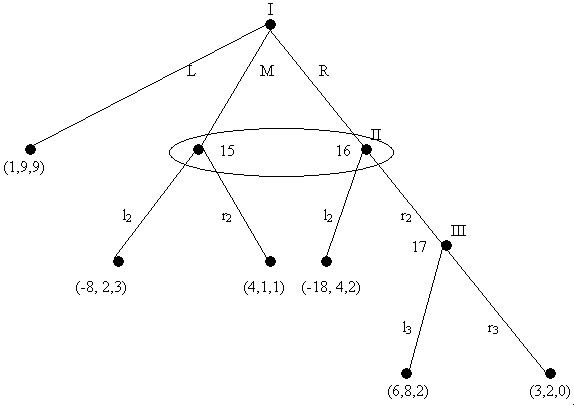
This challenge is a central topic in the study of repeated games on networks, where information is often localized.
[PDF] Repeated Games and Networks - LSE
This research paper provides a formal introduction to games with local and imperfect monitoring. While the paper is quite technical overall, the introductory sections clearly define the concepts we're interested in.
First, in section "2 A Baseline Setup," read the paragraph beginning with "The Repetition and Local Monitoring". This formally defines local monitoring, where a player only sees what happens in their immediate vicinity. Then, in the "Departures" section just below, note how the author explicitly introduces the concept of imperfect local monitoring, where players observe only a "noisy signal" of others' actions. This is precisely the problem we are tackling.
The key takeaway is that imperfect monitoring forces players to make inferences. You don't just react to what happened; you react to what you think happened, and this introduces a significant potential for error.
When Simple Strategies Fail: The Echoes of Mistrust
In our last lesson, we touched on strategies like Tit-for-Tat: start by cooperating, then do whatever your opponent did in the last round. This seems fair and reciprocal, but it is notoriously fragile in a noisy environment.
Imagine P1 and the Hinge are both playing Tit-for-Tat. P1 cooperates, but due to a misunderstanding (noise), the Hinge perceives it as a defection. The Hinge retaliates with a defection. P1, seeing this clear defection, also retaliates. This can set off a long and destructive "echo effect" of back-and-forth defections, even if both parties initially intended to cooperate. A single mistake can poison the well.
This excellent video from Veritasium explores this exact problem within the context of Robert Axelrod's famous computer tournaments.
This game theory problem will change the way you see the world
This video discusses the evolution of cooperation and what happens when "noise" is introduced into the system.
Please watch the segment from "What happens if there is a little bit of random error". Pay close attention to how a single error causes Tit-for-Tat to break down and the simple, yet powerful, strategic adjustment that can fix it.
The solution, as the video explains, is to introduce generosity. A strategy like Generous Tit-for-Tat doesn't retaliate for every single perceived defection. For example, it might cooperate even after a partner defects, but only with a certain probability (say, 10% of the time). This willingness to occasionally "turn the other cheek" acts as a circuit breaker, stopping the echo effect of mutual retaliation and allowing cooperation to be restored.
In the context of a vee, this translates to giving a partner the benefit of the doubt. If the Hinge cancels a date, instead of immediately assuming the worst and retaliating, P1 might choose to forgive this time, assuming good intent until proven otherwise. This prevents a spiral of mistrust from a single ambiguous event.
A Deeper Model: The Dynamics of a Trust "Account"
Generous Tit-for-Tat provides a strategic fix, but we can also model the process of trust-building more directly. Your background in stochastic processes will be useful here, as we can think of trust as a state variable that evolves over time.
A recent paper proposes a "Trust-Building Game" that captures this idea beautifully. Instead of trust being an abstract belief, it's modeled as a tangible, observable quantity—like a balance in a bank account—that is built up through consistent, reliable actions.
The Trust-Building Game: A Model for Sustainable Cooperation - arXiv
This paper offers an intuitive and dynamic model for how trust is cultivated over repeated interactions.
Please read the following parts of the paper: In "2.1 The Trust-Building Game," read the paragraphs describing the game's structure to grasp the overall concept. In "2.1.2 Mathematical Modeling," focus on these key subsections: "State Variable: Trust as a Dynamic Behavioral Measure," which defines trust T_t. "Dynamics of Trust," which presents the simple but powerful update equation. "Decision Rule of Player 2," which explains how the trust level leads to action.
Let's distill the core components of this model and apply them to our vee.
1. The Trust Variable ()
This is a score from 0 (complete distrust) to 1 (full trust). In a vee, the Hinge would have a trust score from P1's perspective () and another from P2's perspective (). Similarly, the Hinge would maintain a trust score for each partner. It's an observable summary of a partner's reliability based on their past actions.
2. The Trust Update Rule
Trust evolves according to a simple rule:
- is the trust-building signal in the current period. We can set for a positive action (e.g., keeping a promise, showing up on time) and for a negative one (e.g., breaking a promise, being inconsistent).
- is the memory parameter (). This is crucial.
- A high (e.g., 0.9) means past behavior is heavily weighted. Trust is slow to build but also slow to erode. This represents a partner with a "long memory."
- A low (e.g., 0.3) means recent actions are most important. Trust can be built quickly, but a single misstep can destroy it just as fast. This represents a partner who is more "in the moment."
3. The Decision Threshold ()
A partner doesn't just blindly react. They grant trust and engage in deeper cooperation only when the trust variable crosses a certain personal threshold, . For example, P1 might only agree to a vulnerable conversation or a shared vacation (a cooperative action) if their trust score for the Hinge, , is above, say, 0.8.
This model elegantly captures the dynamics of imperfect monitoring. A partner doesn't need to perfectly monitor every single action. Instead, they monitor the aggregate trust score. As long as the Hinge's actions are consistently positive ( most of the time), their trust score will trend upwards and eventually surpass P1's and P2's thresholds, leading to sustained cooperation. A few "blips" (where ) might cause a temporary dip, but if the partner's memory parameter is high enough, the overall trust will remain robust.
Conclusion
In this lesson, we moved from the idealized world of perfect information to the more complex and realistic domain of imperfect monitoring. We saw how easily trust can be broken by simple misunderstandings and explored two distinct ways to model the remedy.
Key Takeaways:
- Imperfect monitoring is a core feature of real-world relationships, where actions are ambiguous and we only observe noisy signals of intent.
- Simple reciprocal strategies like Tit-for-Tat are fragile under these conditions, prone to destructive "echo effects" of retaliation triggered by a single error.
- Introducing forgiveness via strategies like Generous Tit-for-Tat provides a robust way to break these negative spirals and maintain cooperation.
- Alternatively, we can model trust as a dynamic state variable () that evolves over time. Cooperation is then triggered when this trust level surpasses a partner's personal threshold (), with the memory parameter () determining how sensitive the trust level is to new information.
So far, we have looked at the general conditions for long-term cooperation (Folk Theorem) and the challenges of doing so under uncertainty. In our next lesson, we will synthesize these ideas by returning to the specific strategies of tit-for-tat and grim trigger, analyzing their strengths and weaknesses in detail within the context of managing explicit agreements in a vee relationship.