Welcome back to our exploration of network structure and power. In the previous lesson, we established a quantitative method for measuring the hinge's brokerage opportunity using betweenness centrality. We saw that in a simple vee, the hinge is the sole broker, uniquely positioned to control the flow of information between their partners.
This lesson addresses the flip side of that coin. A brokerage opportunity is only as valuable as the freedom one has to exploit it. Today, we will use network constraint measures to assess the structural autonomy of each partner in a vee. This concept will help us understand the degree to which an individual's network connections limit their strategic freedom. For you as a relationship analyser, this provides a powerful diagnostic tool for identifying how much independence each person's position in the network affords them, which has profound implications for relationship dynamics and stability.
From Brokerage to Autonomy: The Concept of Constraint
In the last lesson, we focused on the power that comes from bridging a structural hole—a gap between otherwise disconnected parts of a network. A person who bridges such a hole gains access to diverse, non-redundant information and control over its flow. However, the value of this position is not absolute. Imagine a broker whose two main contacts, while not connected initially, decide to become friends. Suddenly, the broker is no longer the exclusive conduit between them. Their contacts can share information directly, compare notes, and coordinate their actions. The broker's power has been constrained.
This fundamental tension between being embedded within a dense, trusting group versus bridging disparate, novel groups is central to network theory. The following video by Jon Kleinberg for Cornell University offers an excellent conceptual overview of this trade-off.
INFO2040X mod1 kleinberg structural holes v1
This video introduces Ron Burt's pioneering work on structural holes and explains the different advantages that come from being embedded within a group versus bridging between groups.
Please watch the following segments to grasp the core ideas: Begin with the introduction to different network positions, where the video contrasts those who are central to a community with those who link different communities. Next, observe the schematic example of managers A and B. Manager A is deeply embedded in one group, while Manager B, with the same number of connections, bridges three different groups. Pay attention to the discussion of the benefits of Manager A's embedded position, which fosters greater trust. Finally, understand Manager B's counterbalancing advantage, which involves spanning structural holes for creativity and power.
As the video illustrates, Manager A's position is highly constrained. Their world is one of dense, overlapping ties, which builds trust but limits access to novel information. Manager B, by bridging structural holes, has low constraint and high structural autonomy.
Network Constraint, as developed by sociologist Ronald Burt, is a summary measure of the extent to which your connections are connected to each other. It's effectively a measure of the lack of structural holes.
- High Constraint: Your network is closed. Your contacts are highly connected to each other, creating a redundant, cohesive group. This limits your autonomy but can foster high levels of trust and support.
- Low Constraint: Your network is open. Your contacts are not connected to each other, meaning you bridge multiple structural holes. This grants you high autonomy, access to diverse information, and brokerage power.
Deconstructing Burt's Constraint Measure
To calculate constraint, we need to consider how an individual's (ego's) time and energy are distributed among their contacts (alters), both directly and indirectly. The blog post "Hand Calculation of Burt's Constraint in Networks" provides a clear, intuitive breakdown.
Hand Calculation of Burt's Constraint in Networks - Ruqin Ren
This resource explains the core logic behind the constraint calculation without getting lost in complex mathematics.
Please read the first two main sections: The first section explains what constraint measures—the lack of structural holes. In the section "Understanding the Algorithm," focus on the breakdown of the formula into direct and indirect influence. This is the key to understanding the calculation.
As the author explains, the constraint that contact j places on ego i depends on two things:
- Direct Investment (): The proportion of ego
i's relational energy that is dedicated to contactj. - Indirect Investment (): The extent to which
i's energy is invested in third parties (q) who, in turn, invest their energy inj.
Burt's formula for the constraint that contact j exerts on ego i combines these factors:
The total constraint on ego i, , is the sum of the constraints from all of their contacts: .
The key insight is that your autonomy is reduced (i.e., constraint is high) if you invest heavily in a contact who is also closely tied to your other contacts.
Applying Constraint to a Vee Relationship
Let's now apply this measure to our simple, undirected vee network: P1—H—P2. To make the calculation tractable, we'll follow the simplification for binary (unweighted) networks presented in the paper "Unpacking Burt's Constraint Measure." In this case, the proportion of investment from ego i to one of their contacts j is simply , where is the total number of contacts i has.
Unpacking Burt's Constraint Measure - UKnowledge
This paper provides a more formal analysis of the constraint measure. We will use its simplified formulation for binary networks.
In section 3. Undirected Binary Data, read the paragraph that begins the simplification for binary graphs. The key takeaway is that for a person with N contacts, the relational energy p_{ij} spent on any one contact is 1/N.
Constraint on the Hinge (H)
- Ego: Hinge (H).
- Contacts: P1 and P2. So, the number of contacts is .
- Calculate : The proportion of H's energy to P1 is . To P2, it is .
- Calculate Dyadic Constraints:
- Constraint from P1 on H ():
- Direct term: .
- Indirect term: The sum is over H's other contacts, which is just P2. We need to check for a path H P2 P1. Since P1 and P2 are not connected, . The indirect term is .
- .
- Constraint from P2 on H (): By symmetry, this is also .
- Constraint from P1 on H ():
- Total Constraint on H: .
Constraint on a Partner (P1)
- Ego: Partner 1 (P1).
- Contacts: H is the only contact. So, .
- Calculate : The proportion of P1's energy to H is .
- Calculate Dyadic Constraint:
- Constraint from H on P1 ():
- Direct term: .
- Indirect term: P1 has no other contacts, so the sum over
qis empty and equals 0. - .
- Constraint from H on P1 ():
- Total Constraint on P1: Since H is the only contact, . By symmetry, .
Interpreting the Results
- Hinge (H):
- Partners (P1, P2): ,
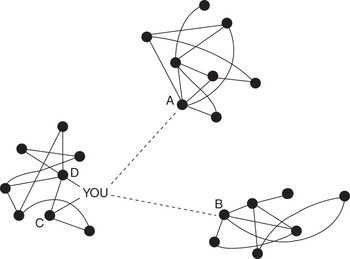
The analysis reveals that the hinge has a significantly lower constraint score than the partners. This quantifies our intuition: the hinge possesses greater structural autonomy. Because their two partners are disconnected, the hinge's network is open, affording them the freedom that comes with bridging a structural hole. The partners, in contrast, have a completely closed network; their entire relational world (within this structure) consists of a single person, the hinge. Their autonomy is maximally constrained by that single tie.
This visualizes the hinge's low-constraint position in a more complex setting:
From Vee to Triad: The Rise of Constraint
What happens if the structure changes? Let's say P1 and P2 form a direct relationship, turning the vee into a closed triad. Now, from the hinge's perspective, their two contacts are connected.
Let's recalculate the constraint on the hinge (H):
- Ego: H. Contacts: P1, P2 ().
- Constraint from P1 on H ():
- Direct term: .
- Indirect term: The path H P2 P1 now exists. P2 has two contacts (H and P1), so . The indirect term is .
- .
- Total Constraint on H: By symmetry, is also . The total constraint is .
The hinge's constraint score jumped from 0.5 to 1.125. The formation of the P1-P2 link dramatically reduced the hinge's structural autonomy. This demonstrates quantitatively why a hinge may, consciously or not, have an incentive to prevent their partners from forming a strong independent bond, as it erodes their unique brokerage position.
This connects to a fascinating finding in the formal analysis of constraint. For very small networks, a complete, closed network (like our triad) produces the maximum constraint. Interestingly, for networks with more than seven contacts, the highest constraint comes not from a completely connected group, but from a "shadow ego" structure—where one of ego's contacts is also connected to all of ego's other contacts. This creates a powerful rival broker, maximally constraining ego's autonomy.
Conclusion
In this lesson, we have moved from measuring brokerage opportunities to assessing structural freedom. By using Burt's network constraint measure, we can quantify the degree to which each partner in a vee is structurally autonomous.
- Key Takeaways:
- Network Constraint is a measure of the closure and redundancy in an individual's personal network. It is inversely related to structural autonomy.
- Low constraint (high autonomy) arises from bridging structural holes—connecting to people who are not themselves connected.
- In a simple vee structure, the hinge partner has a lower constraint score than the non-hinge partners, reflecting their greater structural autonomy.
- The formation of a direct link between the non-hinge partners (transforming a vee into a triad) dramatically increases the hinge's constraint, reducing their structural power.
Preview of the next lesson:
We have now examined two key aspects of static network structure: brokerage (betweenness) and autonomy (constraint). But networks are not static; things flow through them. How do emotions, ideas, or new relationship norms actually spread? In our next lesson, we will shift our focus to dynamics by exploring common models of influence propagation, such as linear threshold and independent cascade models, to understand how change can ripple through a vee network.