Introduction
Hallo! Welcome to our fourth lesson. In the previous session, you learned how to use German cases (nominative, accusative, and dative) to define the roles of nouns in a sentence. You now understand that verbs and prepositions are the "APIs" that demand specific cases for the "arguments" (nouns) that follow them.
Today, we will build directly on that knowledge to use personal pronouns and possessive articles to talk about your work and colleagues. This is a crucial step for making your German more fluid and professional. Instead of repeating nouns like "the colleague" or "the project," you'll learn to say "him," "her," "it," and refer to "my project," "her team," or "their code."
We will cover:
- Personal Pronouns in the nominative, accusative, and dative cases, including the critical distinction between formal (Sie) and informal (du) address.
- Possessive Articles (mein, dein, sein, etc.) and how they change based on the case, gender, and number of the noun they describe.
By the end of this lesson, you'll be able to form sentences like: "Ich gebe ihm meinen Bericht" (I give him my report), a common and essential structure in any professional setting.
Part 1: Personal Pronouns & The Formal "You"
Personal pronouns (ich, du, er, sie, es...) are shortcuts that replace nouns. Just like the nouns they replace, these pronouns must also be in the correct case.
Let's start with a quick overview.
| Case | ich (I) | du (you, inf.) | er (he) | sie (she) | es (it) | wir (we) | ihr (you, pl. inf.) | sie (they) | Sie (you, formal) |
|---|---|---|---|---|---|---|---|---|---|
| Nominative | ich | du | er | sie | es | wir | ihr | sie | Sie |
| Accusative | mich | dich | ihn | sie | es | uns | euch | sie | Sie |
| Dative | mir | dir | ihm | ihr | ihm | uns | euch | ihnen | Ihnen |
- Nominative (Subject): Ich schreibe den Code. (I write the code.)
- Accusative (Direct Object): Der Manager fragt mich. (The manager asks me.)
- Dative (Indirect Object): Der Kollege hilft mir. (The colleague helps me.)
du versus Sie: A Critical Distinction
In a professional German environment, the most important pronoun choice you'll make is between the informal du and the formal Sie. Using the wrong one can be seen as either unprofessional or overly stiff. For a lead engineer like yourself, mastering this is key to communicating effectively with your team, superiors, and stakeholders.
Let's watch a short video that sets the scene for office communication in Germany.
🎯 „So redest du im Büro richtig – Chef beeindruckt, Kollegen begeistert! 💬🔥 | Simply Deutsch“
The video 'So redest du im Büro richtig' from the channel 'Simply Deutsch' gives a great conversational overview of when to use 'du' and 'Sie' in the workplace.
Please watch from 01:29 to 02:16 and from 05:29 to 06:27. Focus on the core advice given: when in doubt, start with 'Sie'. Notice the phrases used for offering the informal 'du'.
As the video highlighted, the default rule is:
- Use
Sie(and its formsIhnen,Ihr) with new colleagues, superiors, and anyone you don't know well. It is always capitalized. - Use
du(and its formsdich,dir,dein) with colleagues who have explicitly offered it to you, or in workplaces with a very informal culture (common in startups).
The senior person or the person who has been at the company longer usually offers the du. This is called "das Du anbieten".
For a more detailed breakdown, this article provides a clear guide.
Du or Sie? A guide to formal vs. informal 'you' in German
The article 'Du or Sie? A guide to formal vs. informal ‘you’ in German' from Lingoda provides an excellent written summary of the rules.
Read the sections 'When to use ‘Sie’ and ‘du’ in German' and 'When in doubt, stick to the formal ‘Sie’'. This will reinforce the video's message and provide clear rules for you to follow.
Part 2: Possessive Articles
Possessive articles indicate ownership (my, your, his, her, etc.). In German, they are derived from personal pronouns and must be declined. This means their endings change to match the case, gender, and number of the noun they are describing.
Think of the possessive article as a function that takes three parameters: case, gender, and number. The output is the correctly declined word. They follow the same declension pattern as the indefinite article ein, which you're already familiar with.
Here are the base forms:
- ich → mein- (my)
- du → dein- (your, informal)
- er/es → sein- (his/its)
- sie → ihr- (her)
- wir → unser- (our)
- ihr → euer- (your, plural informal)
- sie/Sie → ihr-/Ihr- (their/your, formal)
This chart provides a fantastic visual summary of how the endings are applied across the cases.
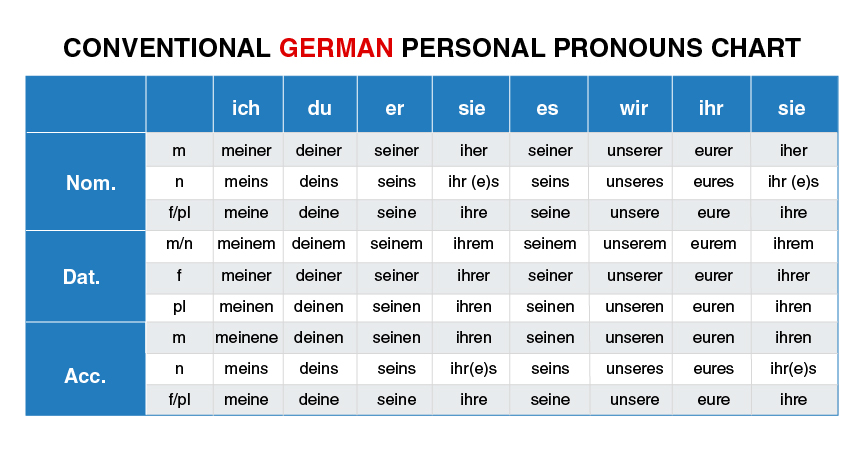
Now, let's watch a video that walks through this system step-by-step.
Possessivpronomen im Akkusativ, Dativ und Nominativ #learngerman #deutschlernen #deutschkurs
The video 'Possessivpronomen im Akkusativ, Dativ und Nominativ' by Jannika Deutsch is a very clear, structured explanation of how to decline possessive articles. It includes short exercises to check your understanding as you go.
Watch the video from the beginning to 03:10, and then from 04:52 to 06:40. First part (0:00-3:10): Focus on the Nominative and Accusative forms. Notice how only the masculine form changes in the accusative. Second part (4:52-6:40): Focus on the Dative forms. Pay attention to the endings for masculine/neuter (-em), feminine (-er), and plural (-en).
Let's apply this to your technical work:
-
Nominative (Subject):
- Das ist mein Computer. (masc., but no ending because it's like ein)
- Das ist meine REST-API. (fem.)
- Unser Team ist sehr agil. (neut.)
-
Accusative (Direct Object):
- Ich sehe seinen Fehler im Code. (I see his mistake in the code.)
- Sie schließt ihren Laptop. (She closes her laptop.)
- Wir müssen unser Backend verbessern. (We have to improve our backend.)
-
Dative (Indirect/Prepositional Object):
- Ich helfe meinem neuen Kollegen. (I am helping my new colleague.)
- Er gibt seiner Managerin ein Update. (He gives his manager an update.)
- Wir arbeiten mit unseren Tools. (We work with our tools.)
Test your understanding!
You want to tell a colleague about your work. Complete the sentences with the correct form of mein (my) or unser (our).
- Ich entwickle eine neue Funktion für _______ Projekt. (das Projekt, neuter)
- Kannst du _______ Code reviewen? (der Code, masculine)
- Ich habe mit _______ Chefin gesprochen. (die Chefin, feminine)
Show answer
- Ich entwickle eine neue Funktion für unser Projekt. (Accusative after
für, neuter noun -> no ending) - Kannst du meinen Code reviewen? (Accusative after
reviewen, masculine noun -> -en ending) - Ich habe mit meiner Chefin gesprochen. (Dative after
mit, feminine noun -> -er ending)
Part 3: Putting It All Together in a Professional Context
Now, let's see how these pronouns and possessives appear in real-world professional phrases. We will draw examples from a business phrasebook, focusing on situations relevant to your role.
Business German Phrasebook Learn 1000 essential phrases
The 'Business German Phrasebook' is a great resource. We won't read it cover-to-cover, but instead, I'll pull out specific examples that demonstrate today's grammar in the context of meetings, interviews, and daily work.
You don't need to read the entire PDF. Just look at the following examples I've selected from the sections on Meetings, Job Interviews, Leadership, and Technology. Notice how personal pronouns and possessive articles are used.
Examples from the "Business German Phrasebook"
In a Meeting (Section: "MEETINGS & CALLS")
- Kannst du mich bitte daran erinnern, wann unser Treffen morgen stattfindet?
(Can you remind me when our meeting is tomorrow?)mich= Accusative personal pronoununser= Nominative possessive article (das Treffen)
- Sag mir Bescheid, wenn du meinen Bildschirm sehen kannst.
(Let me know when you can see my screen.)mir= Dative personal pronounmeinen= Accusative possessive article (der Bildschirm)
During a Job Interview (Section: "JOB INTERVIEW")
- Wie Sie in meinem Lebenslauf sehen können, habe ich bereits im Vertrieb gearbeitet.
(As you (formal) can see in my CV, I have already worked in sales.)Sie= Nominative formal pronounmeinem= Dative possessive article (der Lebenslauf)ich= Nominative personal pronoun
- Meine Gehaltsvorstellungen liegen zwischen 80.000 und 90.000 Euro brutto.
(My salary expectations are between €80k and €90k gross.)Meine= Nominative plural possessive article (die Vorstellungen)
Leading a Team (Section: "LEADERSHIP")
- Ich glaube, dass es meine wichtigste Aufgabe als Manager ist, mein Team zu motivieren.
(I believe that my most important task as a manager is to motivate my team.)meine= Nominative possessive article (die Aufgabe)mein= Accusative possessive article (das Team)
- Wie hast du meine Leistung für diesen Monat bewertet?
(How did you evaluate my performance for this month?)meine= Accusative possessive article (die Leistung)
Discussing Technology (Section: "COMPUTERS & TECHNOLOGY")
- Ich habe mein Laptop-Ladegerät vergessen; kann ich mir deins ausleihen?
(I forgot my laptop charger; can I borrow yours?)mein= Accusative possessive article (das Ladegerät)mir= Dative personal pronoun (reflexive here)deins= a possessive pronoun, a slight variation we'll cover later. It stands for "dein Ladegerät".
- Kann mir jemand aus deinem Team bei der Installation dieser Software helfen?
(Can someone from your team help me install this software?)mir= Dative personal pronoundeinem= Dative possessive article (das Team)
Studying these examples shows you how grammar functions directly within the professional conversations you aim to have.
Conclusion
Excellent work today! You have connected your knowledge of cases to pronouns and possessives, which is a significant leap towards fluency. You are now equipped to talk about people and things without constant repetition, making your speech more natural and efficient.
Key Takeaways:
- Personal pronouns (ich/mich/mir, er/ihn/ihm, etc.) replace nouns and must adopt the correct case required by the verb or preposition.
- The
Sie/dudistinction is vital for showing respect and navigating workplace hierarchy. When in doubt, start withSie. - Possessive articles (mein, dein, sein, etc.) show ownership and are declined like the article 'ein', matching the gender, number, and case of the noun they describe.
In our next lesson, we will focus on information gathering by learning to ask and answer basic questions using W-Fragewörter (wer, was, wo, wann, wie). This will allow you to proactively engage in conversations, ask for clarification, and retrieve the information you need in a professional setting. For example, you'll be able to ask, "Wem gehört dieser Laptop?" (To whom does this laptop belong?) or "An wessen Projekt arbeitest du?" (On whose project are you working?).