Introduction
Welcome to your third lesson! In our last session, we established the fundamental architecture of a German sentence, focusing on the crucial "verb-second" rule. You now know how to structure statements and ask questions correctly.
Today, we'll populate those structures with correctly formed nouns. This lesson addresses one of the most important concepts in German grammar: applying the accusative and dative cases with common verbs and prepositions.
Think of cases as defining the function of a noun within your sentence "code." In the last lesson, you learned about the subject, which is always in the nominative case. Now, we'll focus on the other key roles a noun can play: the accusative case (typically the direct object) and the dative case (typically the indirect object). Just as a function in Python requires arguments in a specific order and of a specific type, a German verb dictates which cases its objects must take. Mastering this will make your sentences not just structurally sound, but grammatically precise.
We will cover three main areas:
- How verbs determine the case of an object.
- How prepositions can override the verb and demand a specific case.
- How to handle "two-way" prepositions that change cases based on context.
Part 1: Cases Determined by Verbs
The verb is the engine of the sentence, and it often determines the case of the nouns that follow it. Let's start with a video that gives a fantastic overview of why cases exist and how to distinguish between accusative and dative.
Akkusativ oder Dativ? | German Cases Explained!
To begin, watch this video from the 'YourGermanTeacher' channel. It explains the core function of cases and introduces the fundamental distinction between accusative and dative objects.
Please watch from the beginning to 05:47. Focus on: The explanation of why cases are important for understanding a sentence's meaning. The use of question words (Wer/Was?, Wen/Was?, Wem?) to identify the nominative, accusative, and dative cases.
The Accusative Case: The Direct Object
The accusative case is used for the direct object of a verb. This is the person or thing that directly receives the action. As you just heard in the video, the good news is that most German verbs take an accusative object.
This means you don't need to memorize a long list. Instead, your default strategy should be to use the accusative case unless you have a specific reason not to.
Consider these verbs common in your field: entwickeln (to develop), schreiben (to write), implementieren (to implement), testen (to test), brauchen (to need). They all take a direct object in the accusative case.
Examples:
- Ich schreibe den Code. (I write the code.)
- der Code (masc.) -> den Code (acc.)
- Wir implementieren eine neue Funktion. (We are implementing a new feature.)
- die Funktion (fem.) -> die Funktion (acc. - no change)
- Das Team braucht ein tägliches Stand-up-Meeting. (The team needs a daily stand-up meeting.)
- das Meeting (neut.) -> das Meeting (acc. - no change)
Notice that only the masculine article changes in the accusative (der -> den, ein -> einen).
The Dative Case: The Indirect Object
The dative case is typically used for the indirect object. This is often the recipient or beneficiary of an action—the person to whom or for whom something is done.
As the video explains, there is a finite, manageable list of common verbs that only take a dative object. It's highly efficient to memorize these. Key examples include: helfen (to help), antworten (to answer), danken (to thank), gefallen (to please/be liked by), and gehören (to belong to).
Examples:
- Ich helfe dem neuen Entwickler. (I am helping the new developer.)
- der Entwickler (masc.) -> dem Entwickler (dat.)
- Der Projektleiter antwortet der Kundin. (The project manager answers the (female) client.)
- die Kundin (fem.) -> der Kundin (dat.)
- Diese Aufgabe gefällt mir. (This task pleases me / I like this task.)
miris the dative form ofich. We'll cover pronouns in the next lesson.
Verbs with Both Accusative and Dative Objects
Some of the most useful verbs, like geben (to give), schicken (to send), and zeigen (to show), can take both an accusative object (the thing) and a dative object (the person).
The rule of thumb is: Dative for the person, Accusative for the thing.
- Ich gebe dem Team (Dativ) eine neue Aufgabe (Akkusativ).
(I give the team a new task.) - Er schickt mir (Dativ) den Link (Akkusativ) zur Dokumentation.
(He sends me the link to the documentation.) - Kannst du dem Kunden (Dativ) den Prototyp (Akkusativ) zeigen?
(Can you show the customer the prototype?)
Let's watch the final part of the video, which clearly explains this interaction.
Akkusativ oder Dativ? | German Cases Explained!
This segment of the video explains how to handle sentences with two objects and summarizes the key rules.
Watch from 14:49 to 20:40. Focus on the concept of the indirect object (person, dative) and direct object (thing, accusative), and the bonus tip about identifying the main verb.
Test your understanding!
You want to say: "I am explaining the CI/CD pipeline to the new colleague."
The words are: Ich erkläre (I explain), der neue Kollege (the new colleague, masc.), die CI/CD-Pipeline (fem.).
How would you structure this sentence with the correct cases?
Show answer
Ich erkläre dem neuen Kollegen (Dativ) die CI/CD-Pipeline (Akkusativ).
The colleague is the person receiving the explanation (indirect object -> dative). The pipeline is the thing being explained (direct object -> accusative). Note that masculine nouns often add an "-n" in the dative case (dem Kollegen), a detail we will revisit.
Part 2: Cases Determined by Prepositions
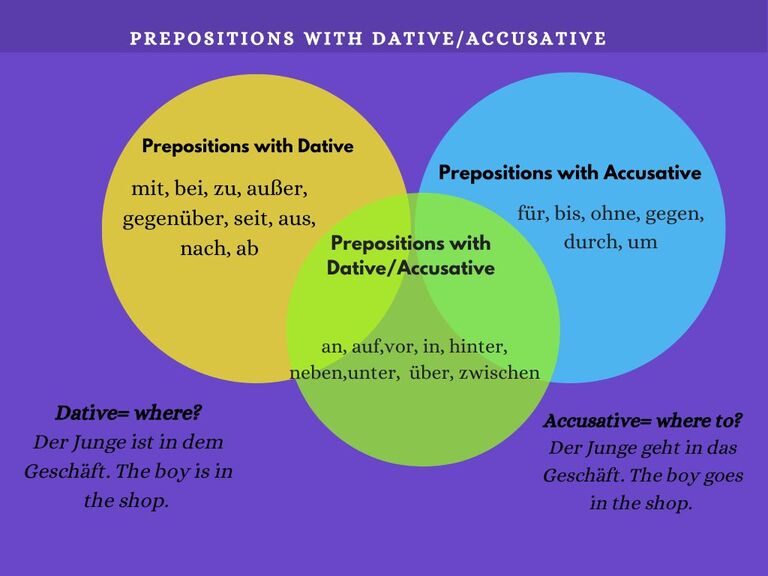
Sometimes, a preposition in the sentence will dictate the case of the noun that follows it. This rule takes precedence over the verb's tendency. These prepositions fall into three groups.
This Venn diagram gives you a great mental map of these three categories.
Prepositions that ALWAYS take the Accusative
Memorize this short list: für, durch, gegen, ohne, um
- Diese API ist für das Frontend-Team. (This API is for the frontend team.)
- Wir sind gegen diesen Vorschlag. (We are against this proposal.)
- Man kann ohne einen Docker-Container nicht arbeiten. (One cannot work without a Docker container.)
Prepositions that ALWAYS take the Dative
This is a slightly longer, but very important list: aus, bei, mit, nach, von, zu
- Ich spreche mit dem Scrum Master. (I am speaking with the Scrum Master.)
- Wir fangen nach dem Daily an. (We will start after the daily stand-up.)
- Ich fahre zu einem Kunden in Berlin. (I am driving to a client in Berlin.)
The resource page from Lingoda provides an excellent, comprehensive list of verbs paired with their required prepositions. You don't need to read it now, but bookmark it for future reference. It's an invaluable tool for a professional context. For example, you'll see common combinations like arbeiten an + Dativ (to work on something) and sich beschäftigen mit + Dativ (to be busy with something).
Part 3: Two-Way Prepositions (Wechselpräpositionen)
The most interesting group are the "two-way" prepositions. These can take either the accusative or the dative case. The choice depends on the context, following a clear, logical rule that should appeal to your engineering mindset.
The Rule:
It's a conditional check based on location vs. direction.
- If the preposition answers the question Wo? (Where? - indicating a static location), use the Dative case.
- If the preposition answers the question Wohin? (Where to? - indicating movement or a change of location), use the Accusative case.
The main two-way prepositions are: in, an, auf, über, unter, vor, hinter, neben, zwischen.
This video provides an excellent, memorable demonstration of this principle.
🇩🇪Lerne alles über WECHSELPRÄPOSITIONEN in 15 Minuten (Dativ oder Akkusativ?)
The channel 'Dein Sprachcoach' uses a simple frog-and-box example to clearly illustrate the Wo? (Dative) vs. Wohin? (Accusative) rule for two-way prepositions.
Watch from 01:30 to 09:18. Pay close attention to: The nine prepositions that are 'two-way'. The examples for 'Wo?' (where?), which describe a static position and take the Dative. The examples for 'Wohin?' (where to?), which describe movement to a destination and take the Accusative.
Let's apply this logic to your work environment:
-
Location (Wo? -> Dativ):
- Die Daten sind in der Datenbank. (The data is in the database.)
- Der Code läuft auf dem Server. (The code is running on the server.)
- Das Ticket steht im Backlog. (The ticket is in the backlog.)
-
Direction (Wohin? -> Akkusativ):
- Ich lade die Daten in die Datenbank. (I am loading the data into the database.)
- Wir deployen den Code auf den Server. (We are deploying the code onto the server.)
- Ich verschiebe das Ticket ins Backlog. (I am moving the ticket into the backlog.)
ins=in das
Test your understanding!
Complete the sentences with the correct article (der/den/dem).
- Der Entwickler legt den Laptop auf ___ Tisch. (The developer puts the laptop onto the table.)
- Der Laptop liegt auf ___ Tisch. (The laptop is lying on the table.)
Show answer
- Der Entwickler legt den Laptop auf den Tisch. (
Wohin?-> Accusative) - Der Laptop liegt auf dem Tisch. (
Wo?-> Dative)
For a detailed text-based summary with more examples, the article "German Two-Way Prepositions" by German with Laura (LINK) is a great resource to review later.
Conclusion
You've just navigated one of the core systems of German grammar. Getting cases right is a significant step toward sounding fluent and professional.
Key Takeaways:
- Cases define a noun's role: Nominative (subject), Accusative (direct object), Dative (indirect object).
- Verbs have requirements: Most take the accusative. A smaller, specific set takes the dative (e.g.,
helfen,antworten). Some take both (person = dative, thing = accusative). - Prepositions have rules: Some prepositions are fixed and always demand either the accusative (e.g.,
für,ohne) or the dative (e.g.,mit,zu). - Two-way prepositions are conditional: They take the Dative for static location (Wo?) and the Accusative for direction/movement to a destination (Wohin?).
In our next lesson, we will build directly on this foundation by learning how to use personal pronouns and possessive articles. These words also change according to their case, and mastering them will allow you to talk about your team, your work, and your projects with grammatical precision (e.g., "I give him my report" - Ich gebe ihm meinen Bericht).