Introduction
In our last lesson, you learned how to use a validated regression model to identify the vital few process drivers from observational data and predict outcomes. That's a powerful skill for understanding your process as it currently operates.
However, what if you want to explore the effect of new settings or test multiple factors simultaneously in a structured way? This is where we move from passive analysis to active experimentation. This lesson introduces you to Design of Experiments (DOE), a foundational tool for any Green or Black Belt.
Our learning outcome for today is to explain the principles of Design of Experiments (DOE), including factors, levels, responses, and randomization. We will cover the essential vocabulary and concepts that form the basis for designing, running, and analyzing powerful industrial experiments. This is the first step in moving beyond analyzing existing data to proactively and efficiently finding optimal process conditions.
1. What is DOE and Why Is It So Powerful?
At its core, DOE is about understanding the cause-and-effect relationships in your process. Given your background in industrial engineering, you are very familiar with the input-process-output model. DOE provides a formal, statistical framework for this model.
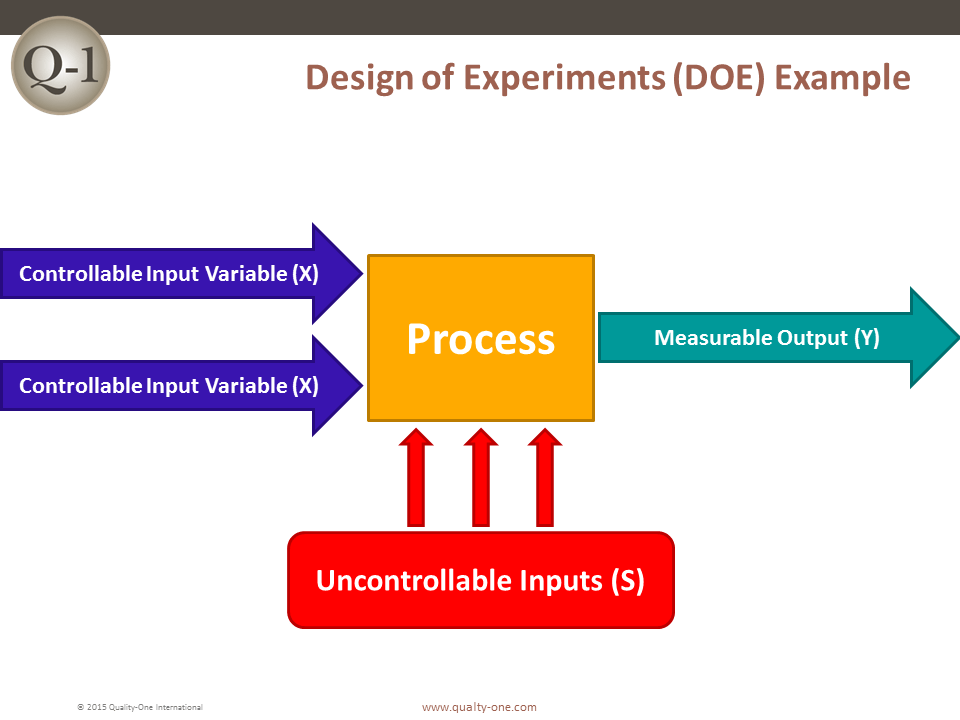
You might think, "I already experiment by changing one thing and seeing what happens." This common approach, known as One-Factor-At-a-Time (OFAT), is intuitive but has two major drawbacks:
- It is inefficient. It requires many experimental runs to test several factors.
- It can lead you to the wrong conclusion. It completely misses interactions between factors—cases where the effect of one factor depends on the level of another.
DOE, on the other hand, is designed to test multiple factors simultaneously, making it far more efficient and capable of detecting critical interactions.
To see why OFAT can be misleading, let's look at a practical comparison.
Optimizing Processes with Design of Experiments
This document from JMP, a leading statistical software provider, has an excellent section that visually demonstrates the pitfalls of the traditional One-Factor-At-a-Time (OFAT) approach compared to DOE.
Please read the section titled 'The traditional experimental approach' (starts on page 5). Pay close attention to how the OFAT method explores the experimental space and contrast it with the DOE approach shown at the end of the section. Notice how OFAT misses the true optimal setting because of the interaction between time and temperature.
As you saw, the OFAT method led to a suboptimal result. The DOE approach not only required fewer runs but also revealed the true path to the best yield by uncovering the interaction between the factors. This efficiency and insight are why DOE is a cornerstone of the Six Sigma Improve phase.
2. The Language of DOE: Factors, Levels, and Responses
To use DOE effectively, we need to speak the language. Let's formally define the key terms you'll encounter. The following video uses a simple and relatable bakery example to explain these core concepts.
Design of Experiments (DOE) – The Basics!!
This video from Green Belt Academy provides clear, practical definitions for the fundamental components of a designed experiment. It connects these concepts directly to the input-process-output model.
Please watch the following two segments: Outputs and Inputs (04:54 - 08:18): This part defines response variables (the outputs or 'Y's) and factors (the inputs or 'X's) within the context of a process. Levels and Treatments (13:07 - 16:12): This segment explains what levels are (the specific settings of a factor) and how they combine to form unique experimental runs called treatments.
Let's quickly summarize those key terms in a manufacturing context:
- Response (Y): The output or result of the process you want to measure and improve. This is your project's CTQ.
- Examples: Seal strength, surface finish, defect count, cycle time.
- Factors (X's): The controllable input variables you believe might influence the response.
- Examples: Temperature, line speed, raw material supplier, pressure.
- Levels: The specific values or settings you choose for each factor in your experiment.
- Examples: Temperature set at 350°C (low level) and 400°C (high level); Supplier A and Supplier B.
- Treatment: A specific combination of factor levels for a single experimental run.
3. Principles of a Good Experiment: Managing Error
In a perfect world, if you repeated the exact same treatment, you would get the exact same response every time. In reality, this never happens due to experimental error or noise—the inherent, unexplained variation in a process.
A well-designed experiment doesn't eliminate this error, but it manages it so you can confidently determine the true effects of your factors. This is achieved through three key principles: randomization, blocking, and replication.
Let's explore what error is and how randomization and blocking help us deal with it.
Design of Experiments (DOE) – The Basics!!
The same video from Green Belt Academy continues with an excellent discussion on the two types of experimental error and the strategies used to combat them. This is one of the most important concepts in DOE.
Please watch the segment from 16:12 to 26:50. Focus on: The difference between systematic error (special cause, must be eliminated) and random error (common cause, must be managed). The core principle: "Block what you can, randomize what you can't." How blocking is used to isolate known sources of variation (like different operators or batches of material). How randomization of the run order protects the experiment from unknown or uncontrollable 'lurking' variables (like tool wear or environmental shifts).
The third key principle is replication.
- Replication: Repeating an entire set of experimental runs (or specific treatments) multiple times. This is different from taking multiple measurements on one sample.
Replication serves two main purposes:
- It allows you to get a more precise estimate of the experimental error.
- It increases the statistical power of the experiment, making you more likely to detect a significant factor effect if one truly exists.
This next short clip explains the importance of replication.
Design of Experiments (DOE) – The Basics!!
Let's conclude the video by understanding the role of replication.
Watch the segment from 26:50 to 29:13, which explains how replication improves the statistical power of your experiment and allows you to estimate more complex effects, which we'll discuss in later lessons.
4. Putting It All Together: The DOE Process
These principles—testing factors together, randomization, blocking, and replication—are not just abstract ideas. They are embedded in a formal, structured process for conducting experiments. As an IE, you'll appreciate this systematic approach.
Statistical Process Control, Part 6: Design of Experiments
This guide from Oregon State University provides a concise, step-by-step overview of the DOE process, which is very useful for planning your own experiments.
Please read the section 'DOE: Step-by-step' on page 4. This outlines the 7 key steps from defining objectives to planning for post-experiment actions. You will see how the concepts we've discussed (response variables, factors, replicates) fit into this framework.
By following these structured steps and embedding the principles of randomization, blocking, and replication, you ensure that the data you collect is trustworthy and that your conclusions about which factors drive your process are statistically valid.
Conclusion
In this lesson, we established the foundational principles of Design of Experiments. You've moved beyond the limitations of analyzing historical data or using inefficient OFAT methods and now understand the language and logic of structured experimentation.
Key Takeaways:
- DOE is a powerful method for systematically testing multiple factors at once to efficiently find cause-and-effect relationships, including interactions that OFAT would miss.
- The core terminology includes Responses (outputs, Y), Factors (inputs, X), and Levels (settings for the factors).
- A robust experiment must manage experimental error using three key principles:
- Randomization: Protects against unknown sources of variation.
- Blocking: Isolates known, unavoidable sources of variation.
- Replication: Improves the precision and power of the experiment.
- These principles are applied within a structured, step-by-step process to ensure valid and reliable results.
Preview of the Next Lesson:
Now that you understand the "what" and "why" of DOE, we'll start looking at the "how." In our next lesson, we will focus on screening experiments. These are highly efficient types of DOE used at the beginning of an investigation to quickly filter a long list of potential factors and identify the "vital few" that warrant more detailed study.