Introduction
In our last lesson, we explored how to design both full and fractional factorial experiments to characterize the "vital few" factors influencing your manufacturing processes. We introduced the critical concepts of aliasing (or confounding) and design resolution as the necessary trade-offs for the efficiency gained by using fractional designs.
This lesson takes a much deeper dive into that trade-off. Simply choosing a fractional design isn't enough; a key skill for any Green or Black Belt is to critically evaluate that design before committing time and resources to running the experiment. Today's learning outcome is to evaluate the aliasing structure and resolution of a fractional factorial design to understand its limitations. We will learn how to read the "fine print" of a design to understand exactly which effects are tangled together, assess the risks this poses, and make informed decisions about how to proceed.
1. Understanding Design Resolution
In the previous lesson, we defined resolution as a Roman numeral (III, IV, V) that gives a quick summary of the "cleanliness" of a design. Now, let's formalize that understanding. A design's resolution tells us about the shortest "word" in its defining relationship. For example, if a design's defining relationship is I = ABC, the shortest word is ABC (length 3), so it is a Resolution III design. If I = ABCD, it's a Resolution IV design.
This isn't just a theoretical curiosity; the resolution number directly tells you the confounding pattern you can expect.
Fractional Factorial Design (DoE) Simply explained
The numiqo channel provides a very clear and concise explanation of what the different resolution levels mean in practice. This will help solidify the concepts we touched on in the last lesson.
Watch the following two clips: What is the Resolution? (02:11 - 02:41): This clip defines resolution as a measure of how well a design can distinguish between effects. Resolutions 3, 4, and 5 (07:24 - 08:51): This is the most important part. Pay close attention to the description of what is confounded at each resolution level. This directly explains the practical limitations of each design type.
To summarize the key points from the video:
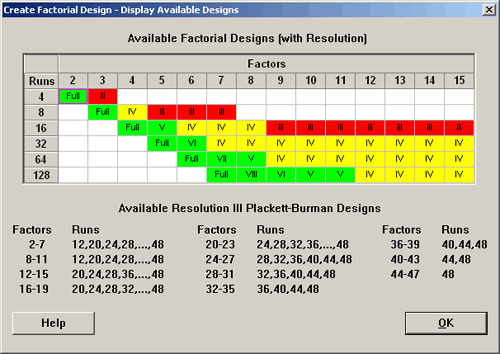
- Resolution III: Main effects are confounded with two-factor interactions (e.g., A = BD). These are risky for characterization experiments because you can't tell if a significant effect is from the factor itself or an interaction. They are best used for screening.
- Resolution IV: Main effects are NOT confounded with two-factor interactions (they are confounded with three-factor interactions, which are usually negligible). However, two-factor interactions are confounded with other two-factor interactions (e.g., AB = CD). These are excellent, efficient designs for characterizing main effects.
- Resolution V: Main effects are clean, and two-factor interactions are also clean (confounded only with three-factor interactions). These are the "gold standard" for fractional designs but require more runs.
2. Decoding the Alias Structure
Resolution gives us a general warning level, but to truly evaluate a design, we need to look at the specific alias structure. This is the full list of which effects are confounded with which.
So, how is this list generated? The defining relationship is the key. By multiplying any effect (like a main effect 'A' or an interaction 'AB') by the words in the defining relationship, you can reveal its aliases.
Experiments 4G - Fractional factorials: using aliasing notation to plan experiments
This video from K Dunn provides a clear, practical demonstration of how to find the aliases for any effect and what the strategic implications are.
Please watch the following segments: Finding Aliases (00:00 - 03:43): Observe the method of multiplying a factor (like 'B') by the defining relationship to find its aliases. Critically, listen to the discussion on how you might use this information to assign factors strategically. For example, assigning a less critical factor to a column with more confounding. Resolution and the Shortest Word (03:43 - 06:40): This section reinforces the link between the length of the shortest word in the defining relationship and the design's resolution. It also shows an example of a Resolution IV design where main effects are clean, but 2FIs are aliased with other 2FIs. Use Cases for Resolutions III, IV, and V (06:40 - 08:03): This provides excellent context for when to use each type of design based on your experimental goals: screening, characterization, or detailed modeling.
The key takeaway is that evaluating the alias structure is not just a mechanical exercise. It's a strategic step where you, the engineer, combine statistical information with your process knowledge. If the alias report shows that the interaction between Mold Temperature and Injection Pressure (AB) is aliased with the interaction between Material Type and Cooling Time (CD), you must ask yourself: "Based on my experience, are both of these interactions likely to be significant? If so, this design won't work because I won't be able to tell them apart."
3. A Practical Example: Evaluating a Saturated Design
Let's walk through a case study to see how these concepts are applied. This is where you move from theory to the practical skills needed for a Six Sigma project. We'll use a tutorial from Stat-Ease that investigates how to improve a bicycle's speed.
The experimenter, Lance, wants to study 7 factors but only has time for 8 runs. This creates a 2^(7-4) design, which is a Resolution III design. Let's see what limitations this imposes.
Fractional Factorial with Foldover - Stat-Ease
This Stat-Ease tutorial provides a step-by-step case study that perfectly illustrates the process of evaluating a design's limitations. We will first look at the initial, highly-fractionated design.
Please read the section 'Saturated Design Example'. Focus on these points: The Setup: An 8-run, 7-factor experiment is created. Note the software 'red-flags' this as a low-resolution design. The Alias Report: The tutorial shows how to access the alias list. Critically, it states: 'The output indicates that each main effect will be confounded with three two-factor interactions.' The Problem: When the analysis is run, it shows that factors B, E, and G are significant. But the tutorial points out a major fallacy: because this is a Resolution III design, we can't be sure if it's the main effects (B, E, G) or their aliased two-factor interactions that are actually causing the change.
This example is the essence of today's learning outcome. Lance's initial analysis is dangerously misleading. He identified significant effects, but because he didn't properly evaluate the alias structure beforehand, his conclusions are built on a shaky foundation. An aliased main effect might lead you to optimize the wrong factor, wasting time and resources.
4. Overcoming Limitations: The Foldover Strategy
So, what do you do when your evaluation reveals unacceptable aliasing? You have a few options:
- Choose a Higher-Resolution Design: The simplest solution is to increase the number of runs to get a Resolution IV or V design. In Lance's case, this would mean moving from 8 runs to 16 or 32.
- Reassign Factors: As mentioned in the K Dunn video, you can strategically place factors you're less interested in, or those less likely to interact, into the more heavily aliased columns of the design.
- Plan a Follow-up Experiment: If you've already run a low-resolution design, you can add a new block of runs to de-alias the effects. This is a powerful sequential approach called folding.
Let's see how Lance uses a "complete foldover" to fix the confounding in his experiment.
Fractional Factorial with Foldover - Stat-Ease
Now let's look at the solution in the same Stat-Ease tutorial. By adding a 'foldover' block of runs, we can systematically break the alias chains.
Please read the sections 'Complete Foldover Design' and 'Investigation of Aliased Interactions'. The Foldover Process: A foldover involves adding a new set of 8 runs where all the factor signs (+/-) are reversed from the original 8 runs. The Improved Alias Structure: Notice the key result: 'Complete foldover of a resolution III design results in a resolution IV design.' The main effects are now free and clear of two-factor interactions! New Ambiguity: While main effects are clear, the 2FIs are now aliased with each other (the signature of a Res IV design). The tutorial shows how the experimenter uses process knowledge to decide which aliased interaction (BE vs. AF) is the most plausible. This is a great example of combining statistics with engineering judgment.
By adding 8 more intelligently chosen runs, Lance upgraded his experiment from a risky Resolution III to a much more useful Resolution IV. He successfully separated the main effects from the two-factor interactions, allowing him to draw much more reliable conclusions.
Conclusion
Today, we've moved beyond simply creating a design to critically evaluating its fitness for purpose. You now understand that the efficiency of fractional factorial designs requires a careful and conscious acceptance of specific trade-offs.
Key Takeaways:
- Design Resolution is a grade that tells you the level of confounding in a design. Resolution IV is often the "sweet spot" for characterization, balancing run-size and clarity.
- Evaluating the alias structure is a non-negotiable step before running an experiment. You must know which effects are confounded to assess the risk to your conclusions.
- Your process knowledge is essential for judging whether an aliased relationship is problematic.
- If a design's limitations are unacceptable, you have clear strategies to mitigate them, such as choosing a higher-resolution design or planning a foldover to de-alias effects.
Preview of the Next Lesson:
We have now designed our experiment and rigorously evaluated its structure to be confident in its ability to answer our questions. The next step is to run the experiments, gather the data, and analyze the results. In our next lesson, we will focus on how to "Analyze factorial experiment results using ANOVA to determine factor significance." This is where we will finally use statistical analysis to declare which factors and interactions have a real, measurable impact on our process output.