Welcome back. In our last lesson, we delved into the internal structure of Chinese characters, breaking them down into their semantic and phonetic components. You learned that the majority of characters are not arbitrary pictures but logical compounds that provide clues to both meaning and sound.
Today, we are going to zoom out from the individual character to the next level of the system: the word. This lesson connects the microscopic world of strokes and radicals to the macroscopic structure of the language you will actually use to communicate. We will explore the fundamental relationship between a character, its sound (syllable), and its role in forming words. Crucially, we will answer a key question: why are most words in modern Mandarin two characters long? Understanding this principle is the final piece of the structural puzzle before we begin building your vocabulary in earnest.
Part 1: The Atomic Unit - Character, Syllable, Morpheme
The entire Chinese writing system is built on a simple but powerful correspondence. In almost all cases:
One Character = One Syllable of Sound
This is the central axiom. Every time you see a single character, you can be confident it represents a single, distinct syllable. Let's look at a familiar example.
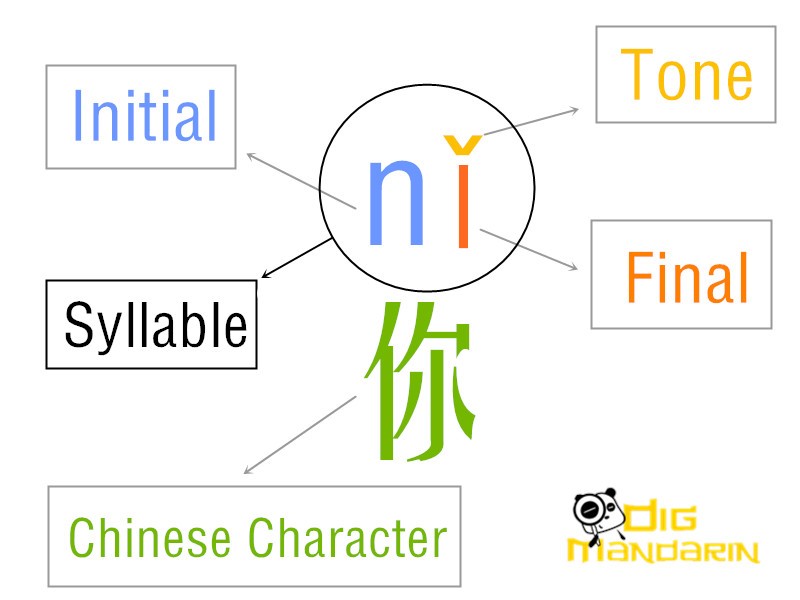
This one-to-one mapping between the visual symbol (character) and the auditory unit (syllable) is the bedrock of the system.
Furthermore, each character isn't just a sound; it's almost always a morpheme—the smallest unit of a language that carries meaning. This is analogous to morphemes in English like "un-", "-ly", or "cat". To solidify these core definitions, let's watch a quick explanation.
Chinese Word Logic Explained in 10 Minutes
This video from Grace Mandarin Chinese provides a crystal-clear breakdown of the relationship between syllables, characters, and morphemes.
Please watch from the beginning of the explanation up to the discussion of classical Chinese. The key concepts to absorb are: The one-to-one correspondence of syllable to character. The definition of a character as a morpheme, or a unit of meaning.
So, we have a system where individual characters like 人 (rén, person), 木 (mù, tree), and 好 (hǎo, good) each represent a single syllable and a single core meaning. This raises a logical question: if one character is already a meaningful unit, why doesn't the language just consist of single-character words?
Part 2: The Polysyllabic Shift - Why Two is Better Than One
In Classical Chinese, the language used in ancient texts, most words were indeed just one character. However, modern Mandarin has an overwhelming preference for two-character (disyllabic) words. This isn't an accident; it was a necessary evolution to solve a major system-level problem: ambiguity from homophones.
Over thousands of years, the phonology of Chinese simplified, meaning many words that once sounded different began to sound the same. This created a situation where a single syllable, like shí, could refer to dozens of different things.
Why Chinese Needs Two Syllable Words
This segment of another Grace Mandarin Chinese video explains the historical context perfectly. It's the "why" behind modern Chinese word structure.
Please watch the section from "To understand why...". Pay close attention to the explanation of how the language evolved. Old Chinese: was primarily monosyllabic. The Problem: Sound changes led to a massive increase in homophones (同音字). The Solution: Two-syllable words were created to reduce ambiguity. The example of shí is a powerful illustration of the problem.
This shift was a natural optimization. While the single character 石 (shí) is ambiguous, the two-syllable word 时间 (shíjiān, time) is clear and distinct. The result is that today, while single-character words still exist (especially for very common concepts like 我 wǒ, 吃 chī), the vast majority—around 80%—of words in the modern language are composed of two or more characters.
Part 3: The Logic of Word Formation
Now that we know why most words are two characters long, we can examine how they are constructed. Since you're accustomed to analyzing systems, you can think of this as a combinatorial process where meaningful units (characters/morphemes) are combined to create new, more specific meanings.
The building blocks of Chinese, part 1: Chinese characters and words in a nutshell | Hacking Chinese
This article from Hacking Chinese provides a concise introduction to this concept.
Please read the section that starts with the paragraph "To learn to read or write...". It introduces the idea of multi-character words with clear examples like 中国 (zhōngguó).
The article gives the example of 中国 (zhōngguó) - China, which combines:
- 中 (zhōng) - middle
- 国 (guó) - kingdom/country
This is a very common pattern, where two characters, each with its own meaning, are put together to form a new, logical compound. Here are a few more examples you'll encounter frequently:
- 飞机 (fēijī): 飞 (fēi) to fly + 机 (jī) machine = airplane
- 火车 (huǒchē): 火 (huǒ) fire + 车 (chē) vehicle = train (from the age of steam engines)
- 你好 (nǐhǎo): 你 (nǐ) you + 好 (hǎo) good = hello
By knowing the meaning of the individual characters, you can often deduce or, at the very least, more easily remember the meaning of the compound word. This turns vocabulary acquisition from rote memorization of thousands of arbitrary sounds into a more logical process of recombination.
Part 4: A Note on "Wordhood"
Finally, it's worth noting that the concept of a "word" in Chinese is more fluid than in English. In written English, we have spaces that clearly demarcate words. Chinese has no spaces. As you have a background in computing, you can appreciate the tokenization problem this presents.
The building blocks of Chinese: Making sense of compound words | Hacking Chinese
This follow-up Hacking Chinese article delves into this interesting ambiguity. You don't need to master all the details, but absorb the main ideas.
Read through the article, focusing on these key points: The introductory section reinforces that meaning is conveyed through words. The section "What is a word in Chinese anyway?" highlights the lack of spacing and the historical focus on characters over words. The discussion of separable words (离合词) like 吃饭 (chīfàn) is particularly illuminating. This shows how some "words" behave like phrases, where you can insert other elements between the characters (e.g., 吃了饭 chī le fàn - ate the meal). The final conclusion summarizes the main point: understanding the character components is essential for understanding and using words correctly.
This fluidity doesn't need to be a source of confusion. Rather, it reinforces the core principle of this lesson: the character is the fundamental building block. If you understand the characters, you have the keys to unlock the words they form, even when the boundaries are a bit fuzzy.
Conclusion
Today we've completed our journey from the lowest level of the writing system to its functional output. You now have a complete mental model of how Chinese is constructed, from strokes to words.
Key Takeaways:
- One Character, One Syllable: The fundamental rule is that a single Chinese character corresponds to a single syllable of sound and usually represents one morpheme (a unit of meaning).
- The Polysyllabic Solution: Modern Chinese is dominated by two-character words. This was an evolutionary fix to resolve the massive ambiguity created by homophones in the older, monosyllabic form of the language.
- Combinatorial Logic: Many two-character words are logical combinations of their constituent characters (e.g.,
fly+machine=airplane). Understanding the parts helps you learn the whole. - Fuzzy Boundaries: The definition of a "word" is more fluid in Chinese than in English. This reinforces the importance of focusing on the character as the primary building block of meaning.
You now possess the complete conceptual framework for the Chinese writing and word-formation system. In our next lesson, we will put this knowledge to practical use by setting up the single most important tool for your HSK 2 goal: a Spaced Repetition System (SRS). This tool is designed to help you efficiently memorize the two-character words that form the core of the HSK vocabulary.