Welcome back. In our previous lesson, we established a foundational piece of the Chinese character puzzle: the radical. You learned to recognize common radicals and to use them as semantic keys, unlocking clues to a character's general meaning. We saw how radicals like 氵 (water) and 扌 (hand) bring a whole category of meaning to any character they inhabit.
Today, we complete the picture by introducing the other essential component. If the radical provides the meaning clue, what provides the sound clue? This lesson addresses that question by introducing the most common type of character construction: the phono-semantic compound. Your goal is to learn how to decompose a character into its two fundamental parts: its semantic (meaning) component and its phonetic (sound) component. Grasping this dual structure is the key to transforming your learning process from rote memorization into a logical system of decoding, a skill that will be invaluable as you build your HSK 2 vocabulary.
The 80% Rule: Introducing Phono-Semantic Compounds
In the last lesson, we focused on radicals as semantic components. However, most characters are not constructed from meaning alone. The vast majority—around 80%—are compounds built from two distinct parts: one suggests the meaning, and the other suggests the pronunciation.
This is a powerful concept because it reveals that the writing system is not completely divorced from the spoken language. There is a deep, systematic connection between the shape of a character and its sound.
Phonetic components, part 1: The key to 80% of all Chinese characters | Hacking Chinese
This article from Hacking Chinese provides an excellent introduction to the principle of phono-semantic compounds.
Please read the first two sections of the article. Start from the top and read down to just before the heading "The power of phonetic components". Focus on understanding the core argument: that most characters belong to this category, and how they are formed. Pay close attention to the example of 洋 (yáng - ocean), which breaks down into the water radical (semantic) and the sheep character (phonetic).
The Canonical Example: 妈 (mā) - Mother
Let's solidify this concept with one of the most common and clear examples, the character for "mom," 妈 (mā). This character is a perfect illustration of the phono-semantic principle in action.
What is a pictophonetic character? | Chinese_Character_Course Level 1_Lesson 14
This short clip from "Learn Chinese with Litao" breaks down the character 妈 (mā) perfectly.
Please watch from the beginning until the end of the video. The presenter will show you: How the character for "woman," 女 (nǚ), is used as a meaning component. How the character for "horse," 马 (mǎ), is used as a sound component, lending its pronunciation ma. This structure is formally defined as a pictophonetic character.
As the video showed, 妈 (mā) is composed of:
- 女 (nǚ): The semantic component (radical), indicating the character is related to a female.
- 马 (mǎ): The phonetic component, indicating the character's pronunciation is
ma.
The meaning of "horse" is irrelevant here; 马 is included solely for its sound. To reinforce these precise terms, let's turn to a quick definition.
Chinese Radicals: The Beginner’s Guide < Skritter Blog
This section from the Skritter blog gives a concise definition of the two component types.
Please read the section titled "Meaning and Sound". The key takeaway is the formal definition of a phonetic component (carries sound information) and a semantic component (carries meaning information). Notice how it uses the same example of 妈 and 马.
From a Single Component to a Family of Characters
The true power of this system becomes apparent when you see how a single phonetic component can generate an entire family of related-sounding characters. The character 青 (qīng), meaning green or blue, is a classic phonetic component. Watch what happens when we combine it with different semantic radicals.

This pattern is extremely common. The video below will walk you through the 青 family and several others, illustrating the concept with great clarity. A key idea introduced here is "phonetic drift". Over thousands of years of language evolution, the pronunciation of a compound character might "drift" slightly from its original phonetic component. The tone might change, or the initial consonant might shift. This is analogous to a predictive feature in a machine learning model: it provides a strong probabilistic clue, even if it's not 100% deterministic.
How 80% Chinese Characters were Created! 🀄️🔥形声字
This "SoEasy Chinese" video is a superb visual explanation of how phonetic components work.
Please watch from this point to the end of the video. The section from the 青 family is crucial. Notice how the radical changes the meaning (water=clear, sun=sunny, heart=feeling) while the pronunciation stays close to qing. The video then presents many more examples with different phonetic bases like 中 (zhōng) and 包 (bāo). You don't need to memorize these characters now; just focus on observing the pattern of decomposition into a semantic part (the radical) and a phonetic part (the base character).
How to Tell the Components Apart
So, when you encounter a new character, how do you distinguish the semantic component from the phonetic one? Here is a practical heuristic:
- Identify the Radical: Look for one of the common radicals you learned in the previous lesson. They often appear in predictable positions (left, top, bottom). This is almost always the semantic component.
- Isolate the Remainder: The rest of the character is likely the phonetic component.
- Test the Hypothesis: Look up the pronunciation of the phonetic component as a standalone character. Is it similar to the pronunciation of the full character you're analyzing?
Let's test this with an example.
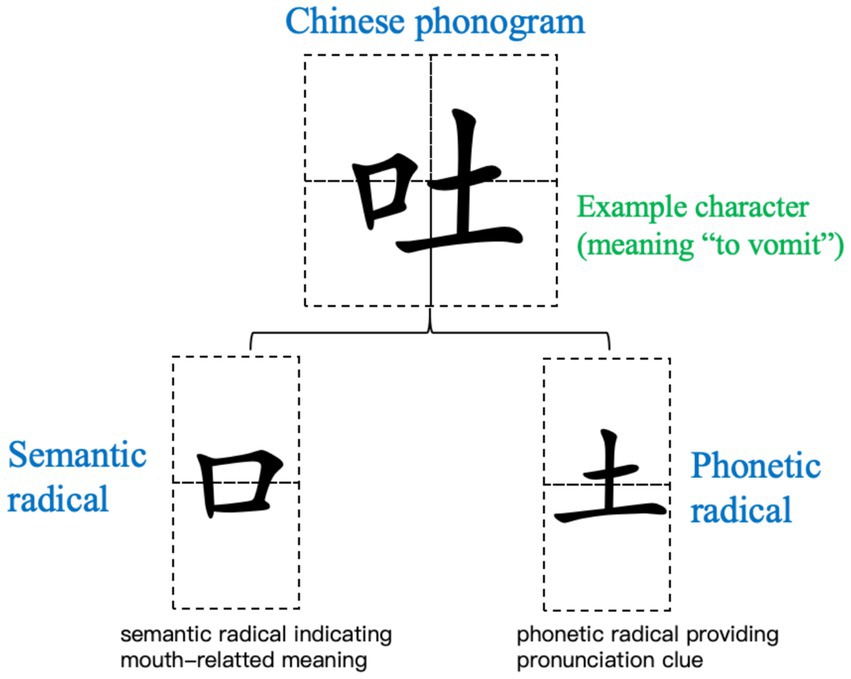
Let's apply our heuristic to 吐 (tù) - "to vomit":
- Identify the Radical: On the left, we see 口 (kǒu), the mouth radical. This makes perfect semantic sense for an action like vomiting. This is our semantic component.
- Isolate the Remainder: The remaining part is 土 (tǔ), meaning "earth."
- Test the Hypothesis: The pronunciation of 土 is
tǔ. The pronunciation of 吐 istù. The sounds are very close (differing only in tone), confirming that 土 is acting as the phonetic component.
Conclusion
In this lesson, you have learned the fundamental principle that governs the structure of the vast majority of Chinese characters. By understanding their dual nature as phono-semantic compounds, you can now approach character learning not as an exercise in brute-force memorization, but as a systematic process of decoding.
Key Takeaways:
- Approximately 80% of Chinese characters are phono-semantic compounds.
- These characters are composed of a semantic component (usually a radical) that hints at the meaning, and a phonetic component that hints at the sound.
- A single phonetic component can be used to form a "family" of characters with similar pronunciations (e.g., 清, 晴, 情 all derive their sound from 青).
- The phonetic clue is not always perfect due to "phonetic drift", but it provides a powerful starting point for guessing pronunciation.
- You can typically identify the components by first finding the radical (semantic part) and then treating the remainder as the phonetic part.
You have now completed the core introduction to the Chinese writing system. You've gone from strokes to radicals (semantic components) and now to phonetic components. In our next lesson, we will zoom out one final level to see how these individual, single-syllable characters are combined to form the two-character words that are the backbone of modern spoken and written Chinese.