Welcome to the first lesson of Module 2. Having established a strong foundation in the sounds and phonetic transcription of Mandarin with Pinyin, we now pivot to the visual heart of the language: the Chinese writing system. For the next several lessons, we will be focusing on how to read, understand, and, most importantly for your paper-based exam, write Chinese characters.
Today, we'll start with a foundational question every beginner must answer. You may have heard that there isn't just one way to write Chinese. This lesson will explain the two primary writing systems, Simplified and Traditional characters, so you can understand their differences and, crucially, know which system is required for your goal of passing the HSK exam.
1. Two Scripts, One Language
Unlike English, which has a single standard alphabet, modern written Chinese exists in two standard forms: Traditional Chinese (繁體字 / fántǐzì) and Simplified Chinese (简体字 / jiǎntǐzì).
- Traditional characters are the forms that have evolved over thousands of years. They are generally more complex, with more strokes, and are seen as preserving more of the characters' historical and etymological origins.
- Simplified characters are the result of a large-scale script reform undertaken by the government of mainland China in the 1950s and 1960s. The primary goal was to make characters easier to learn and write in order to boost national literacy rates.
It's essential to understand that these are two different scripts for the same language. The underlying grammar, vocabulary, and pronunciation (which you've learned to write as Pinyin) are identical. The difference is purely in the visual representation of certain characters.
Let's look at a classic example: the character for "horse," pronounced mǎ.
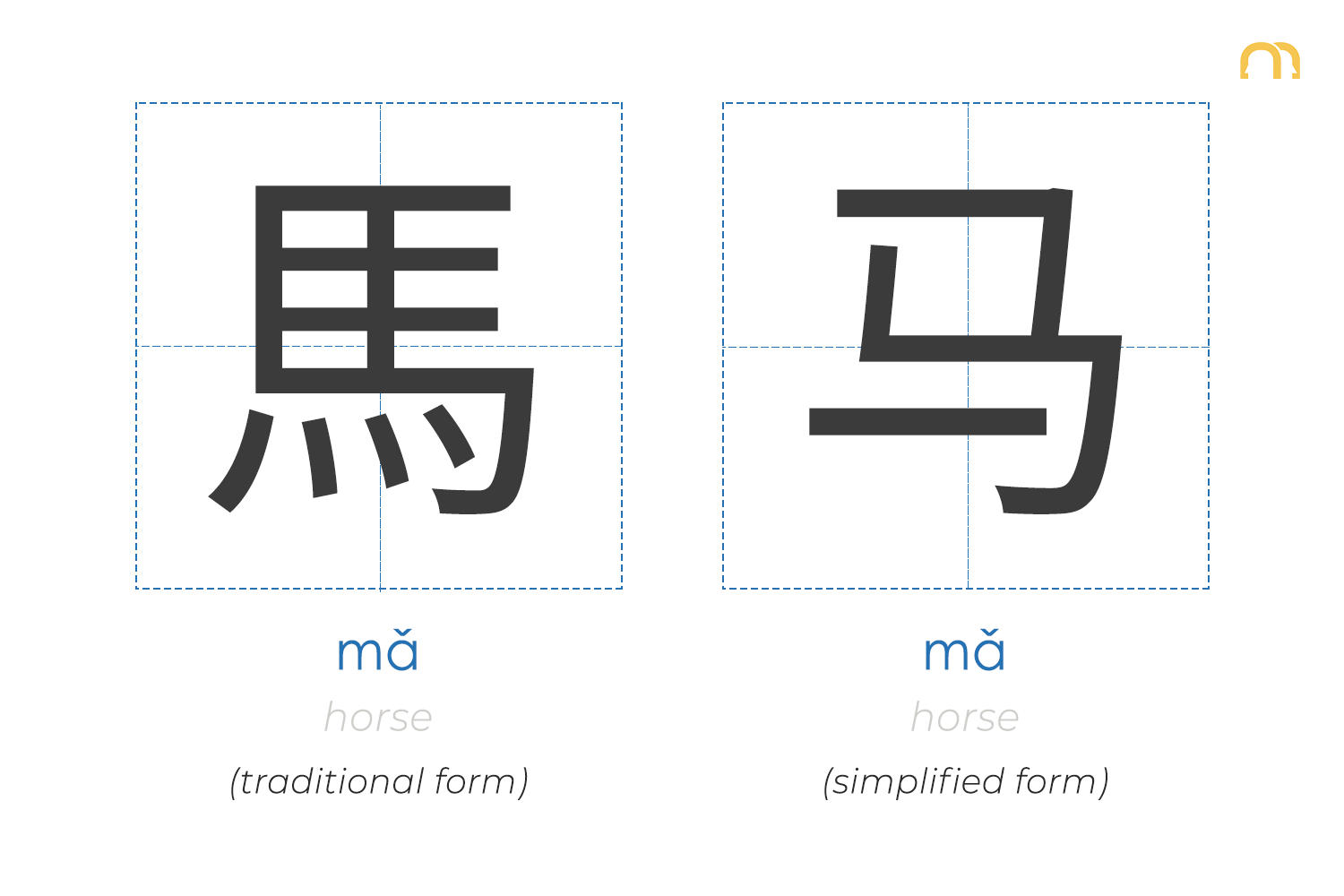
The traditional form, 馬, is a detailed pictograph that clearly shows the horse's head, mane, legs, and tail. The simplified form, 马, reduces this to just three strokes, capturing the essence in a more abstract way. This is a perfect illustration of the simplification process.
2. How Different Are They Really?
The simplification effort was not a complete overhaul. In fact, a significant portion of characters were unchanged because they were already simple enough. This leads to what is sometimes called the "70/30 rule". The following article from HSKLord provides an excellent, data-driven overview of the key differences and practical implications.
Simplified vs Traditional Chinese: Which Should You Learn? | HSKLord
This article breaks down the differences between the two systems, where they are used, and which one makes sense for different learning goals.
Please read the following sections from the article: Start with the section "What's the Difference?". This part defines the two scripts. Continue reading to understand the crucial "70/30 rule" discussed in the paragraph beginning "However, it's crucial to understand...". Next, carefully examine the comparison table showing ten common characters. This gives you a concrete feel for the range of simplification, from minor tweaks to radical changes. Finally, read the section "How Different Are They Really?". Pay attention to the idea of predictable, systematic patterns in simplification.
As you read, note these key points:
- Only about 30% of commonly used characters actually have a different simplified form. The other 70% are identical.
- The simplification wasn't random. It often followed systematic rules, such as replacing a complex recurring component (a "radical") with a simpler one across many characters. Your background in mathematics and computing might lead you to see this as a form of algorithmic compression, applying a set of rules to reduce the "data size" (stroke count) of the script.
Here are a few more examples to illustrate the spectrum of differences:

Notice how 'love' (愛/爱) involves removing the 'heart' component (心) from the middle, while 'noodle' (麵/面) is a more drastic change where the complex left side is replaced entirely.
3. Geographical Distribution and Your Goal
The most important practical distinction between the two scripts is where they are used. Your choice of which to learn is determined almost entirely by your geographical or institutional goals.
The following video provides a clear and concise explanation of the geographical divide and reinforces the concepts we've discussed.
Simplified vs Traditional Chinese: Which Should You Learn? | Beginner's Guide Chinese 101
In this video, Maxxie from China gives a beginner-friendly guide to the simplified vs. traditional question.
Please watch the following segments: Introduction and Examples: Watch from the beginning to see more examples of sentences that are identical and sentences that are very different between the two scripts. Geographical Usage: This is the most critical part. Watch the segment from "how widely are either of them used?" which details where each script is the official standard. Recommendation for Beginners: Finally, watch her conclusion from her recommendation for beginners without a specific geographical target.
To summarize and formalize the information from the video and the HSKLord article:
| Region/Institution | Character System Used |
|---|---|
| Mainland China | Simplified |
| Singapore, Malaysia | Simplified |
| Taiwan | Traditional |
| Hong Kong, Macau | Traditional |
| United Nations | Simplified |
| HSK Exam | Simplified |
This table makes the decision for you. Your stated goal is to pass the HSK 2 exam. The Hànyǔ Shuǐpíng Kǎoshì (HSK), being the official proficiency test of mainland China, exclusively uses Simplified characters. All questions, prompts, and reading passages on the exam will be in Simplified Chinese. For the paper-based writing section, you will be required to write Simplified characters from memory.
Conclusion
In this lesson, we have addressed a fundamental aspect of the Chinese writing system.
Key Takeaways:
- Modern written Chinese has two forms: Traditional (older, more complex) and Simplified (developed in the 1950s, fewer strokes).
- They represent the same language; the difference is in the written form of about 30% of characters.
- Simplified Chinese is used in mainland China, Singapore, and by the United Nations. Traditional Chinese is used in Taiwan, Hong Kong, and Macau.
- Most importantly for your goal, the HSK exam system uses Simplified Chinese exclusively.
Therefore, this course will focus entirely on teaching you to read and write Simplified characters. You have a clear, logical path forward.
Now that we've established what we're going to write, our next lesson will begin to explore how to write it. We will learn the fundamental building blocks of all Chinese characters: the eight basic strokes. Mastering these simple strokes is the first step toward being able to write any character, no matter how complex.