Welcome to the final lesson of our first module. In our previous lesson, you learned how to synthesize all the elements of Pinyin—initials, finals, tones, and sandhi rules—to read any given syllable correctly. You essentially learned to encode written Pinyin into accurate sounds.
Today, we will tackle the reverse process: decoding. You will learn to listen to spoken Mandarin and transcribe it into Pinyin, complete with the correct tone marks. This skill is the other side of the phonetic coin. Mastering it will enable you to look up words you hear, take notes from audio materials, and reinforce your own pronunciation by checking it against a written standard. Completing this lesson will make you phonetically self-sufficient, a crucial milestone before we dive into the writing system.
Part 1: The Challenge of Audio Stream Decoding
Approaching this from a systematic viewpoint, listening to a sentence and transcribing it is a problem of decoding a continuous audio signal into discrete, meaningful units. The primary challenges are:
- Segmentation: Identifying the boundaries between syllables in a rapid stream of connected speech.
- Phoneme Identification: Distinguishing between similar-sounding initials (e.g.,
zvs.c,jvs.q) and finals (e.g.,-anvs.-ang). - Tone Recognition: This is often the most difficult aspect. The absolute pitch of a tone varies by speaker and context. You must learn to recognize the contour of the pitch (flat, rising, dipping, falling) relative to the speaker's own vocal range.
- Sandhi Inference: The sound you hear might not be the underlying tone. For example, if you hear a rising (2nd) tone followed by a low (3rd) tone, you have to consider if it might be an instance of two consecutive 3rd tones (
3+3), where the first has changed to a 2nd tone.
Your goal is to develop a mental algorithm that can handle these challenges and convert the audio stream into a structured Pinyin transcription.
Part 2: An Algorithm for Pinyin Transcription
Just as we developed a process for reading Pinyin, we can define one for transcribing it. When you encounter a spoken sentence you need to transcribe, follow these steps:
- Global Listen: Play the entire sentence once at normal speed. Don't try to write anything. Just get a feel for the rhythm, cadence, and number of syllables.
- Segmentation and Phonetic Sketch: Listen again, perhaps using the "slow" function if available. This time, focus on breaking the sentence into individual syllables. For each syllable, jot down the initial and final as best you can. Use a placeholder like
?if you're unsure. At this stage, ignore the tones. For你好 (nǐ hǎo), your sketch might look likeni hao. - Tone Identification: Now, listen specifically for the pitch contour of each syllable. Is it high and flat, rising, dipping, or falling? It's helpful to visualize the tone shapes as you listen.
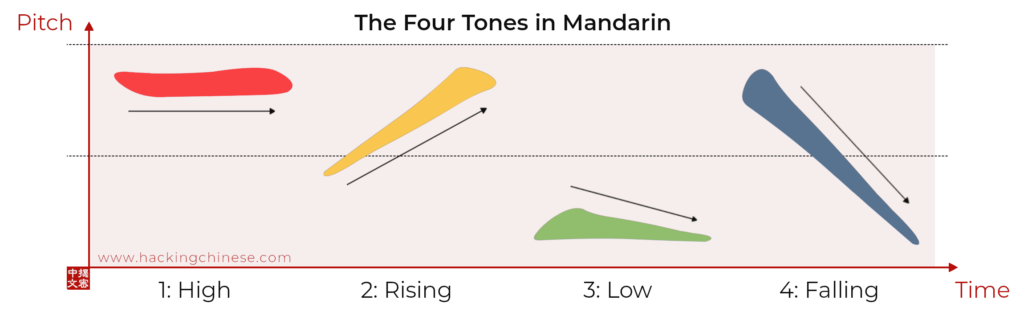
Mark the tone on each syllable in your sketch. Your notes for `nǐ hǎo` might now be `ni(3) hao(3)`.
4. Verification and Refinement: Review your full transcription: ni3 hao3. Now, apply your knowledge of rules.
* Tone Sandhi: You have two 3rd tones in a row. The rule says the first one is pronounced as a 2nd tone. So, ni3 hao3 is pronounced as ni2 hao3, but it is written as nǐ hǎo. This step is crucial for accurate transcription.
* Spelling Conventions: Does your transcription follow spelling rules? For example, if you hear a "yee" sound, did you write yi? If you heard "chü," did you write qu?
* Final Check: Listen one last time, comparing the audio to your final written Pinyin (nǐ hǎo) to confirm it matches.
This systematic process breaks a complex listening task into manageable sub-problems.
Part 3: Focused Drill 1 - Tone Discrimination
The ability to distinguish tones is fundamental. Before transcribing full sentences, let's sharpen your ear for pitch contours in isolation. The following video provides a series of short quizzes to test your tone-listening skills.
Test your Chinese tone listening skills.
This video from Dengdeng's Teaching Diary provides 20 multiple-choice questions to test your tone recognition.
Watch the video from the beginning. For each of the 20 questions, listen to the spoken syllable or short word, and try to identify the correct tone or tone combination before the answer is revealed. Don't worry about getting them all right; the goal is to actively train your ear to notice the pitch contours. Pay close attention to the minimal pairs, where only the tone differs (e.g., mā, má, mǎ, mà).
Part 4: Focused Drill 2 - Syllable and Word Transcription
Now let's add initials and finals to the mix. In this exercise, you will hear a complete syllable or a two-syllable word and then see the correct Pinyin. This is the perfect bridge between isolated tone practice and full sentence dictation.
Pinyin Listening Practice For Beginners | HSK 1 | HSK 2
This video from Chinese With Britt is a Pinyin listening practice session designed for beginners.
Play the video and for each item, do the following: Listen to the audio. Pause the video and attempt to write down the Pinyin with the correct tone mark(s). Use our transcription algorithm: first the consonants/vowels, then the tone. Unpause to see the correct answer. Try this for at least the first 5 minutes of the video (this segment). This will give you practice with a variety of initials, finals, and tones in a controlled setting.
Part 5: Integrated Practice - Sentence Dictation
You are now ready to apply the full algorithm to complete sentences. For this, we'll use a dedicated dictation tool that provides instant feedback.
Chinese (Simplified) Dictation Practice
The dictation tool from Speechling allows you to practice transcribing full sentences, with options for slow playback and immediate correction.
Go to the Speechling dictation page. You can ignore the account creation prompts for now. The interface is straightforward: Click the play button to hear a sentence. Use the "turtle" icon for a slowed-down version if needed. Type what you hear in Pinyin (with tone numbers, e.g., ni3 hao3) into the text box. Click the check button to see the correct answer and compare it with your transcription. Spend about 20 minutes on this. Aim to transcribe 5-10 sentences. Focus on applying the systematic process: sketch the phonetics, identify the tones, and then verify against the rules. This is a challenging exercise, so focus on the process and learning from your mistakes rather than achieving perfection.
Conclusion
In this lesson, you’ve completed your foundational training in Mandarin phonetics. You have moved from analyzing sounds to producing them from script, and now to transcribing them back into script from audio.
Key takeaways from today are:
- Transcription is a systematic decoding process: You can tackle it effectively by segmenting the audio, sketching the phonetics, identifying tones, and verifying with rules for sandhi and spelling.
- Ear training is essential and iterative: Your ability to distinguish tones and phonemes will improve with consistent, focused practice using tools like the ones in this lesson.
- You are now phonetically self-sufficient: You have the skills to move between the spoken and written Pinyin forms of any Mandarin word, a critical ability for independent learning.
This concludes Module 1. You have built a solid foundation in the sound system of Mandarin Chinese. In our next lesson, we will pivot to the second major component of the language: the writing system. You'll learn about the building blocks of Chinese characters—strokes and radicals—and begin your journey into handwriting.