Welcome to the seventh module of your audit course. Having analyzed your account's funnel performance and structural hygiene in previous modules, we now turn to one of the most critical levers for performance: how you allocate your budget. This module will focus on budget and bidding strategies, which determine not just how much you spend, but how effectively that spend translates into results.
In this first lesson, we'll focus specifically on evaluating your budget allocation across campaigns relative to their performance and business priority. Your goal is to move beyond simply setting daily or lifetime budgets and instead develop a strategic framework that directs your investment toward your highest-impact opportunities. We will establish a system to identify where your budget is being wasted and how to re-channel it to drive growth and efficiency.
1. The Starting Point: Auditing Your Current Budget Flow
Before you can optimize, you must first diagnose. A common issue in many ad accounts, even well-managed ones, is a gradual disconnect between budget allocation and performance. Money often continues to flow to legacy campaigns or ad sets out of habit, while newer, better-performing assets are starved for the budget they need to scale.
Consider the example below from a Meta Ads Manager report.
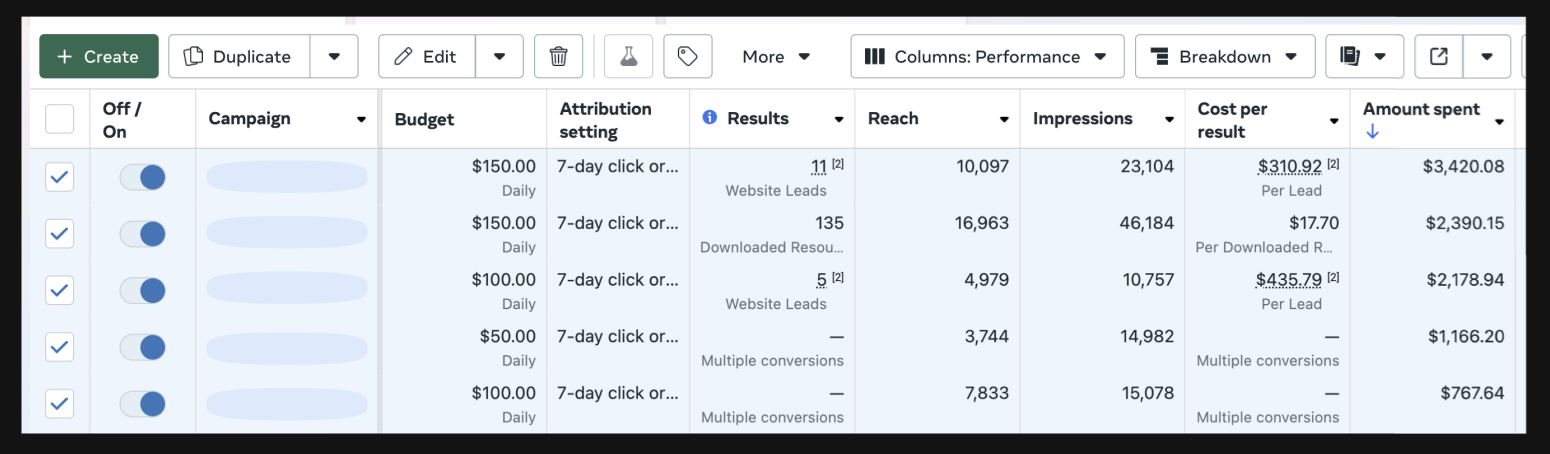
This image perfectly illustrates what we call "budget leaks." The advertiser is spending the same amount of money on two campaigns with vastly different returns. The core task of a budget audit is to systematically identify these discrepancies across your entire account. Your three years of performance marketing experience have likely shown you that what seems like a small inefficiency can represent significant wasted spend when scaled over time.
To begin this process, you need to create a clear map of where your money is currently going. The following reading provides a step-by-step guide to conducting this initial analysis.
Meta Ads Budget Distribution Methods: 6 Ways to Win
This first section from the AdStellar article, "Meta Ads Budget Distribution Methods," outlines a practical process for conducting a baseline audit of your budget. It will guide you through exporting the right data and identifying initial areas of concern.
Please read the section titled "Step 1: Audit Your Current Budget Structure and Performance Baseline." Focus on the process described for exporting and sorting your campaign data to reveal your "budget distribution reality." Pay close attention to the concept of calculating your blended, account-level metrics to establish a performance baseline.
By following this process, you will produce a data-backed overview of your account's financial landscape. You'll be able to clearly see the campaigns that consume the most budget and compare that spend against the results they generate. This analysis will reveal both your "budget drains" and your hidden scaling opportunities, setting the stage for strategic reallocation.
2. A Strategic Framework: The 70/20/10 Rule
Once you have a clear picture of your current budget distribution, the next step is to impose a strategic structure on it. Instead of allocating budgets arbitrarily, we will use a proven framework that aligns spend with performance and business goals. The 70/20/10 Rule is a powerful mental model for this purpose.

This framework divides your budget into three distinct tiers:
- 70% for Proven Winners: The majority of your budget is dedicated to your most consistent, high-performing campaigns. These are the workhorses of your account that reliably deliver results above your target KPIs.
- 20% for Scaling Tests: This portion funds campaigns that are showing strong early potential but don't yet have a long track record. They have graduated from the experimental phase and are candidates for becoming your next "proven winners."
- 10% for Experiments: A small, protected portion of your budget is reserved for pure testing. This includes new audiences, novel creative concepts, or untested ad formats. Most experiments will fail, but the successful ones are the source of future growth.
The following reading details how to implement this framework within your Meta ad account.
Meta Ads Budget Distribution Methods: 6 Ways to Win
This section of the AdStellar article provides a detailed breakdown of the 70/20/10 allocation method. It explains the criteria for classifying campaigns into each tier and the strategic rationale behind this split.
Read the section "Set Up the 70-20-10 Budget Allocation Framework." As you read, think about how you would classify the existing campaigns in your own account. What specific performance metrics (e.g., ROAS over 30 days, CPA below a certain threshold) would you use to define a "proven winner" for your brand?
Applying this framework transforms budget allocation from a reactive task into a proactive strategy. It ensures you are defending your core profitability while systematically investing in future growth.
3. Continuous Rebalancing: Keeping Your Allocation Dynamic
The 70/20/10 framework is not a static, one-time setup. It is a dynamic system that requires regular maintenance. Audience performance decays, creative fatigues, and new opportunities emerge. A successful budget strategy must be responsive to these changes. This is achieved through a disciplined, recurring process of review and rebalancing.
The goal is to create a weekly or bi-weekly rhythm where you assess performance, re-classify campaigns within your 70/20/10 structure, and shift budget accordingly. A campaign in the "Scaling Tests" tier that has now maintained strong performance for 30+ days should be "graduated" into the "Proven Winners" bucket, earning a larger share of the budget. Conversely, a former "Proven Winner" showing signs of fatigue may be demoted to have its creative or audience refreshed.
A key principle when reallocating is to make changes gradually. As you know from your experience, drastic budget changes (typically over 20-25% in a single day) can reset the algorithm's learning phase and destabilize performance. The "20% Budget Shift Rule" is a valuable guideline: make incremental budget increases or decreases to allow the algorithm to adapt smoothly.
The following resources provide a practical guide for establishing this review cadence and making rebalancing decisions.
Facebook Budget Optimization: Complete Guide For 2026
This article offers a tangible protocol for daily and weekly performance reviews. It gives you a checklist-style approach to monitoring and analysis, which is crucial for maintaining your strategic budget allocation over time.
Please read the two subsections under "Step 6: Performance Monitoring and Iterative Refinement": Daily Performance Review Protocol and Weekly Deep-Dive Analysis. Focus on how the weekly analysis directly informs your 70/20/10 framework by re-evaluating budget drift and campaign performance.
Meta Ads Budget Distribution Methods: 6 Ways to Win
This final reading reinforces the concept of rebalancing and highlights the importance of using both leading and lagging indicators to make decisions.
Read the section "Use Performance Data to Continuously Rebalance Distribution." Pay attention to the idea of shifting budget from underperformers to those with "headroom for scale" and using leading indicators like CTR and CPM to anticipate future performance shifts.
By institutionalizing this rebalancing process, you ensure your budget remains agile, continuously flowing toward your best opportunities and away from areas of inefficiency.
Conclusion
In this lesson, we have established a comprehensive methodology for evaluating and managing your Meta Ads budget allocation. You have moved from a static "set it and forget it" approach to a dynamic, strategic system.
Here are the key takeaways:
- Audit First: Always begin by auditing your current budget distribution to establish a baseline and identify clear "budget leaks" and scaling opportunities.
- Use a Framework: The 70/20/10 rule provides a robust structure to align your budget with campaign performance and business priorities, balancing profitability with innovation.
- Rebalance Continuously: Budget allocation is not a one-time task. A disciplined weekly review and rebalancing process is essential to adapt to changing performance and market conditions.
- Shift Budget Gradually: Adhere to the "20% rule" when adjusting budgets to avoid resetting the learning phase and destabilizing campaign performance.
Now that you have a framework for deciding how much to spend across your campaigns, the next logical question is how you instruct the platform to spend that budget. In our next lesson, we will dive into bid strategies, exploring how choices between lowest cost, cost cap, and bid cap can dramatically impact campaign delivery, cost control, and overall performance.