Introduction
In our last lesson, we established that description is not an objective report but is filtered through a character's unique point of view—their biases, mood, and focus. This process of conveying a character's sensory experience of the world, rather than just observing it, is the engine behind one of the most fundamental techniques in writing.
Today, we will dissect that technique. The learning outcome for this lesson is to distinguish between dramatizing an event (showing) and summarizing it (telling).
You've expressed a preference for treating writing as a technical discipline, and that is precisely how we will approach this. "Show, Don't Tell" is often presented as vague, quasi-mystical advice. We will treat it as a choice between two distinct narrative modes, each with a specific function, cost, and optimal use case. Think of them as two different tools in your toolkit: a high-magnification lens for close-up, real-time work, and a wide-angle lens for capturing the landscape.
1. Defining the Two Narrative Modes: Dramatization vs. Summary
At its core, the distinction is about controlling the reader's experience of time and proximity to the events of the story.
- Dramatization ("Showing") is the act of rendering an event in real-time. The narrative slows down to match the pace of the action, immersing the reader in the scene as it unfolds. It's experiential.
- Summarization ("Telling") is the act of reporting on events that have happened. It compresses time, conveying information efficiently but from a greater distance. It's informational.
Let's look at a clear visual representation of this distinction.
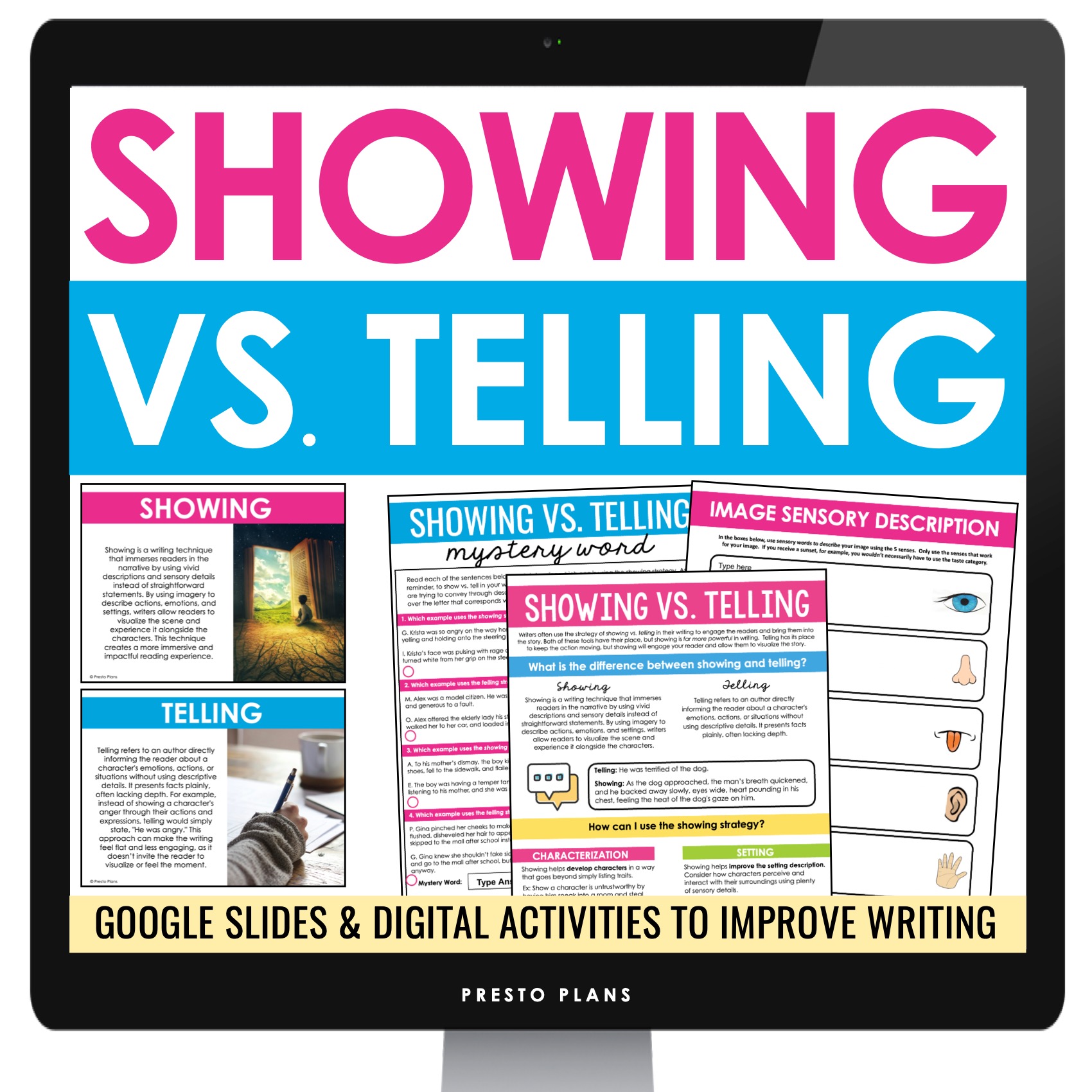
To build on this, we'll watch a video that defines these two modes using concrete examples from a published story.
Scene Versus Summary: Which Is the Best for Your Story
The video 'Scene Versus Summary' from the channel Ignited Ink Writing provides a clear, practical breakdown of these two modes. It uses examples from Tobias Wolff's short story 'Bullet in the Brain' to illustrate the functional difference.
Watch the video from the beginning to 03:46, and then from 06:13 to 08:27. Focus on how the 'in scene' passages create a sense of immediacy and tension, while the 'summary' passages report information without dramatizing it. Note the direct comparison of the bank robbery written as a scene versus as a summary.
As the video demonstrates, dramatization uses tools like dialogue, specific actions, and sensory details to make the reader feel present. Summarization uses declarative statements to convey the outcome of events without detailing the process.
- Dramatized Event: We see the robber's actions, hear Anders's comment, and feel the tension in the room.
- Summarized Event: We are told that a robber got angry because of a funny comment.
The dramatized version has a higher emotional impact and immerses the reader, but it also takes up more narrative space. The summarized version is efficient but distant. Neither is inherently better; they simply have different jobs.
2. Strategic Application: When to Dramatize, When to Summarize
Your job as a writer is to decide which events in your story earn the real estate of dramatization. A common mistake for developing writers is to either summarize key moments, robbing them of their power, or to dramatize mundane transit, killing the story's pace.
This choice is a central part of shaping a narrative.
An Illustrated Guide to Writing Scenes and Stories
In 'An Illustrated Guide to Writing Scenes and Stories,' Jeff VanderMeer discusses this exact decision-making process. He frames it as the first crucial step in turning a sequence of events into a story.
Read the first section, 'Choosing What You’ll Dramatize and What You Won’t.' Pay attention to the 'dragon slayer' example. The point is that most of a character's day, even a dragon slayer's, is not story-worthy and should be summarized or skipped.
So, how do we build a decision-making framework?
Use Dramatization ("Showing") for:
- Pivotal Plot Points: The inciting incident, the midpoint reversal, the climax, and any other scene where the plot takes a significant turn. These are the moments the story is built around.
- High-Stakes Conflict: Any scene where characters are in direct opposition, whether it's a physical fight, a tense argument, or a critical negotiation.
- Character-Defining Moments: Scenes that reveal a character's true nature, force them to make a difficult choice, or demonstrate a significant change in their worldview.
- Key Emotional Experiences: Moments of profound connection, loss, terror, or realization. The goal is for the reader to feel it with the character.
Use Summarization ("Telling") for:
- Transitions: Moving characters across time or space where nothing critical to the plot or character arc occurs (e.g., "The journey to the capital took three weeks.").
- Repetitive Actions: Summarizing routine or training montages (e.g., "He spent the next month honing his skills with the sword.").
- Information Conveyance: Quickly delivering necessary backstory or world-building that doesn't warrant a full scene or flashback.
- Pacing Control: Deliberately de-emphasizing a scene to speed up the narrative and maintain momentum toward a more important event.
Test your understanding!
Consider this scenario: A detective is investigating a murder. Over a week, she interviews three unhelpful witnesses, travels to a different city to follow a dead-end lead, and finally discovers a critical clue in the victim's old office.
Which parts of this scenario would you dramatize and which would you summarize? Justify your choices based on the framework above.
Show answer
-
Dramatize:
- The discovery of the critical clue in the office. This is a pivotal plot point. It changes the direction of the investigation and moves the story forward. The reader should experience this moment of discovery alongside the detective.
-
Summarize:
- The interviews with the three unhelpful witnesses. Since they are "unhelpful," they don't significantly advance the plot. Dramatizing all three would be repetitive and slow the pace. You could summarize them: "Her first three interviews yielded nothing but contradictions and dead ends, leaving her more frustrated than when she started."
- The travel to a different city. Unless something important happens during the journey, the travel itself is a transition. A simple summary like, "The next day, she took a four-hour train ride to Boston on a hunch that proved fruitless," is sufficient.
This strategic choice focuses the reader's attention on the moment that matters—the discovery—while efficiently conveying the passage of time and the detective's mounting frustration.
3. A Spectrum, Not a Switch: The Role of Psychic Distance
The distinction between showing and telling is not a binary switch but a spectrum. You can control the "zoom level" of your narrative camera, moving smoothly from a wide, summary shot to a tight, experiential close-up. In the last lesson, we called this psychic distance.
Let's re-examine this concept as the mechanism that controls the show/tell gradient.
Understanding Psychic Distance
The article 'Understanding Psychic Distance' provides an excellent camera metaphor for this concept. It breaks the spectrum down into five illustrative levels, showing how you can modulate the distance between the reader and the character.
Read the introduction and the section 'Five levels of psychic distance.' Pay close attention to how the same basic event (Ida Marie stepping outside) is rendered at different 'zoom' levels, from a very distant summary to a deeply immersive, dramatized moment.
Let's recap those levels as a system:
- Level 1 (Wide Shot - Pure Tell): "A woman stepped out onto the sidewalk." Utterly objective summary.
- Level 2 (Medium Shot - Telling with a hint of interiority): "Ida Marie didn't appreciate the unreasonably warm weather..." We are told her name and her emotion.
- Level 3 (Medium Close-up - A Blend): "Ida cursed November’s unreasonable heat, which made her shirt stick to her back..." We get a sensory detail, bringing us closer. This is effective summary.
- Level 4 (Close-up - Showing with a hint of telling): "God, how she hated those second summers." We are in her head, hearing her voice, but she is still explaining her feelings.
- Level 5 (Macro - Pure Show): "Another damn seventy-degree day in November. Forget pumpkin spice; this year was sweaty tee shirts..." We are not told she is hot or annoyed; we experience the thoughts and sensations that prove it. This is full dramatization.
Understanding this gradient allows you to make precise, deliberate choices. You don't have to choose between a dry report and a fully dramatized scene. You can use a "telling" style that is still rich with character voice and specific detail (like Level 3), making your summaries engaging rather than dull.
Conclusion
Today we have demystified "Show, Don't Tell" by reframing it as a technical choice between two narrative modes: dramatization and summarization. This is not a moral imperative but a strategic decision based on an event's function within the story.
Key Takeaways:
- Dramatization ("Showing") immerses the reader in key moments by rendering them in real-time with sensory detail. Use it for high-impact events.
- Summarization ("Telling") condenses time and information to maintain pace and de-emphasize less critical events. Use it for transitions and exposition.
- The choice is functional: Decide what to dramatize based on what is most critical for the plot, character arc, and emotional core of your story.
- It's a spectrum: You can control the "zoom level" using psychic distance, moving from a distant summary to an intimate, dramatized experience, allowing for a range of effects between the two extremes.
Preview of the Next Lesson
We've established the 'what' and 'why' of showing versus telling. In the next lesson, we will focus on the 'how' in a very specific context. The learning outcome will be to apply the principle of 'Show, Don't Tell' by converting abstract emotional statements into concrete actions or sensations. We will take statements like "She was sad" and engineer them into moments of powerful, dramatized emotion.