Introduction
In our last lesson, we established that dialogue is a form of conflict, a "battle" driven by characters' incompatible goals. We analyzed this on a strategic level, looking at how the entire scene is shaped by what each character wants.
Today, we zoom in from strategy to tactics. The learning outcome is to control conversational flow by analyzing turn-taking, interruptions, and topic changes. If dialogue is a battle, then these are the moment-to-moment mechanics of the fight: the parries, feints, and lunges. We will deconstruct the underlying "protocol" that governs conversation, treating it as a system that can be analyzed and engineered for specific dramatic effects.
1. The Protocol of Conversation: Turn-Taking
Before you can break the rules of conversation for effect, you must understand them. From a technical standpoint, a conversation is a highly structured, cooperative system for exchanging information. Linguistics provides a useful framework for this called Conversation Analysis (CA).
To begin, let's explore how the very structure of a dialogue, stripped of its content, reveals the nature of the interaction.
The video 'Conversation analysis 1' from the Language and Linguistics channel provides a systematic way to look at dialogue. This first segment introduces the core idea that conversational structure is itself a source of information.
Watch the video from the beginning to 08:17. Pay attention to how the speaker deduces the type of interaction (lecture, interview, conversation) just by looking at the pattern of speakers and the length of their turns. This demonstrates that flow is a mechanical property.
This structural view is key. As writers, we are the architects of this structure. The core mechanism that governs this structure is turn-taking. Speakers in a natural conversation are remarkably adept at managing turns with minimal overlap. They do this by recognizing when a speaker's contribution is complete and a transition is possible.
To analyze this, we'll use two key concepts from Conversation Analysis:
- Turn Construction Unit (TCU): The fundamental building block of a turn. A TCU can be a single word ("What?"), a phrase ("Over there."), or a full clause ("I didn't see him."). Think of it as a single, complete utterance that conveys a piece of meaning.
- Transition Relevance Place (TRP): The end of a TCU. This is the point where the conversational "protocol" allows for a speaker change. It's a natural pause or point of completion where another speaker can take the floor without it being perceived as a rude interruption.
How do characters (and readers) recognize a TRP? They are unconsciously tracking three signals simultaneously:
- Grammar: Has a grammatically complete unit (a phrase or clause) been finished?
- Intonation: Has the speaker's pitch indicated the end of a thought (e.g., falling intonation) or a question (rising intonation)?
- Action: Has the turn fulfilled a conversational action (e.g., answering a question, making a request)?
To see these concepts explained in detail, let's return to the video.
This next segment of 'Conversation analysis 1' breaks down the mechanics of TCUs and TRPs. This will give you the precise vocabulary to analyze how turns are constructed and exchanged.
Please watch from 24:24 to 30:45 to understand Turn Construction Units (TCUs). Then, watch from 33:26 to 45:36 to learn how grammar, intonation, and action signal turn completion, and to understand Transition Relevance Places (TRPs).
In summary, a smooth conversation flows from one speaker to the next at TRPs. The speakers are cooperating to maintain the flow. But in fiction, conflict is often more interesting than cooperation. This brings us to interruptions, which are deliberate violations of this turn-taking protocol.
2. Seizing Control: Interruptions and Punctuation
An interruption is a tactical move to seize control of the conversation. A character interrupts to assert dominance, to prevent another from speaking a truth, or out of sheer urgency. On the page, we signal these disruptions with specific punctuation, primarily the em dash (—).
It is critical to distinguish between an interruption and a hesitation.
- Em Dash (—): Signals an abrupt cut-off. The speech is stopped by an external force (another speaker, a car crash) or an internal one (a sudden, sharp change of thought).
- Ellipsis (...): Signals a trailing off or faltering. The speaker hesitates, loses their train of thought, or invites the other person to fill in the blank. The speaker is yielding the floor, not having it taken from them.
Let's examine the specific rules for punctuating these conversational moves.
The 'Fiction Style Guide: Dialogue' from Articulate Editing provides a clear, rule-based guide to punctuating various dialogue events. We'll focus on the sections that mechanically distinguish interruptions from other pauses.
Please read the following three sections: 'Interrupting speech with action': Focus on how em dashes are used to set off an action beat within a sentence. 'Punctuating speech that is abruptly cut off': Note the specific use of the em dash for interruptions versus the ellipsis for trailing off. 'Stammers and stutters and pauses (oh my!)': Pay close attention to the different roles of ellipses, em dashes, and hyphens for conveying faltering speech, abrupt shifts, and stutters.
To reinforce these rules, let's review a highly practical guide that clarifies common points of confusion.
Mini Lesson: Punctuating Interrupted Dialogue
The 'Mini Lesson: Punctuating Interrupted Dialogue' from Touchstone Editing is an excellent resource that directly addresses your goal of mastering the mechanics. It presents three clear scenarios for interruption.
Read the main body of the article, focusing on the three numbered ways to punctuate interrupted dialogue. Pay special attention to the distinction between using em dashes inside the quotation marks (for a cut-off) versus outside (for an action interrupt). The comments section of this article is also a rich resource of edge cases, which you may find useful for future reference.
Here is a summary of the core punctuation mechanics:
| Scenario | Punctuation | Example |
|---|---|---|
| Character is cut off by another speaker or event. | Em dash inside quotes, at the end of the line. | "I think you should—" "Don't tell me what to think," he snapped. |
| Character trails off, hesitates, or falters. | Ellipsis inside quotes, at the end of the line. | "I think you should..." "Should what?" she asked. |
| Character interrupts themselves with an action. | Em dashes outside quotes, surrounding the action. | "I think"—he slammed his fist on the table—"you should listen." |
| Character interrupts themselves with a sudden change of thought. | Em dash inside quotes, linking the two thoughts. | "I want you to take the—wait, what was that noise?" |
Mastering this punctuation gives you precise control over the rhythm and power dynamics of your dialogue.
Test your understanding!
Analyze the following exchange. What is the tactical purpose of each character's punctuation?
Character A: "The plan is simple. We go in through the north entrance, disable the primary sensor grid, and then..."
Character B: "And then what? Get caught? The north entrance is a—"
Character A: "The north entrance"—she held up a keycard—"is already taken care of."
Show answer
- Character A's ellipsis (...): This is a deliberate, dramatic pause. A is not faltering; she is inviting B to question the plan, creating a moment of suspense before revealing her trump card. She is controlling the flow by creating a vacuum.
- Character B's em dash (—): B is abruptly cut off by A. The em dash shows that A has seized control of the conversation, interrupting B mid-sentence to reassert the validity of her plan.
- Character A's action-interrupting em dashes (—...—): A interrupts her own speech with a physical action. This is the most dominant move in the exchange. It forces B to stop talking, observe the action (seeing the keycard), and then listen to the completion of the sentence. The flow of information is completely dictated by A.
3. Redirecting the Flow: Topic Changes
The final tool for controlling conversational flow is the topic change. A character can redirect the entire conversation by refusing to engage with the current subject and introducing a new one. This is a powerful move that can reveal priorities, demonstrate avoidance, or assert status.
A topic change can be subtle, but when one character fails to follow the shift, it can cause the conversational system to break down.
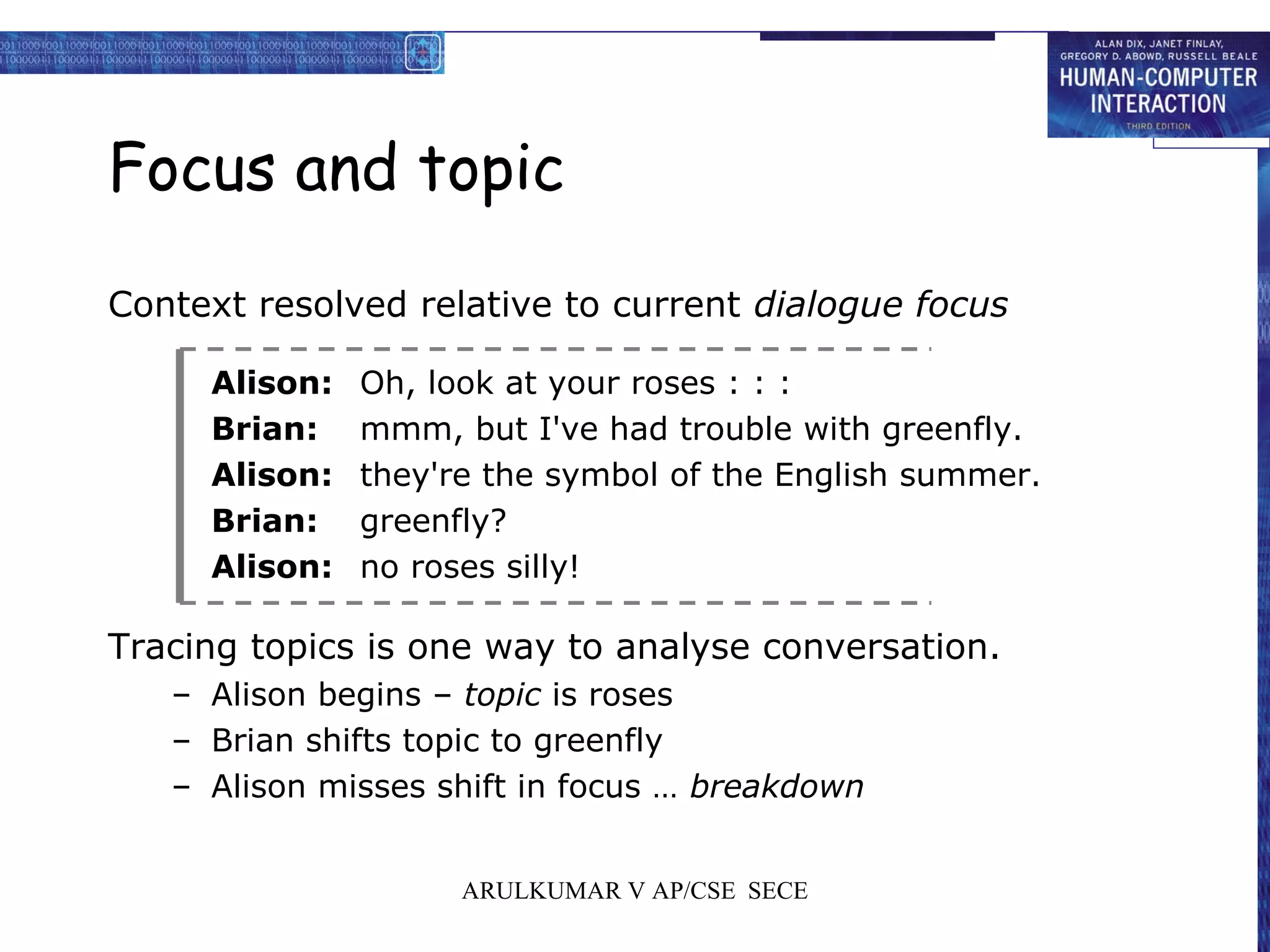
In fiction, you can engineer these shifts for specific effects:
-
Deflection/Avoidance: A character is asked an uncomfortable question. Instead of answering, they change the subject.
"Did you file the report?"
"Is that a new tie? It looks great on you." -
Asserting Dominance: A higher-status character dismisses a subordinate's topic to show it's unimportant.
"Sir, the reactor core is showing some anomalies—"
"Did you book my dinner reservation?" -
Revealing True Concern: A character's attempt to change the subject reveals what's really on their mind.
"The party was fun. The music was a bit loud, though."
"Yeah... Have you heard from Sarah? She hasn't been answering my texts."
Analyzing who controls the topic is analyzing who controls the conversation.
Conclusion
Today, we deconstructed the mechanics of conversational flow, moving from the cooperative protocol of turn-taking to the combative tactics of interruptions and topic changes.
Key Takeaways:
- Turn-Taking is a System: Conversations follow a protocol where speakers exchange turns at Transition Relevance Places (TRPs), which mark the end of Turn Construction Units (TCUs).
- Punctuation is Control: The em dash (—) and ellipsis (...) are not interchangeable. The em dash signals an abrupt cut-off or interruption, a move to seize control. The ellipsis signals a hesitation or trailing off, a yielding of control.
- Topic Changes are Tactical: Deliberately shifting the topic is a way to deflect, assert dominance, or reveal a character's underlying priorities. It's a powerful tool for manipulating the flow of a scene.
Preview of the Next Lesson
We have now examined the high-level goals of dialogue (last lesson) and the turn-by-turn flow of the conversation (this lesson). We've also touched on how punctuation signals actions within the flow. In the next lesson, we will focus entirely on that integration of speech and action. The learning outcome will be to use action tags instead of dialogue tags to simultaneously convey speech and physical action, grounding your dialogue in the physical world and making it more dynamic.