Introduction
In our last lesson, we analyzed the tactical flow of conversation, focusing on turn-taking, interruptions, and topic changes. We saw how punctuation, particularly the em dash, could signal an action interrupting the flow of speech. Today, we will build directly on that idea.
This lesson focuses on a fundamental technique for making dialogue dynamic and efficient. Your learning outcome is to use action tags instead of dialogue tags to simultaneously convey speech and physical action. We will treat this as an engineering problem: how to replace a simple, single-function component (he said) with a multi-function component that not only attributes speech but also grounds characters in the physical world, reveals subtext, and controls pacing. By mastering this, you will solve one of the most common failure modes in prose: the "talking heads" syndrome, where characters feel like disembodied voices in a void.
1. Defining the Tool: Action Tags and Action Beats
The term "action tag" is a functional description. In the craft of writing, this technique is more commonly known as an action beat. An action beat is a sentence of description—containing a character's action—placed adjacent to a line of dialogue. Its proximity to the dialogue serves to identify the speaker.
Let's start with a clear definition and a demonstration of how this works to solve the "talking heads" problem.
How to Improve Our Story with Action Beats
The article 'How to Improve Our Story with Action Beats' by Jami Gold provides a robust and systematic breakdown of this technique. We will use it as our foundational text for this lesson. First, let's establish a clear definition.
Read the first two sections of the article, 'Recap: What Are Action Beats?' and the short introduction preceding it. Focus on the core definition: an action beat is a sentence adjacent to dialogue that identifies the speaker.
Now, let's see and hear this in practice. The core function is to replace a simple dialogue tag like said with a physical action.
Mastering DIALOGUE TAGS in Writing (With Examples!) | Fiction Writing Advice
In this segment from 'Mastering DIALOGUE TAGS in Writing' by writer Brandon McNulty, you'll see a direct comparison between a simple tag and an action tag.
Watch from 04:41 to 05:27. Notice how the line 'Brandon approached the chalkboard' performs two jobs at once: it tells us who is speaking and it grounds the scene by establishing a setting (a classroom) and a physical movement.
As you saw, the action beat is more efficient. Instead of:"Pay attention," Brandon said. He approached the chalkboard.
We have the more integrated:"Pay attention." Brandon approached the chalkboard.
Or even:Brandon approached the chalkboard. "Pay attention."
The action attributes the dialogue simply by being in the same paragraph. This is the fundamental mechanism.
2. The Mechanical Rules: Punctuation and Placement
For this technique to work, you must follow specific punctuation rules. Your computer science background will appreciate that this is like syntax; getting it wrong leads to a compilation error in the reader's brain. An action beat is a complete sentence and must be punctuated as such. It is not part of the same sentence as the dialogue.
The article "What are action beats and how can you use them in fiction writing?" by Louise Harnby provides an excellent, rule-based guide to the formatting.
What are action beats and how can you use them in fiction writing ...
This article offers precise, granular rules for punctuating action beats. We'll focus on the sections that detail the syntax for placing beats before, after, and within dialogue.
Read the section titled 'How to punctuate and format actions beats'. Study the three subsections carefully: 'Before the dialogue', 'After the dialogue', and 'Within the dialogue'. Pay close attention to the use of full stops (periods) and capital letters.
Let's codify those rules into a clear system:
Scenario 1: Action Beat BEFORE Dialogue
The action beat is a complete sentence ending in a period. The dialogue begins with a capital letter.
He slammed the book on the table."We're doing this my way."
Scenario 2: Action Beat AFTER Dialogue
The dialogue ends with a period (or question mark/exclamation point) inside the quotation marks. The action beat begins with a capital letter.
"We're doing this my way."He slammed the book on the table.
Scenario 3: Action Beat Interrupting a Single Sentence of Dialogue
This is used for a brief pause or emphasis. The action beat is set off by em dashes (—). The second part of the dialogue does not begin with a capital letter because it is a continuation of the same sentence.
"This time"—he leaned forward, lowering his voice—"we're doing this my way."
Scenario 4: Action Beat Between Two Sentences of Dialogue
The beat is placed between two complete sentences of dialogue spoken by the same character. Punctuate it as a combination of Scenarios 2 and 1.
"I've had enough of your excuses."He stood up, his chair scraping against the floor."From now on, we're doing this my way."
Test your understanding!
Correct the punctuation in the following example:
"This isn't working," she fiddled with her pen, "I need a new approach."
Show answer
There are two correct ways to punctuate this, depending on the intended rhythm:
-
As an interruption between two separate sentences:
"This isn't working." She fiddled with her pen. "I need a new approach." -
As a mid-sentence interruption (for a quicker, more integrated pause):
"This isn't working"—she fiddled with her pen—"and I need a new approach."(Note the addition of 'and' to make it a single grammatical sentence).
The original version is incorrect because it uses commas to create a comma splice. The action beat she fiddled with her pen is an independent sentence.
3. Advanced Functionality: Adding Layers of Meaning
Now that we have the mechanics, let's explore the power of this tool. A well-chosen action beat does far more than attribute speech. It's a vehicle for subtext, emotion, and pacing.
A. Revealing Emotion and Subtext
Action beats are one of the most powerful tools for implementing the "Show, Don't Tell" principle. Instead of telling the reader a character is nervous, you show them an action that implies nervousness.
Let's watch two clear examples of this.
Mastering the Use of Dialogue Tags [4 Tips]
The Reedsy channel's video 'Mastering the Use of Dialogue Tags' demonstrates how action beats convey emotion and subtext more effectively than simple tags or adverbs.
First, watch from 02:49 to 03:33. Note the example of Percy's hand inching towards his holster, which shows his intent without needing an adverb like 'he said threateningly.' Next, watch from 04:40 to 05:03. The example of Moira fiddling with her coat button is a perfect demonstration of subtext—her action contradicts her words, telling the reader she is likely lying.
This functionality is especially useful for revealing a character's state when their words are trying to conceal it. A mismatch between dialogue and action is a direct signal of subtext to the reader.
"I'm fine." He plowed his fingers through his hair and took a deep breath.
The action beat tells the truth; the dialogue does not.
B. Controlling Pace and Rhythm
The density and complexity of your action beats directly affect the pace of the scene.
- Fast Pace (e.g., banter, argument): Use minimal or no action beats. Let the dialogue fly back and forth.
- Slow Pace (e.g., tense negotiation, introspection): Use more deliberate action beats to slow the scene down, forcing the reader to linger on each moment and action.
The Jami Gold article we looked at earlier has a good summary of this function. Under the heading Method #5: Tweak Pacing & Rhythm (LINK, section 6), it explains that too many beats can interrupt flow, while adding a beat can give a fast exchange a necessary pause for absorption.
4. System Diagnostics: Common Failure Modes
Every tool can be misused. When using action beats, you must guard against two common errors: repetition and using "empty" beats.
How to Improve Our Story with Action Beats
Let's return to the Jami Gold article to diagnose potential problems with this technique. This is crucial for ensuring your action beats are adding value, not just bulk.
Read the section titled 'The Risks of Action Beats'. Focus on the two main warnings: repetition (of actions, rhythm, or sentence structure) and 'empty' action beats that serve no purpose.
To summarize the failure modes:
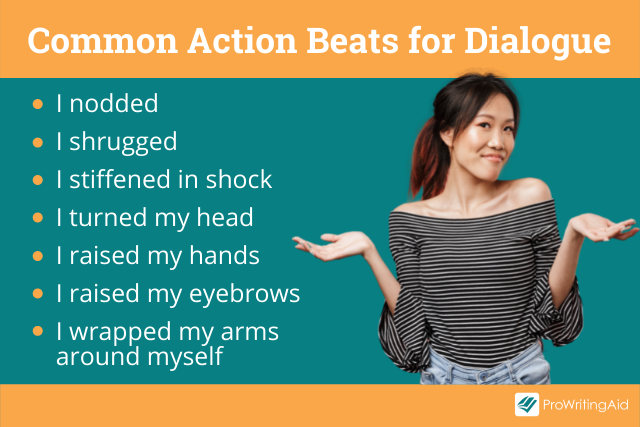
- Repetitive Actions: Your character is constantly nodding, shrugging, sighing, or smiling. This becomes a noticeable and annoying authorial tic. Track these actions to ensure variety.
- Empty Beats: The action adds no new information. It's "busy work" to avoid using
said.- Weak:
"I don't know." He took a breath.(Everyone breathes. This is meaningless unless the character was previously holding their breath for a specific reason.) - Strong:
"I don't know." He refused to meet my eyes, focusing instead on a loose thread on his sleeve.(This action is purposeful; it shows evasion and nervousness.)
- Weak:
Every action beat should serve a purpose: advance the plot, reveal character, convey subtext, describe the setting, or control the pace. If it does none of these, it's a candidate for deletion.
Conclusion
In this lesson, we have systematically deconstructed the action beat as a multi-purpose writing tool. We established its core function as a replacement for the dialogue tag, detailed the syntactical rules for its use, and explored its advanced functions in conveying subtext and controlling pace.
Key Takeaways:
- Action beats replace dialogue tags: A sentence describing a character's action, placed in the same paragraph as their dialogue, attributes the speech to them.
- Punctuation is syntactic: Action beats are separate sentences and must be punctuated accordingly, with periods and capital letters, unless used as a mid-sentence interruption with em dashes.
- Beats are multi-functional: A good action beat simultaneously attributes speech and shows emotion, reveals subtext, grounds the scene, or manipulates pacing.
- Avoid empty actions: Every beat must have a purpose. Diagnose and eliminate repetitive or meaningless "busy work" actions.
Preview of the Next Lesson
You are now equipped with the primary tool for avoiding "talking heads" syndrome. In our next lesson, we will broaden the scope. The learning outcome will be to avoid 'talking heads' syndrome by grounding every few lines of dialogue with physical interaction or setting details. We will move from the specific tool of the action beat to a more general strategy of how often and in what ways to anchor a conversation in the physical world to maintain reader immersion.