Introduction
Welcome back. In our last lesson, we established a mechanical framework for understanding scene rhythm through the interplay of action, dialogue, and thought beats, using the Motivation-Reaction Unit (MRU) as our analytical tool. We saw that every element in a scene should be part of a cause-and-effect chain.
Today, we begin our deep dive into the mechanics of dialogue, starting with its most critical function in your story's architecture. While dialogue can serve many purposes, its primary role is to act as an engine for the plot. As the Scribophile article "Writing Effective Dialogue" states, a line of dialogue should always help move a story forward, distinguishing it from the often aimless small talk of real life.
Our learning outcome for this lesson is to analyze dialogue that advances the plot by introducing new information or forcing a decision. We will examine these two functions as distinct but related mechanisms for ensuring your dialogue drives the narrative, rather than just filling space.
1. Dialogue as an Information Delivery System
One of the most direct ways dialogue moves the plot is by introducing new information that changes the characters' understanding of their situation or presents a new challenge. However, delivering this information without it feeling like a clumsy "info-dump" is a core technical challenge.
The Anti-Patterns: Inefficient Information Transfer
Before analyzing effective methods, it's crucial to identify common failure modes. Clumsy exposition breaks the reader's immersion and signals amateur writing.
Bad Dialogue vs Good Dialogue (Writing Advice)
The video 'Bad Dialogue vs Good Dialogue' provides clear examples of two common anti-patterns: 'on-the-nose' dialogue and the 'As you know, Bob' exchange.
Please watch the following two short segments: On the Nose Dialogue (02:37 - 04:01): Notice how Anakin Skywalker explicitly states his internal emotional state. This is inefficient because it tells the audience directly what could be shown through subtext or action. 'As You Know, Bob' Exchange (08:16 - 09:20): Analyze the dialogue between Bilbo and Frodo. The key flaw here is that both characters already possess the information being shared. It exists purely for the audience's benefit, making the exchange feel artificial. Keep these anti-patterns in mind as we explore superior techniques.
The Effective Method: Information Revealed Through Necessity
Effective expositional dialogue arises from a clear, story-driven need. One character must explain something to another character who is ignorant of it, and this explanation has immediate plot consequences.
Bad Dialogue vs Good Dialogue (Writing Advice)
Let's return to the 'Bad Dialogue vs Good Dialogue' video for a prime example of effective information delivery.
Watch the segment on the John Wick example from 09:20 to 10:54. Pay close attention to the narrative function of this scene. Vigo is not talking for the audience's benefit; he is explaining the magnitude of his son's error to his son, who is dangerously ignorant of the facts. The information introduced (who John Wick is) directly establishes the central threat of the plot.
The John Wick example works because the dialogue is an action with clear motivation. The information transfer isn't passive; it's a desperate warning that elevates the stakes. The new information—"he was the one you send to kill the boogeyman"—re-contextualizes the entire plot for both the son and the audience simultaneously.
The Advanced Method: The "Chessboard" Technique
A more subtle method involves guiding a conversation through a series of logically adjacent topics to arrive at a key piece of information. This feels natural to the reader and allows you to embed plot-critical details within a seemingly normal conversation.
How To Write Dialogue: Tyrion vs Janos Slynt
The video 'How To Write Dialogue: Tyrion vs Janos Slynt' provides an excellent analysis of this technique, which the creator likens to moving across a chessboard.
Watch the segment from 01:55 to 06:09. Focus on the logical chain of topics Tyrion uses to maneuver the conversation: He starts with the Night's Watch. This leads to its former Lord Commander, Jeor Mormont, and his son, Jorah Mormont. This connects to another exiled lord, Ned Stark, and his execution. The execution leads to who was responsible (Joffrey), who was supposed to prevent it (Cersei), and who was present (Janos Slynt). Notice how this chain allows Tyrion to introduce the plot-advancing information: his contention with Janos over Ned's death and his dim view of Joffrey's rule. This isn't an info-dump; it's a strategic conversational attack.
This "chessboard" approach is an almost algorithmic way to structure a conversation for information release. Each step is a logical consequence of the last, making the final destination—the delivery of new, plot-relevant information—feel earned and natural.
2. Dialogue as a Forcing Function
The second primary way dialogue advances plot is by acting as a forcing function. It creates a situation where a character is compelled to make a decision, and that decision has consequences that drive the story forward. This often takes the form of a question, a demand, or a revelation that removes the option of inaction.
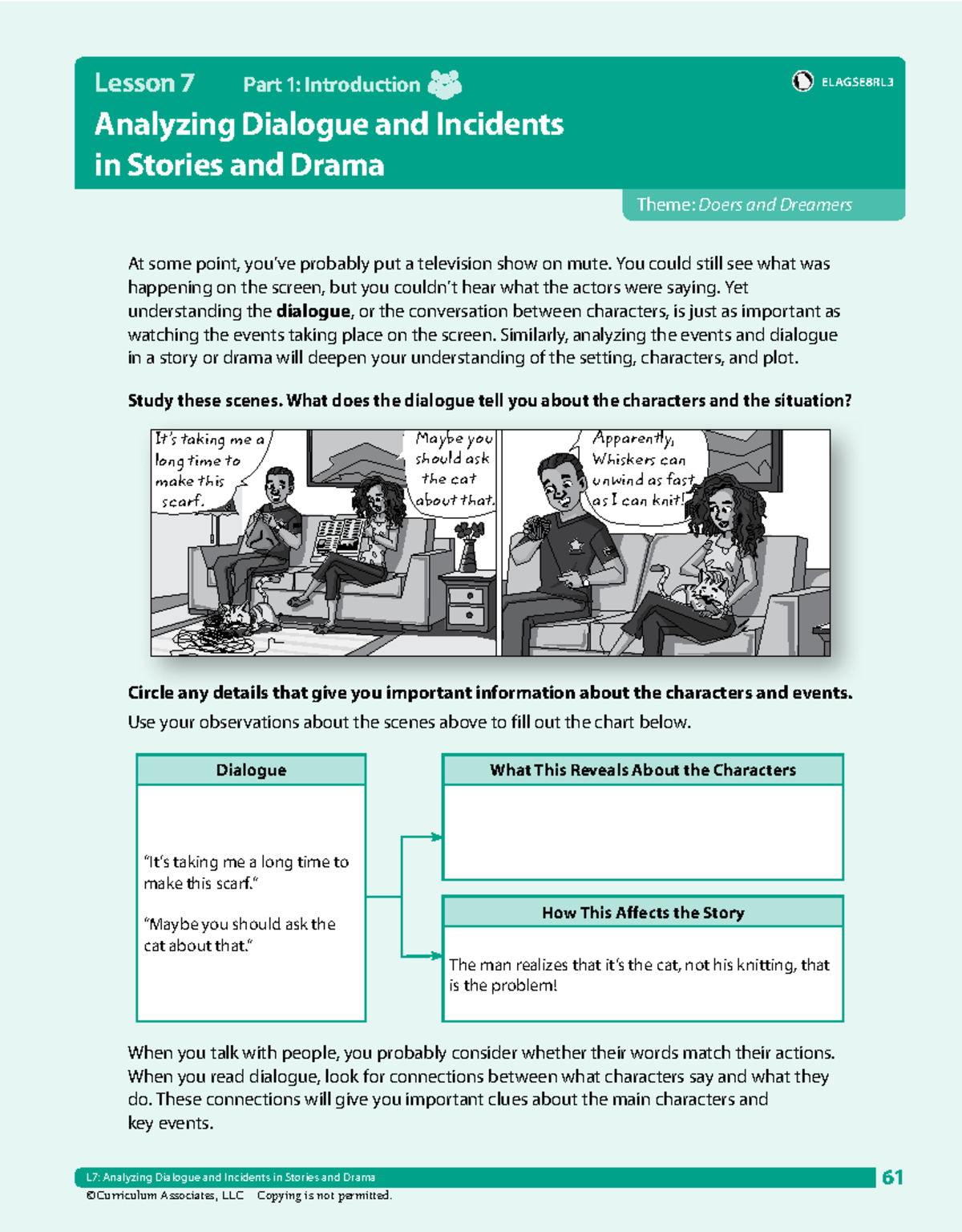
Let's look at more complex examples.
Dialogue writing examples from top books vs AI (2023)
The article 'Dialogue writing examples from top books vs AI' provides several excellent, concise examples of dialogue advancing the plot. We will analyze a few of them.
Please read the following two examples from the article: Find the heading 'Historical dialogue example' and read the excerpt from Amy Harmon's A Girl Called Samson. Here, the Reverend's question, "Can you read, Deborah?" is a direct forcing function. It's not small talk; it's a test. Her answer will introduce a piece of information (her literacy) that will have direct consequences on her future in the plot. Next, find the 'Romantic suspense dialogue example' and read the excerpt from Colleen Hoover's Layla. The detective's line, "Why don't we start with how the two of you met," forces the protagonist, Leeds, to act. He cannot ignore the question. His decision to answer, and what he chooses to say, will directly move the plot forward while he simultaneously manages the crisis upstairs.
In both cases, the dialogue creates a bottleneck.
- Deborah cannot remain silent without consequence. She is forced to decide whether to reveal her skill.
- Leeds cannot refuse to speak to the detective. He is forced to engage in a conversation that will dictate the next sequence of events.
The dialogue removes passivity and compels a character to make a choice, thus becoming the engine of the plot's next movement.
Test your understanding!
A junior programmer, Alex, has just discovered a critical security flaw in his company's flagship product, scheduled to launch tomorrow. His manager, Ben, is notoriously dismissive of problems that threaten deadlines.
Write a short dialogue exchange where Alex uses a line of dialogue as a forcing function to make Ben confront the issue, rather than just passively reporting the information.
Show answer
An ineffective, passive approach might be:
"Ben, I think I found a bug. It might be a security issue."
This allows Ben to easily dismiss it. A better, more forceful approach would be:
Alex: "Ben, I need you to look at this. Are you willing to sign off on the launch knowing that every user's data will be exposed?"
This line of dialogue is a forcing function. It does two things:
- Introduces new information: The severity of the flaw ("every user's data will be exposed").
- Forces a decision: It frames the situation as a direct choice for which Ben will be accountable ("Are you willing to sign off..."). He can no longer passively dismiss the report; he must actively decide to either investigate or accept a defined, severe risk.
Conclusion
In this lesson, we analyzed the mechanical function of plot-advancing dialogue. We established that in narrative construction, unlike real life, dialogue must be purposeful. Its primary purpose is to drive the story.
Key Takeaways:
- Dialogue advances the plot through two main mechanisms: introducing new information and forcing a decision.
- Information delivery must be motivated. Avoid "As You Know, Bob" exchanges where characters state things they both already know. Instead, reveal information when one character needs to explain something to an ignorant one, as in the John Wick example.
- Forcing functions are dialogue lines (often questions or demands) that corner a character, compelling them to make a choice that has plot consequences. This removes passivity and creates forward momentum.
- Techniques like the "chessboard" method allow you to weave information into a conversation naturally, making its delivery feel like a strategic outcome rather than an info-dump.
Preview of the Next Lesson
You now understand how to analyze dialogue for its plot function. However, the most efficient writing makes a single line of dialogue do multiple jobs at once. In our next lesson, we will address another critical function: analyzing dialogue that reveals character through word choice, speech patterns, and worldview. You will learn how the way a character delivers plot-advancing information simultaneously tells us exactly who they are.