Introduction
In our last lesson, we focused on the structural role of dialogue as a driver of plot, analyzing how it can introduce new information and act as a forcing function to compel character decisions. We established that every line of dialogue should serve a purpose in advancing the narrative.
Today, we add a second, equally critical layer to our analysis. The most efficient writing makes a single line serve multiple functions. While what a character says moves the plot, how they say it reveals who they are. This lesson is dedicated to today's learning outcome: to analyze dialogue that reveals character through word choice, speech patterns, and worldview.
We will deconstruct "character voice" into a set of analyzable components, treating it not as an elusive art but as a technical system where a character's background and psychology are encoded into their speech.
1. The Components of a Character's Voice
A character's unique way of speaking is not arbitrary. It is the direct output of their entire being: their history, profession, education, and fundamental beliefs about the world. To analyze this systematically, we can model it as a function where a set of inputs (the character's background) produces a specific output (their speech patterns).
To understand these inputs and outputs, let's explore a framework for what shapes a character's voice and how those factors manifest in dialogue.
How to Make Character Voices Sound Different (Dialogue Writing Advice)
The video 'How to Make Character Voices Sound Different' provides a structured way to think about the 'source code' behind a character's voice. It breaks down the origins of speech patterns into three logical categories.
Watch the segment from 00:35 to 05:12. As you watch, focus on building a mental model of the three core inputs that shape a character's voice: Character History: Note how factors like personality (introvert/extrovert), upbringing, age, and education level create a baseline for their speech. Daily Lives: Pay attention to how career, hobbies, and general attitude (positive/negative) introduce specific jargon and color their perspective. Character Traits: Observe how inherent traits like decisiveness, formality, or intelligence directly translate into specific word choices and sentence structures.
This video gives us the "why"—the underlying factors that generate a unique voice. Now let's look at the specific "what"—the technical components of speech that you can manipulate on the page.
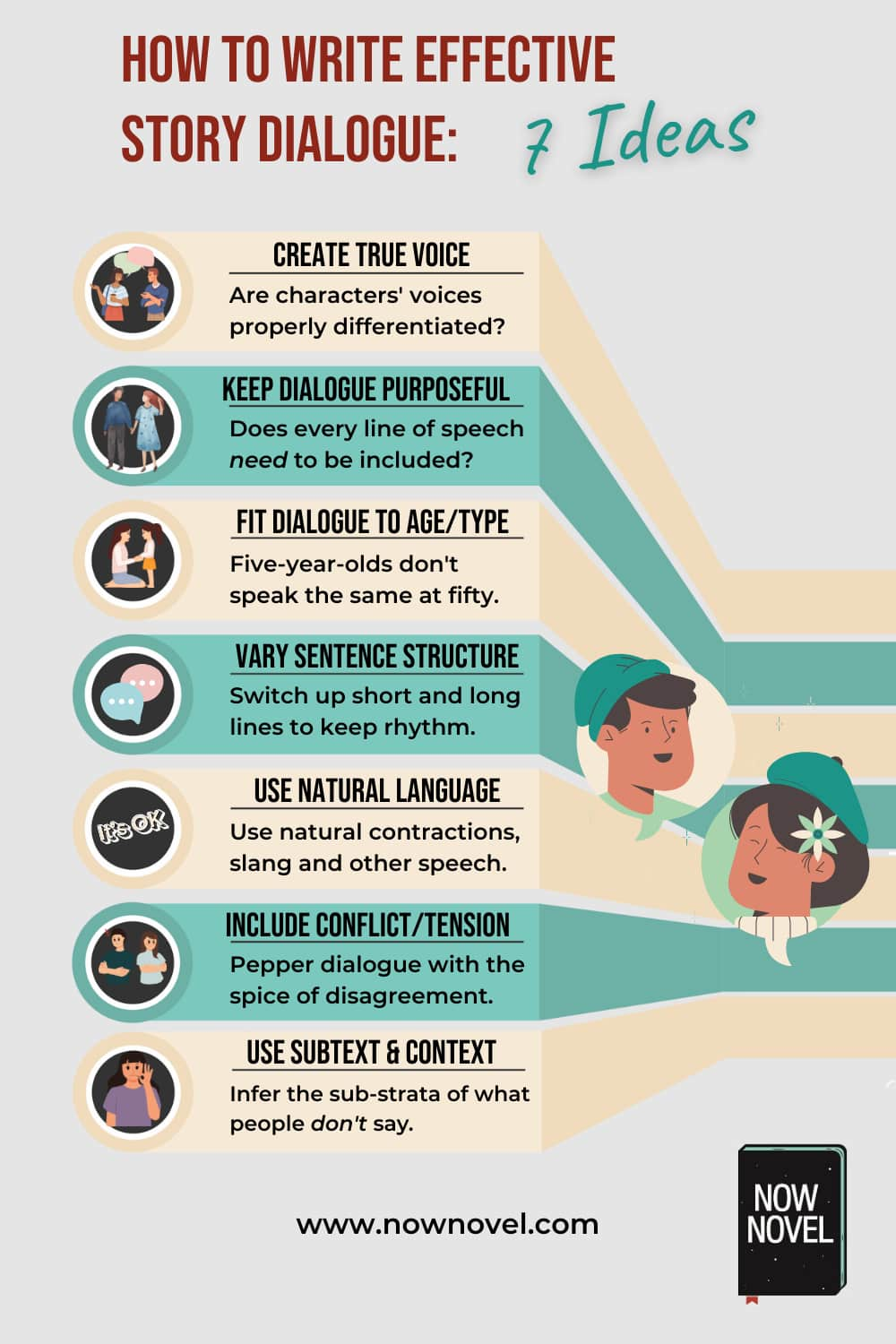
To be more granular, these inputs (history, traits) manifest through specific linguistic outputs:
- Vocabulary/Word Choice: The specific words a character uses. Is their vocabulary large or small? Formal or informal? Concrete or abstract? Do they use jargon from a specific field?
- Sentence Structure (Syntax): The way they assemble their sentences. Are they short and direct (signaling decisiveness or simplicity) or long and complex (signaling thoughtfulness or evasiveness)? Do they use grammatically correct structures or fragments?
- Rhythm and Cadence: The flow and pacing of their speech. Do they speak quickly, in a rush, or slowly and deliberately? Do they use frequent pauses?
- Worldview/Ideation: The concepts and beliefs they communicate. Do they speak in metaphors or are they literal? Are they cynical, optimistic, analytical, or emotional? This is their core belief system bleeding into their language.
With this framework, we can move from simply reading dialogue to performing a technical analysis of it.
2. Analysis in Action: Power, Control, and Worldview
Let's apply this framework to a character whose dialogue is a masterclass in revealing power and a ruthless worldview. Tywin Lannister from Game of Thrones rarely needs to raise his voice or make explicit threats; his character is almost entirely revealed through his precise word choice and conversational control.
Dialogue Dive: When Game of Thrones' Writing Was Still Good
The video 'Dialogue Dive: When Game of Thrones' Writing Was Still Good' provides an excellent scene for analysis. We will examine how Tywin Lannister's dialogue reveals his character.
Please watch the scene breakdown from 06:44 to 11:49. As you watch, don't just follow the plot. Instead, analyze the mechanics of Tywin's speech: Word Choice: Notice his formal, yet dismissive, language. He addresses the king as 'your grace' but denies his requests. Sentence Structure: Observe how he uses statements and imperatives where others would use questions or requests. When Joffrey asks why the meetings are in the tower, Tywin doesn't answer directly but states the logistical facts, forcing Joffrey to draw the conclusion. Topic Control: Pay attention to how he masterfully deflects Joffrey's questions by changing the subject to something seemingly unrelated (the dragon skulls), thereby reasserting dominance. Subtext: The line 'we could arrange to have you carried' is a perfect example of worldview. On the surface, it's a polite offer. Subtextually, it is a veiled threat that reveals his pragmatic ruthlessness.
Tywin's dialogue is an engine of character revelation.
- His worldview is that of ultimate authority; he sees the king not as his superior but as a tool or an obstacle.
- This is encoded in his speech patterns: he doesn't answer questions, he reframes them. He doesn't ask, he informs.
- His word choice maintains a veneer of propriety ("your grace") that makes the underlying assertion of power even more potent.
Every line he speaks reinforces the central pillar of his character: absolute control.
3. Analysis in Action: Contrasting Voices
Character is often revealed most clearly through contrast. Placing two characters with different backgrounds and worldviews in the same scene and analyzing their interaction is a highly effective diagnostic tool.
Let's analyze a text-based example.
Techniques for Excellence in Literary Fiction
The article 'Action, Conflict, Character-based Plots, Change, Dialogue ...' provides a fantastic pair of excerpts from the short story 'Reddog.' This will allow us to analyze two clashing voices line by line.
First, read the section under the heading 'CHARACTER-SPECIFIC DIALOGUE' for a concise definition. Then, read the two excerpts from the story 'Reddog.' The first is the interaction between the assistant warden and the prisoner. The second is between the prisoner and the graduate student, Ms. Pearlstein. As you read, focus on creating a 'spec sheet' for each character based only on their dialogue: The Prisoner: What does his word choice ('Hey, Captain', 'She a looker?', 'sweetie pie'), his questions (focused on personal benefit or challenging authority), and his informal syntax reveal about his education, background, and worldview? Ms. Pearlstein: What does her word choice ('Please try to keep to the subject', 'Ms. Pearlstein'), her initial squeaky voice, and her attempt to follow a script reveal about her background, her inexperience, and her goals in the scene?
Deconstruction of the "Reddog" Dialogue:
This example is a powerful illustration of how dialogue encodes character.
The Prisoner:
- Word Choice: Uses informal, street-level language ("Hey," "ain't"). His attempt at flirting ("She a looker?") and later provocation ("sweetie pie," "Virginity?") is a tool to unbalance others and assert control.
- Speech Patterns: His sentences are often questions aimed at probing for weakness or advantage ("Maybe I get out of max sooner?"). This reveals a mind constantly calculating angles.
- Worldview: Cynical and transactional. He sees the world as a power game. He assumes everyone has an angle and is suspicious of "do-gooders." His dialogue isn't for connection; it's for leverage.
Ms. Pearlstein:
- Word Choice: Formal and procedural ("Please try to keep to the subject"). She insists on her formal title ("Ms. Pearlstein"), which is an attempt to establish professional authority.
- Speech Patterns: She tries to stick to her prepared questions, revealing a structured, academic approach. Her "squeaky" voice and eventual angry outburst ("Answer my question!") show her losing the control she's trying to project.
- Worldview: Initially academic and detached. She sees the prisoner as a "subject." Her inability to handle his provocations reveals a certain naivety about the environment she has entered.
The conflict in the scene is a direct result of these two clashing communication styles, each one a perfect reflection of the character's background and psychological state.
Test your understanding!
Imagine two software engineers are looking at the same piece of buggy legacy code.
- Character A: A 25-year-old recent graduate, optimistic, believes in "best practices," and is eager to prove themself.
- Character B: A 55-year-old veteran engineer, cynical, pragmatic, and has seen dozens of "hot new technologies" fail.
Write a short, two-line exchange where they each react to the code. Your goal is to reveal their character and worldview through their word choice and attitude, not just their technical opinion.
Show answer
A possible exchange could be:
Character A: "Wow. This is a total mess. But it's a great opportunity! We can refactor the whole module using an asynchronous microservice architecture. It'll be so much cleaner."
Character B: "Kid, don't touch it. It works. You start pulling on that thread, the whole sweater unravels. Just patch the null pointer, collect your paycheck, and go home."
Analysis:
- Character A's dialogue reveals optimism ("great opportunity"), belief in modern paradigms ("asynchronous microservice architecture"), and a focus on ideals ("cleaner").
- Character B's dialogue reveals cynicism (calling A "kid"), pragmatism over idealism ("It works"), and a worldview based on negative experience ("the whole sweater unravels"). His focus is on minimal effort for a predictable outcome ("patch the null pointer").
Conclusion
In this lesson, we established a systematic method for analyzing how dialogue reveals character. By breaking down "voice" into its core components—word choice, sentence structure, rhythm, and worldview—we can see how a character's speech is a direct function of their background, personality, and beliefs.
Key Takeaways:
- Character voice is not magic; it's a system where inputs (history, traits, daily life) produce predictable outputs (vocabulary, syntax, etc.).
- Word Choice reveals education, formality, and profession (e.g., jargon).
- Speech Patterns like sentence length and rhythm can signal psychological traits like decisiveness, anxiety, or thoughtfulness.
- A character's Worldview—their fundamental beliefs—is constantly encoded in their dialogue, whether through cynical pragmatism (Tywin Lannister, the prisoner) or by-the-book idealism (Ms. Pearlstein).
- The most effective dialogue uses these techniques to reveal character at the same time it is advancing the plot, creating a dense, efficient narrative.
Preview of the Next Lesson
We have now analyzed dialogue for its function in plot and character. Next, we will examine how dialogue operates between characters to generate the story's driving force. In the next lesson, we will analyze dialogue that creates conflict when characters express incompatible goals. This will move us from static analysis to the dynamics of conversational combat.