Introduction
In our previous lesson, we established a systematic method for engineering a protagonist's desire using the SMART framework. We defined this desire as a specific, measurable, external goal—the primary vector that drives the plot forward. A story is set in motion by a character with a clear, active objective.
However, a vector without an opposing force results in constant, uninteresting motion. Conflict, the engine of narrative, arises from resistance. Today, we will engineer that resistance. Our objective is to formulate an antagonist's goal to be in direct opposition to the protagonist's desire. This creates the fundamental push-and-pull that forms a story's structural backbone.
1. The Antagonist as a Resistance Function
First, we must refine our definition of "antagonist." An antagonist is not simply a "bad guy" or a passive obstacle. In a mechanical sense, they are an active, opposing force with their own agency and objectives.
Embrace Your Villain Nature: Why Every Story Starts with the Antagonist
The article 'Embrace Your Villain Nature' from NotMFA provides a robust, technical definition of the antagonist's role. It frames the antagonist not as an afterthought, but as a foundational component of the story's design.
Please read the first three sections: 'Don’t start with your protagonist,' 'Antagonists Aren't Evil. They're Designed,' and 'Opposition Creates Change.' Pay close attention to the idea that plot is what stops the protagonist and that the antagonist is a force designed with its own goals and beliefs.
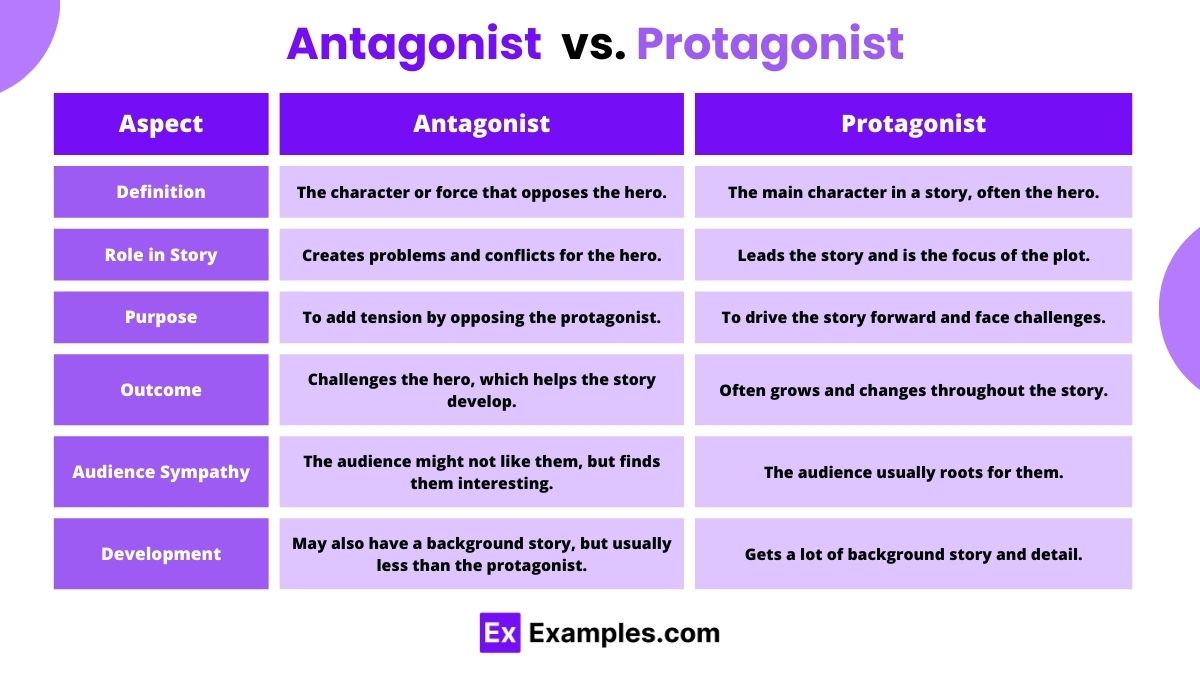
As the article argues, the antagonist is the story's resistance function. They are not defined by morality, but by opposition. A protagonist with a goal but no meaningful opposition is just a person on a to-do list. A protagonist who is actively opposed by an intelligent, motivated counterforce is in a story.
To visualize this relationship, consider this direct comparison:
2. Engineering Opposition: Mutually Exclusive Goals
The core principle for creating conflict is to ensure the goals of the protagonist and antagonist are mutually exclusive. If the protagonist succeeds, the antagonist must fail, and vice versa. There are two primary models for achieving this.
Character Goals and Motivations (Writing Advice)
The video 'Character Goals and Motivations' by writer Brandon McNulty provides clear examples of the two main structures for oppositional goals.
Watch the segment from 02:47 to 04:39. Focus on the distinction between the 'Rocky' example (same goal) and the 'Die Hard' example (different but connected goals).
Let's break down these two models systematically.
Model A: The Zero-Sum Game (Shared Goal)
In this model, the protagonist and antagonist want the exact same thing, but only one can have it.
- Structure: Protagonist wants X. Antagonist wants X. Only one X exists.
- Example (
Rocky): Rocky wants to win the championship belt. Apollo Creed also wants to win (and keep) the championship belt. Their goals are identical and therefore perfectly oppositional. - Application: This is common in stories centered around competitions, rivalries, or races for a single prize (a promotion, an election, a treasure).
Model B: The Collision Course (Conflicting Goals)
In this model, the protagonist and antagonist want different things, but the pursuit of their respective goals brings them into direct conflict over a necessary resource, location, or outcome.
- Structure: Protagonist wants A. Antagonist wants B. The achievement of A and B are mutually exclusive, often because they require control of the same thing.
- Example (
Die Hard): John McClane wants to save the hostages (Goal A). Hans Gruber wants to steal the bearer bonds (Goal B). McClane cannot succeed if Gruber succeeds, and Gruber cannot succeed if McClane succeeds. They are in conflict over control of the Nakatomi Plaza building. - Application: This is common in stories where a hero is trying to prevent a catastrophe, stop a crime, or protect something that the antagonist wants to destroy or exploit.
3. A Design Algorithm for the Antagonist's Goal
With these models in mind, we can use a step-by-step process to formulate the antagonist's goal. This process ensures the opposition is both functional and compelling.
Let's return to the 'Embrace Your Villain Nature' article, which offers a clear, actionable checklist for antagonist design.
Read the section 'How to Design an Antagonist.' We will focus on steps 1 and 2, but the entire list is a valuable design tool.
Here is the algorithm:
-
State the Protagonist's SMART Goal: You must have a clear understanding of what the protagonist wants.
- Example: A marine biologist wants to prove a newly discovered coral reef qualifies for environmental protection before a construction conglomerate begins dredging the area in one month.
-
Formulate a Mutually Exclusive Goal for the Antagonist: Choose one of the two models (Shared Goal or Conflicting Goal).
- Using Model A (Shared Goal): This model is less applicable here, but could be forced. e.g., A rival biologist wants to claim the discovery of the reef for herself, and her methods involve falsifying data that would disqualify it for protection, giving her more time to publish.
- Using Model B (Conflicting Goal): This is a more natural fit. The CEO of the construction conglomerate wants to begin dredging on schedule to avoid massive financial penalties on a government contract. The biologist's success (protection) makes the CEO's success (dredging) impossible.
-
Give the Antagonist Agency: The antagonist must actively pursue their goal.
- Example: The CEO doesn't just wait. She dispatches lawyers to challenge the biologist's credentials, hires a PR firm to discredit the discovery, and pressures local officials to deny research permits. She is an active force.
Test your understanding!
In the last lesson, we developed a protagonist's goal: "To win the annual 'Round the World' yacht race and use the prize money to leave their hometown forever."
Your task is to formulate two different antagonist goals, one for each model of opposition.
- Model A (Shared Goal): Design an antagonist who wants the same thing.
- Model B (Conflicting Goal): Design an antagonist who wants a different thing that makes the protagonist's goal impossible.
Show answer
Here are two possible solutions:
-
Model A (Shared Goal): The antagonist is last year's champion, a wealthy and ruthless sailor. He needs to win the race again to secure a sponsorship deal that will save his family's failing shipping company from bankruptcy. He wants the same prize money and title as the protagonist, and he is willing to sabotage other racers to get it.
-
Model B (Conflicting Goal): The antagonist is an extreme environmental activist who believes the yacht race causes irreparable harm to marine ecosystems. Their goal is to disrupt and ultimately cancel the race by sabotaging key infrastructure (like navigation buoys) and blockading the starting line. Their success (canceling the race) is mutually exclusive with the protagonist's success (winning the race).
4. Beyond Simple Opposition: Conflicting Values
The most compelling antagonists often oppose the protagonist on a deeper, philosophical level. Their goal isn't just a plot device; it's the physical manifestation of a conflicting worldview.
In these cases, the protagonist and antagonist might even agree on a general principle but differ violently on its execution. This creates a more complex and engaging conflict.
The #1 Secret to Writing Iconic Characters
The video 'The #1 Secret to Writing Iconic Characters' uses the film 'Whiplash' to demonstrate a sophisticated form of opposition based on values and methods, rather than simple goal-blocking.
Watch the analysis of 'Whiplash' from 03:30 to 05:28. Notice that Andrew (protagonist) and Fletcher (antagonist) fundamentally agree that greatness is worth the sacrifice. The conflict comes from Fletcher's method of enforcing that belief, which directly threatens Andrew's well-being and humanity.
In Whiplash, the opposition isn't as simple as "Andrew wants to be a great drummer" and "Fletcher wants to stop him." Instead:
- Andrew's Goal: To become one of the jazz greats.
- Fletcher's Goal: To find the next Charlie Parker by pushing students to their absolute breaking point.
Their goals seem aligned. However, Fletcher's method of achieving his goal creates an unbearable, dangerous, and directly oppositional force to Andrew's attempt to achieve his own. The conflict becomes a debate played out through action: "What is the true cost of greatness, and is it worth it?"
This demonstrates that an antagonist's goal doesn't always have to be "I want to destroy the hero." It can be "I want to achieve my goal, and I am indifferent to the fact that the hero will be destroyed in the process."
Conclusion
Today we have engineered the second crucial component of a story's engine: the antagonist's goal. By defining it as a force in direct, mutual opposition to the protagonist's desire, you create the conditions for inevitable and escalating conflict.
Key Takeaways:
- An antagonist is an active resistance function, not a passive obstacle.
- The core of opposition lies in mutually exclusive goals. If one succeeds, the other must fail.
- There are two primary models for this: the Shared Goal (zero-sum game) and the Conflicting Goal (collision course).
- A powerful antagonist has agency and actively pursues their goal, forcing the protagonist to react and escalate.
- The most sophisticated conflicts arise when the opposition is not just about plot, but about a fundamental clash of values or methods.
Preview of the Next Lesson:
We have established the external conflict: the protagonist's desire versus the antagonist's opposing goal. But what makes this conflict resonate? The answer lies inside the protagonist. In our next lesson, we will explore the protagonist's inner world by learning how to define a character's internal need as the flaw or misbelief preventing their fulfillment. This is the element that connects the external plot to the character's internal journey of change.