Introduction
Welcome to our next lesson on character dynamics. In the previous lesson, we established how a story's overall plot acts as a macro-level pressure system. We saw that major turning points like the Inciting Incident, Midpoint, and Climax are engineered to systematically challenge and break a character's core Misbelief, forcing them to move towards their Need.
Today, we zoom in from the architectural level of the plot to the engineering level of the individual scene. Our objective is to design pressure-point scenes where a character must choose between their desire and their need. This is where the abstract conflict becomes a concrete, dramatic choice. We are moving from what the plot does to a character, to how a scene stages that conflict in real-time.
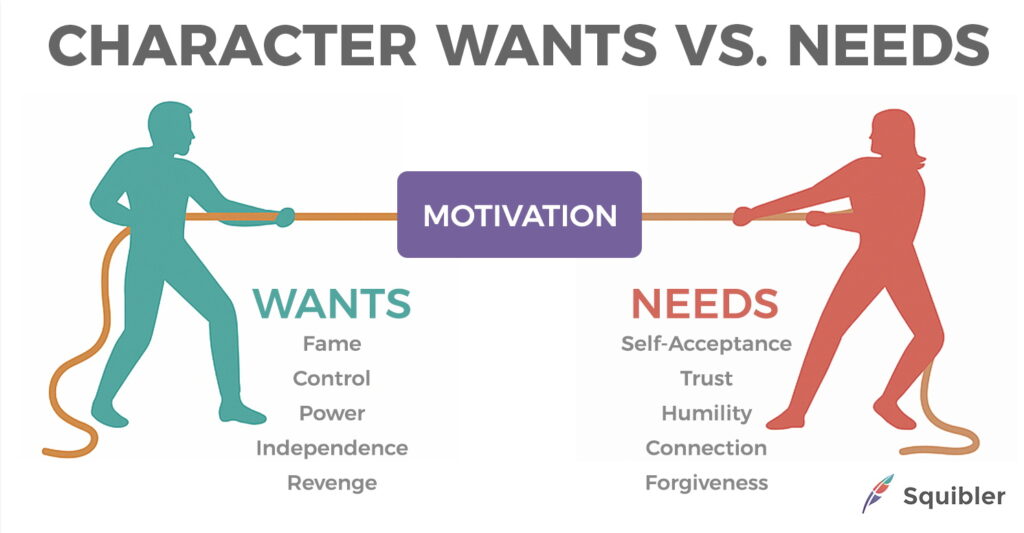
To frame our thinking, consider this visual metaphor for the central conflict we will be engineering today.
1. The Core Mechanic: Forcing a Value Trade
A pressure-point scene is not merely a scene with high stakes; it is a scene that presents the character with a specific, engineered dilemma. The central mechanism is forcing the character into a situation where their conscious goal (Desire or Want) and their subconscious, developmental requirement (Need) are mutually exclusive.
To achieve one, they must sacrifice the other. This is the "horrible choice" we touched on previously, now executed at the scene level.
The article "Character Arcs: How To Show Growth And Change" describes this principle with technical precision.
Character Arcs: How To Show Growth And Change
Let's review a key section from 'Character Arcs: How To Show Growth And Change' that defines the core principle of our lesson today.
Please read the subsection titled 'Decisions Under Pressure'. Pay close attention to the three commands given: 'Prioritize choices over explanations,' 'Raise immediate cost,' and 'Force a value trade.'
The key takeaway is that change is demonstrated through choice under pressure. Our job as writers is to construct the pressure. The core components of this pressure are:
- A Clear Choice: The character must face two or more distinct paths.
- An Immediate Cost: Each path must have a tangible, immediate consequence.
- A Value Trade: The choice must force the character to sacrifice something they value (e.g., their goal, their pride, their safety) in order to gain something else. A pressure-point scene stages a direct conflict between the values underpinning the Desire and the values underpinning the Need.
2. A More Granular Model: The Internal Conflict Equation
While "Desire vs. Need" is a useful high-level concept, we can break it down into a more robust, systematic model that is easier to implement mechanically. This approach treats internal conflict less like a vague feeling and more like an equation with interacting variables.
The following video offers a powerful framework for this, which we will deconstruct and apply.
You’ve Been Lied to About Internal Conflict—Use THIS Instead
The video 'You’ve Been Lied to About Internal Conflict—Use THIS Instead' by Julian Maylett presents a systematic 'internal conflict equation.' It reframes the simple Desire vs. Need into a more dynamic and interconnected system.
We'll watch two key segments that define the engine of our pressure-point scene: Conflicting Desires (09:06 - 10:55): Focus on the definition of conflicting desires as two equally strong but incompatible forces that stem from the character's core 'psychological need' (their flaw/misbelief). Fixations (13:04 - 15:46): Pay attention to how a 'fixation' is defined as the external goal the character pursues in a flawed attempt to reconcile their conflicting desires without addressing the root cause. This will give us a more precise model: the Fixation is the external Desire/Want we see in the plot, and it's fueled by the character's internal Conflicting Desires.
Let's integrate this into a clear, operational sequence:
- Psychological Need (The Flaw/Misbelief): This is the character's core wound or false belief about the world, which we've discussed in previous lessons. Example: A character believes they are unlovable.
- Conflicting Desires (The Internal Tug-of-War): Stemming from this flaw, the character develops two powerful, incompatible desires. Example: (1) The desire to push everyone away to avoid the pain of inevitable rejection, and (2) The desire to earn love and validation from others.
- Fixation (The External Goal/Want): The character chooses an external goal they believe will solve their internal conflict without forcing them to confront their actual flaw. Example: The character becomes fixated on achieving a major professional award, believing the public acclaim will finally prove they are worthy of love.
A pressure-point scene is a scenario where the character's pursuit of their Fixation brings their Conflicting Desires into direct, irreconcilable opposition. To get the award, they might have to collaborate closely with a partner, forcing them to choose between pushing the person away (to avoid rejection) or opening up to them (to earn their help/validation).
3. Staging the Choice: The Scene Dilemma
Now that we have the components of the conflict, where in the scene do we place this choice? The classic Scene/Sequel structure gives us a precise location: the Dilemma.
6 Steps to Create Realistic (and Powerful) Scene Dilemas
The article '6 Steps to Create Realistic (and Powerful) Scene Dilemmas' by K.M. Weiland provides a blueprint for structuring a scene around a moment of difficult choice.
First, read the introductory section to quickly review the Scene/Sequel structure. Note the placement of the 'Dilemma' after the 'Reaction.' Then, read the section 'A 6-Step Checklist for Getting the Most From Your Scene Dilemmas.' This is our practical guide for constructing the moment of choice. Focus on how it translates an abstract choice into a character's tangible, emotional experience.
The sequence within a scene or pair of scenes works as follows:
- Goal: The character tries to achieve something (often related to their Fixation).
- Conflict: They meet an obstacle.
- Outcome/Disaster: They fail, or their success comes with a new, worse complication.
- Reaction: They have an immediate emotional response to the disaster.
- Dilemma: This is the pressure point. The character must now process the failure and confront a new set of options. This is where the Conflicting Desires are activated, forcing a choice about what to do next. The choice is often between doubling down on the Misbelief or trying a new tactic aligned with the Need.
- Decision: The character chooses a new Goal, and the cycle begins again.
The pressure-point scene is essentially the dramatization of the Dilemma and Decision.
4. Application: Engineering a Pressure-Point Scene
Let's use the software architect character from our last lesson's exercise to build a pressure-point scene from these components.
- Character: A brilliant but arrogant software architect.
- Misbelief (Psychological Need): "I am only valuable if I am a lone genius; collaboration is for the mediocre."
- Conflicting Desires:
- To protect her identity as a superior, singular talent.
- To achieve the success and validation that comes from winning.
- Fixation (Desire/Want): To win a prestigious innovation competition.
The Scene Setup (The Disaster): As in our previous example, a critical server failure corrupts a key module of her software right before the final presentation. Her solo effort is dead in the water.
The Pressure Point (The Dilemma):
- Reaction: Panic, fury. She slams her laptop shut. This is a failure of her environment, but it exposes the fragility of her one-person strategy.
- Dilemma: An announcement is made: due to the server issue, a 30-minute extension is granted only to teams that merge their projects. Her main rival, who she scorns for his collaborative approach, also suffered a project-killing failure. He walks over to her workstation. He has the backend component she's missing; she has the user interface he couldn't perfect.
- Choice A (Serve Conflicting Desire #1 / Cling to Misbelief): Reject his offer. Her identity as a "lone genius" remains intact, but she accepts total failure. The cost is her Fixation (the award).
- Choice B (Serve Conflicting Desire #2 / Move toward Need): Accept his offer. She must swallow her pride and collaborate, implicitly admitting her solo approach was insufficient. The cost is her Misbelief (her identity as a lone genius).
This is a perfectly engineered pressure point. There is no easy way out. The scene's drama comes from watching her weigh these two agonizing options and make a decision that will prove who she is becoming. The choice is the character arc in action.
Test your understanding!
A homicide detective has the following profile:
- Misbelief: "True justice requires breaking the rules; procedure only protects the guilty."
- Fixation (Want): To catch a notorious serial killer who has eluded the police for years.
- Need: To learn that procedure and the rule of law protect everyone, including the innocent.
Design a pressure-point scene for this detective. What is the Disaster and what is the core Dilemma (the A/B choice) that forces him to choose between his Want and his Need?
Show answer
Here is one possible design:
-
Disaster: The detective has illegally bugged the primary suspect's apartment. He overhears the suspect on the phone saying, "It's time to get rid of the evidence. Meet me at the old warehouse in one hour." This is the confession he needs, but the evidence is inadmissible in court because it was obtained illegally. If he uses it, the case will be thrown out, and the killer will walk free forever due to double jeopardy rules.
-
Dilemma: He arrives at the warehouse before the suspect. Inside, he finds a terrified, bound-and-gagged person (the killer's next victim) and, nearby, the murder weapon from the previous killings. The killer is moments away from arriving.
-
Choice A (Cling to Misbelief): He can "find" the murder weapon and plant it on the suspect when he arrives, manufacturing "clean" evidence to guarantee a conviction. He'd be breaking the rules to achieve what he sees as "true justice." This serves his Want (catch the killer) but violates his Need. He would be sacrificing the rule of law.
-
Choice B (Move toward Need): He can rescue the victim and call for backup, following procedure. The killer will likely escape when he hears the sirens, and the illegally obtained audio will remain useless. He may lose his one chance to catch the killer. This serves his Need (uphold the law to protect the innocent victim right in front of him) but forces him to sacrifice his immediate Want.
-
The choice forces him to decide what "justice" really means: a guaranteed conviction based on a lie, or adherence to a process that might let the guilty party escape for now.
Conclusion
Today, we deconstructed the mechanics of the pressure-point scene. We moved from the high-level concept of "Desire vs. Need" to a more granular, actionable framework for engineering choices that reveal and drive character change.
Key Takeaways:
- A pressure-point scene's primary function is to force a value trade between a character's conscious Desire (Want) and their unconscious Need.
- The "Internal Conflict Equation" provides a robust model: a deep Psychological Need (Misbelief) creates Conflicting Desires, which in turn drive the character to pursue an external Fixation (Want).
- The Scene-Sequel structure gives us a specific location—the Dilemma—to stage this choice, turning an external failure into an internal decision point.
- Designing these scenes involves creating two clear, costly options: one that reinforces the Misbelief and another that moves towards the Truth/Need.
Preview of the Next Lesson:
We have learned how to construct a scene that forces a character to make a difficult choice. But what makes their eventual decision feel authentic and earned? In our next lesson, we will address the learning outcome: Test a character's behavioral consistency by filtering their decisions through their established values and fears. We will explore the systems that govern a character's decision-making logic, ensuring that their choices—especially under pressure—are both surprising and inevitable.