Introduction
Welcome to the next lesson in our study of character dynamics. In our previous sessions, we systematically categorized the three primary types of character arcs: positive, negative, and flat. We defined a character's internal journey as a conflict between a flawed Misbelief and a more functional Truth. We saw how a positive arc moves toward the Truth, a negative arc clings to the Misbelief, and a flat arc tests a character who already embodies the Truth.
Today, we transition from character design to plot engineering. The central question is no longer "What is a character arc?" but "How does the plot mechanically cause a character arc?" This lesson directly addresses the learning outcome: Link character arc to plot by identifying specific events that force a character to confront their misbelief.
We will analyze the plot not as a sequence of events that happens to a character, but as a purpose-built system of pressure points designed to challenge, test, and ultimately shatter their core Misbelief.
1. The Core Mechanism: Plot as a Pressure System
At its core, a story with a dynamic character arc operates on a single, powerful rule: the character cannot achieve their external, conscious goal (Want) without addressing their internal, unconscious flaw (Need/Misbelief). The plot is the mechanism that enforces this rule.
Think of it as a form of system testing. The character's Misbelief is a fundamental flaw in their internal "operating system." The plot is a series of targeted test cases (scenes and events) designed to provoke a critical failure in that system, forcing a "patch" (the adoption of the Truth).
To begin, let's watch a segment that establishes this essential connection between the outer and inner journeys.
What Screenwriters Should Know About A Character's Inner Journey - Michael Hauge
In 'What Screenwriters Should Know About A Character's Inner Journey,' screenwriter Michael Hauge explains the fundamental connection between a character's outer goal and their inner transformation.
Watch from 07:02 to 08:45. Focus on the 'rule' he presents: the hero cannot achieve their outer goal unless they are willing to step out of their 'identity' (their false self, built on the Misbelief). This creates the central inner conflict that drives the story.
As Hauge explains, the plot confronts the character with a "horrible choice":
- Remain safe within the armor of your Misbelief, but remain unfulfilled and fail to achieve your goal.
- Become terrified by dropping your armor and confronting your fear, but gain the chance to achieve your goal and find fulfillment.
The entire plot is the "tug of war" between these two options. Every significant plot event is designed to increase the tension on that rope.
2. The Causal Chain: How Plot Events Force Confrontation
A character's arc doesn't happen in a vacuum; it's a direct result of plot events. These events are not random. They are strategically placed to dismantle the character's Misbelief piece by piece. The following article provides a clear, structural map of this process.
Everything You Need to Know About the Lie the Character ...
The article 'Everything You Need to Know About the Lie the Character Believes' by K.M. Weiland provides an excellent breakdown of how key plot stages correspond to stages of the character's arc.
Read the article from the beginning down to the section 'Examples of Different Kinds of Lies...' This covers the core theory. As you read, focus on how each structural point of the plot serves a specific function in challenging the Lie: Inciting Event: Challenges the old perspective. First Half of Second Act: Shows the Lie is ineffective against new problems. Midpoint: A 'Moment of Truth' where the Truth is revealed as a possibility. Third Plot Point (Low Moment): A defeat directly caused by clinging to the Lie, proving its ultimate failure. Climax: The character acts on the integrated Truth to confront the final obstacle.
Let's systematize this process into a clear causal chain. The plot forces the character to confront their Misbelief through three critical stages:
Stage 1: The Collision (Setup & Inciting Event)
The story begins by establishing the character's Misbelief and then introduces an Inciting Event that creates a plot Want. Crucially, the pursuit of this Want puts the character on a direct collision course with their Misbelief.
- Function: To make the Misbelief a problem that can no longer be ignored.
Stage 2: The Cracks (Midpoint Revelation)
As the character pursues their Want using their flawed Misbelief, they encounter escalating obstacles and failures. This culminates in the Midpoint, a major plot event that reveals the Truth to them as a viable, more effective alternative. It's the moment a lightbulb goes on, showing them a new path. The Misbelief is no longer the only option; it is now explicitly challenged by a new idea.
- Function: To demonstrate the ineffectiveness of the Misbelief and the effectiveness of the Truth.
Stage 3: The Breaking Point (Climax & Resolution)
In the final act, the plot engineers a high-stakes scenario where the Want and the Need are placed in direct opposition. The character is forced to make a final, irreversible choice. They must actively discard the Misbelief and act on the Truth to succeed.
- Function: To force a definitive, actionable choice between the Misbelief and the Truth.
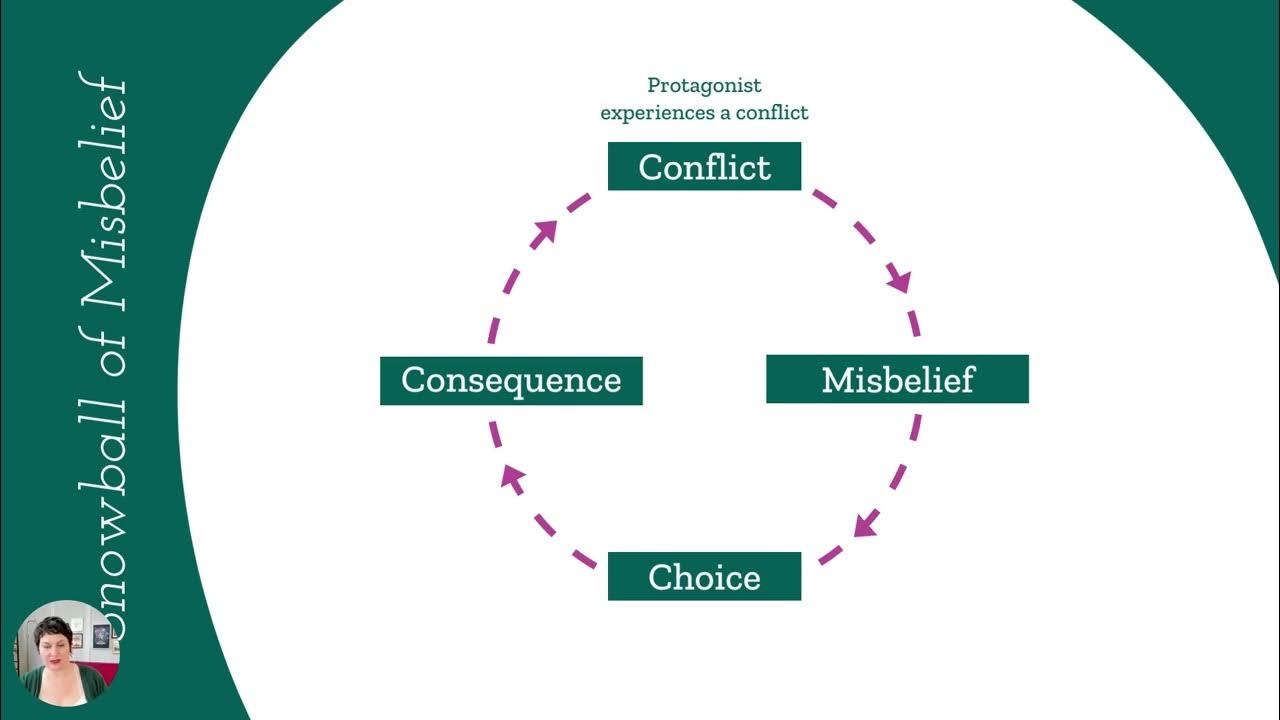
This is the "Snowball of Misbelief" cycle breaking. The plot introduces a conflict where the old choice (based on the misbelief) leads to an unacceptable consequence, forcing a new choice.
3. Case Study: Rain Man
Theory is best understood through application. Let's analyze how the plot of Rain Man systematically forces Charlie Babbitt to confront his Misbelief.
How to Write a Character Arc — "Positive Change" Character Arcs Explained
The StudioBinder analysis 'How to Write a Character Arc' breaks down the plot of Rain Man and shows precisely how plot events target the protagonist's core flaw.
Watch the following three segments: Charlie's Initial State (03:44 - 06:24): Note his Misbelief. He is materialistic and emotionally disconnected due to his 'ghost' (resentment toward his father). The Midpoint Revelation (08:07 - 10:33): Observe how a plot event—Raymond's distress—triggers a memory. This is the 'Funny Rain Man' scene. This revelation is a direct confrontation with his Misbelief, showing him his resentment is based on a misunderstanding. The Climactic Choice (12:42 - 15:52): See how the plot manufactures two key events: the doctor offering him a check ($250k) and the custody hearing. These events force him to choose between his original Want (money) and his emerging Need (connection).
Let's map this to our three-stage model:
- Character: Charlie Babbitt
- Misbelief: "Connection is transactional and dangerous; money is the only reliable measure of worth."
- Want (External Goal): To get his $3 million inheritance.
- Need (Internal Truth): To purge his resentment and form a meaningful human connection.
Stage 1: The Collision
The Inciting Event is the reading of the will. The plot immediately links the Want (money) to the source of his future change (Raymond). To get the money, Charlie must engage with the very thing his Misbelief rejects: a non-transactional, emotionally complex human relationship. The plot forces him onto a cross-country road trip, trapping him in a contained environment where his Misbelief will be repeatedly tested.
Stage 2: The Cracks
The "Funny Rain Man" scene is a perfect Midpoint Revelation. The plot event (Raymond's panicked reaction to hot water) is the trigger. It's not an internal monologue; it's an external action that forces a confrontation. This plot point reveals to Charlie that his entire "ghost"—the resentment fueling his Misbelief—is based on a false narrative. He wasn't abandoned; his brother was sent away to be protected. The Misbelief is now cracked, shown to be built on faulty data.
Stage 3: The Breaking Point
The plot presents a final, escalating series of tests:
- The Check: Dr. Bruner offers Charlie his original Want (money, or at least a large sum) if he will abandon his Need (Raymond). This is a pure, mechanical test. Charlie's rejection of the money is the first concrete proof that his internal operating system has been patched.
- The Hearing: The Climax is not a physical fight but a forced decision. The plot puts him in a room and asks: what is best for Raymond? Charlie must act on the Truth—that he cares for his brother's well-being more than his own desire to "win" or possess him. By letting Raymond go back to Walbrook, he fully sacrifices his Want for his Need, completing the arc.
The plot didn't just happen around Charlie; it was the precision tool used to deconstruct him.
Test your understanding!
A young, ambitious software architect has the following Misbelief: "To be truly great, one must be a lone genius. Collaboration is for the mediocre."
Her external Want is to win a prestigious innovation competition by building a revolutionary new piece of software.
Design two specific plot events that would force her to confront this Misbelief:
- A Midpoint Event that cracks her belief system.
- A Climactic Event that forces a final choice between her Misbelief and the Truth ("Greatness is achieved through collective intelligence").
Show answer
Here is one possible solution:
-
Midpoint Event: After weeks of working alone, she hits an insurmountable coding problem that threatens her entire project. In desperation, she posts an anonymous query on a niche forum. A rival architect, whom she scorns for his collaborative approach, provides an elegant, brilliant solution she never would have considered. For the first time, she is confronted with undeniable proof that another person's mind can solve a problem that her "lone genius" could not. This event reveals the Truth (collaboration has value) as a real possibility, cracking her Misbelief.
-
Climactic Event: On the final day of the competition, just before her presentation, a critical server failure corrupts a key module of her software. It's impossible for her to fix it alone in time. Simultaneously, she discovers that her collaborative rival's project has also suffered a catastrophic, but different, failure. The judges, due to the widespread server issue, offer a single 30-minute extension for any team that merges their projects. She is forced to make a choice: cling to her "lone genius" Misbelief and fail, or embrace the Truth by collaborating with her rival to create a hybrid project that could win. Her decision will be the final, actionable proof of her arc.
Conclusion
Today we connected the abstract concept of character arc to the concrete mechanics of plot. We have established that in a story with a dynamic arc, the plot functions as a deliberate system of pressure designed to force a character to confront and ultimately abandon their core Misbelief.
Key Takeaways:
- Plot is the engine that drives character change. The character's external goal (Want) cannot be achieved without them confronting their internal flaw (Misbelief).
- The plot creates a causal chain of events that systematically breaks down the Misbelief.
- The Inciting Event creates a collision between the character's Want and their Misbelief.
- The Midpoint delivers a revelation that presents the Truth as a viable alternative, cracking the Misbelief's foundation.
- The Climax forces a final, irreversible choice where the character must act on the new Truth to succeed, thus completing their arc.
Preview of the Next Lesson:
We have now seen how major plot beats (Inciting Incident, Midpoint, Climax) function as macro-level pressure points. In our next lesson, we will zoom in. The learning outcome is: Design pressure-point scenes where a character must choose between their desire and their need. We will move from the architectural level of the overall plot to the engineering level of individual scenes, examining how this conflict is staged line by line and action by action.