Introduction
Welcome back. In our previous lesson, we designed a scene list by breaking down your high-level story beats into a sequence of granular, functional units. Using the Scene-Sequel model, we defined each scene by its Goal -> Conflict -> Disaster structure and each sequel by its Reaction -> Dilemma -> Decision structure. This alternating pattern is designed to create an engine of cause and effect.
Today, we will pressure-test that engine. The learning outcome for this lesson is to test the causal chain of an outline by ensuring each event logically results from the one preceding it. You will learn a simple but powerful diagnostic tool to audit your scene list, identify weak links, and ensure your plot is a tightly connected chain of consequence, not just a list of things that happen. This is the mechanical equivalent of checking for logical fallacies in an argument or null pointers in a data structure.
1. The "And Then" Problem: Identifying Weak Causal Links
A narrative outline's most common failure mode is being episodic. This happens when events are connected chronologically but not causally. The symptom of this problem is the phrase "and then."
- The hero fights a dragon, and then he goes to the city, and then he meets a princess.
This structure lacks momentum and tension because the events are arbitrary. They don't necessitate one another. A strong plot is a system where each event is a direct consequence of the one before it.
To diagnose and fix this, we can use a simple rule popularized by Trey Parker and Matt Stone, the creators of South Park.
Storytelling Advice from the Creators of South Park
The article 'Storytelling Advice from the Creators of South Park' by Nathan B. Weller introduces a simple but highly effective test for narrative causality. It presents a binary choice for connecting your story beats.
Read the section titled 'The “But & Therefore Rule” by Matt Stone and Trey Parker'. Focus on the fundamental distinction between an 'and then' sequence and a 'but/therefore' sequence.
As the article states, the test is this: when reviewing the beats of your outline or the scenes in your scene list, see if you can connect them using the words "but" or "therefore." If you are consistently forced to use "and then," you have identified a flaw in the causal chain.
- "Therefore" signifies a direct, logical consequence. Event A occurs, therefore Event B must occur.
- "But" signifies a conflict, obstacle, or reversal. The character attempts A, but B happens instead, forcing a change in direction.
These two conjunctions are the engine of causality. "And then" is the engine stalling.
2. Causality as a System of Action and Reaction
This rule maps directly onto the Scene-Sequel structure we discussed previously. It's a different lens for viewing the same mechanical process.
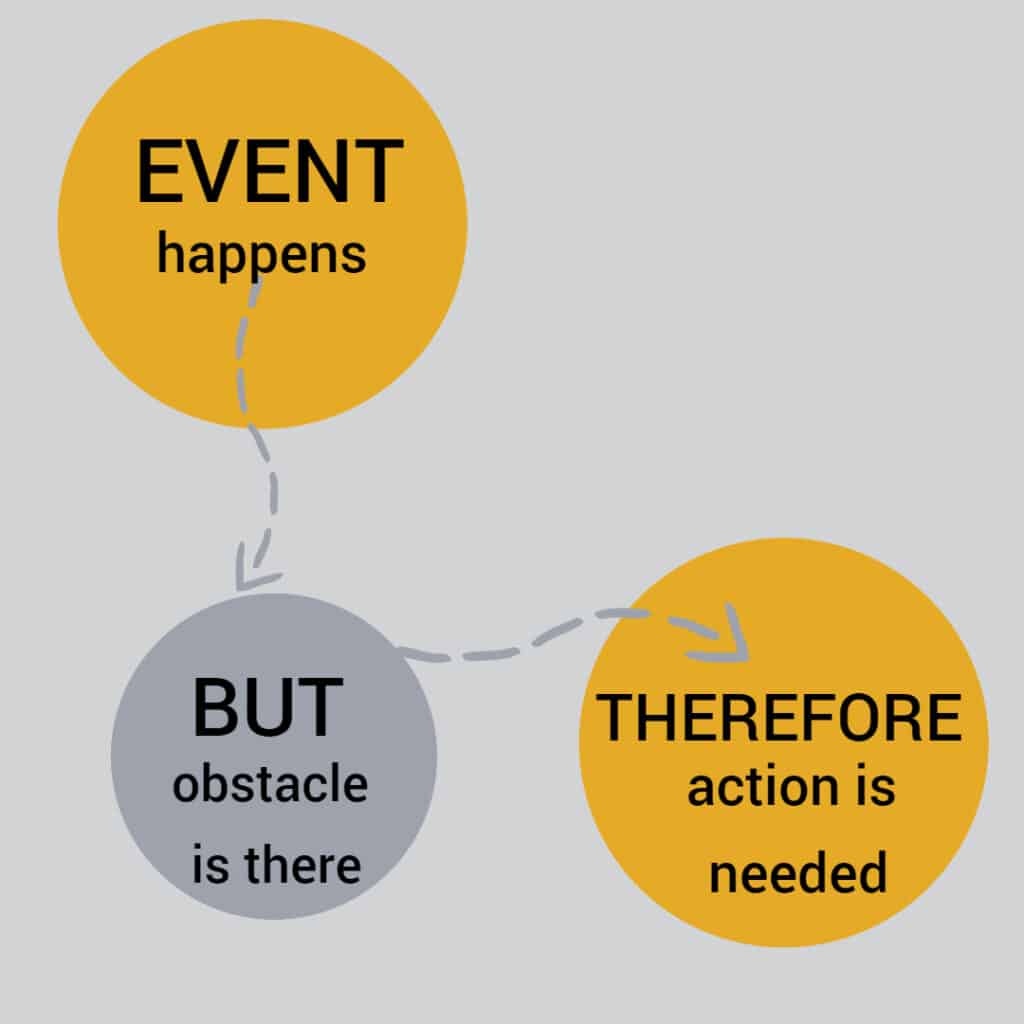
- A character makes a Decision in a Sequel. THEREFORE, their Goal in the next Scene is to act on that decision.
- A character pursues a Goal. BUT, they encounter Conflict that leads to a Disaster.
This creates a repeating loop of action and reaction, visually represented as follows:
Let's see this in action. Consider this weak, "and then" sequence:
- A spy, Anya, needs to retrieve a microchip from a secure vault.
- And then, she deactivates the laser grid.
- And then, she opens the vault door.
- And then, she takes the microchip.
This is a log of events, not a story. There is no tension because there are no meaningful consequences or obstacles. Now, let's rebuild it using "But" and "Therefore."
- A spy, Anya, needs to retrieve a microchip from a secure vault. THEREFORE, she begins by deactivating the laser grid.
- She successfully deactivates the grid, BUT this triggers a silent alarm she didn't know about, starting a 60-second countdown.
- THEREFORE, she must now sprint to the vault and override the electronic lock before security arrives.
- She gets the vault door open with one second to spare, BUT the microchip is not in its designated case.
- THEREFORE, she must quickly search the vault, knowing armed guards are about to burst through the door.
Each step is now a direct consequence of the previous one, creating a chain of escalating problems. The "Buts" introduce conflict, and the "Therefores" show the logical next action under pressure.
To see more examples of this transformation, the comments section of the previous article contains several practical demonstrations.
Storytelling Advice from the Creators of South Park
The comments in the 'South Park' article offer several user-generated examples of transforming 'and then' sequences into causal chains. Analyzing these will help solidify your understanding.
In the comments section, locate the threads started by users 'Michael,' 'Andrew,' and 'Jeremiah.' Read the replies to their comments, paying close attention to how other users break down and reconstruct simple sentences into causal sequences using 'but' and 'therefore'. The comment by 'Alex' provides a particularly detailed and useful breakdown.
3. Formalizing the Causality Test
Now that you have the tool, you can apply it systematically to the scene list you developed in the last lesson. Go through your list, scene by scene, and articulate the transition between each one.
[Outcome of Scene N] -> [BUT/THEREFORE] -> [Goal of Scene N+1]
If the transition feels weak or you are forced to say "and then," you have located a plot hole or a point of low narrative momentum.
The following resource provides a more formal definition of this process, linking it directly to the concept of a "chain of consequence."
The article 'The problem with plot points' from Darling Axe reinforces this idea from a more structural perspective, defining a strong plot as an unbreakable 'chain of consequence'.
Read the section 'Causality and the problem with plot points'. Note how the author states that 'the connections between the plot points are more important that the plot points themselves'. Focus on the description of 'therefore' as the protagonist taking action and 'but' as them reacting to an obstacle.
This reinforces a critical concept: causality ensures the protagonist is an active agent. Their choices and their reactions to obstacles are what forge the plot. An "and then" story is one where things happen to a protagonist; a "but/therefore" story is one the protagonist creates through their actions and decisions.
Test your understanding!
Here is a 4-beat outline for a simple story. It is currently a weak "and then" sequence. Your task is to rewrite it into a strong "but/therefore" chain.
Original Outline:
- A young librarian discovers a hidden map in an old book.
- And then, she decides to travel to the desert shown on the map.
- And then, she runs out of water.
- And then, she finds a hidden oasis.
Reconstruct this sequence using "But" and "Therefore" to create a logical flow where each beat causes the next.
Show answer
Here is one possible reconstruction:
- A young librarian, facing crushing debt, discovers a map in an old book that seems to point to a lost treasure. THEREFORE, she pawns her few belongings to fund a trip to the desert, hoping to solve her financial problems.
- She follows the map into the desert, BUT a sandstorm causes her to lose her way and damages her compass, depleting more water than she'd planned.
- Her water runs out, and she is on the verge of collapse. THEREFORE, in a final act of desperation, she follows a line of birds on the horizon, abandoning the map's path.
- The birds lead her not to the treasure, BUT to a hidden oasis, which saves her life but leaves her with a new problem: she is still lost, now with no map and no treasure.
Notice how each step creates the problem for the next. The desire for treasure (1) leads her to the desert. The sandstorm (2) causes her to run out of water. Running out of water (3) forces her to abandon the map and follow the birds. This leads to the discovery of the oasis (4), which solves the immediate problem (thirst) but complicates her main goal (finding treasure).
Conclusion
In this lesson, we established a rigorous, mechanical test for the causal logic of your outline. By auditing your scene list with the "But & Therefore" rule, you can ensure that your plot functions as an integrated system rather than a disconnected series of events.
Key Takeaways:
- A strong plot is a causal chain, where each event is a direct consequence of the previous one.
- The "But & Therefore" rule is a simple diagnostic tool to test this chain. "And then" signals a weak link.
- "Therefore" connects an action to its logical result (e.g., a Decision leading to a new Goal).
- "But" introduces an obstacle, conflict, or reversal that forces a change in direction (e.g., a Goal leading to a Disaster).
- Applying this test turns your outline into a dynamic system where the protagonist's actions and reactions actively drive the story forward.
Preview of the Next Lesson:
We have now confirmed that our plot events are causally linked. The next logical step is to examine the "why" behind the character's actions within that chain. In the next lesson, we will audit an outline for motivation by verifying every major character action has a clear, established 'why'. This moves our analysis from external plot logic to internal character logic, ensuring that every decision made along the causal chain is believable and compelling.