Introduction
Welcome back. In our last lesson, we constructed a high-level plot skeleton by creating a 15-point beat outline. This gave us the major structural pillars of our story, like an architectural blueprint showing where the load-bearing walls and key rooms are.
Today, we increase the resolution. Our goal is to develop a scene list that specifies the goal, opposition, and outcome for each planned scene. We'll move from the blueprint to the specific construction plan, detailing the function of each "brick" in the wall. You'll learn to break down your high-level beats into a sequence of concrete, functional scenes.
To do this, we will use a robust mechanical framework known as the Scene-Sequel model, first codified by Dwight Swain. This model provides a precise, logical structure for scenes that will resonate with your goal of treating writing as a technical discipline. It defines scenes not by their content, but by their function in a causal chain.
1. From Beats to Scenes: Increasing Resolution
A single "beat" from your 15-point outline is a major plot event. However, that event might unfold over one or several scenes. A scene list is the process of decomposing each beat into these smaller, actionable units.
For example, Beat #6, "Break Into Two," is the moment the protagonist commits to the adventure. This could be a single scene:
- Scene: Luke Skywalker agrees to go with Obi-Wan to Alderaan.
Or it could be a sequence of scenes that build to that commitment:
- Scene A (Action): Luke's goal is to find R2-D2. The opposition is the Sand People. The outcome is that they attack him, and he is rescued by Obi-Wan (a "Yes, but..." outcome—he's saved, but now he's entangled in something bigger).
- Scene B (Reaction/Sequel): Luke reacts to Obi-Wan's stories of the Force and his father. He faces a dilemma: stay on the farm or follow this strange wizard. He decides to stay.
- Scene C (Action): Luke returns home. His goal is to resume his normal life. The opposition is the Empire. The outcome (Disaster) is that he finds his aunt and uncle murdered.
- Scene D (Reaction/Sequel): Luke reacts to the tragedy. His dilemma is now gone; there's nothing left for him. He makes a new decision: to go with Obi-Wan and learn the ways of the Force.
This sequence of four scenes collectively fulfills the function of the "Break Into Two" beat. Your scene list bridges the gap between the high-level outline and the act of writing.
2. The Core Components of a Scene
The Scene-Sequel model categorizes scenes into two fundamental types: the Scene (an action unit) and the Sequel (a reaction unit). Understanding these two building blocks is the key to creating a powerful narrative engine.
To begin, let's focus on the definitions of these components.
The article 'Writing The Perfect Scene' by Randy Ingermanson provides a clear, mechanical breakdown of the Scene-Sequel structure. We'll start by studying the large-scale definitions of these two units.
Read the sections 'The Two Levels of Scene Structure' and 'Large-Scale Structure of a Scene'. Your focus should be on internalizing the three-part pattern for a 'Scene' (Goal, Conflict, Disaster) and a 'Sequel' (Reaction, Dilemma, Decision). Notice how the author describes this as a system that propels the story forward.
Let's formalize those definitions as they relate to our learning outcome.
The "Scene": A Unit of Action
A Scene (in the Swain/Ingermanson sense) is where the character acts to achieve an objective. It has three parts:
- Goal: A specific, concrete, short-term objective that the POV character wants to achieve in this scene. This must be something measurable.
- Bad goal: "Find happiness." (Too abstract).
- Good goal: "Get an herbal soak token from the foreman." (Specific, measurable).
- Conflict (Opposition): The obstacles that stand in the way of the goal. This is not just random trouble; it is direct opposition to the character's objective.
- Example: The foreman refuses to give the token. Other workers get in the way.
- Disaster (Outcome): The result of the conflict. Crucially, it should not be a simple success. The outcome must make the situation worse or introduce a new complication, creating a hook for the next scene. This is often framed as:
- No, and...: The character fails to achieve the goal, and a new problem is introduced. (e.g., "No, you don't get the token, and now the foreman is actively trying to get you fired.")
- Yes, but...: The character achieves the goal, but it comes with an unexpected, negative consequence. (e.g., "Yes, you get the token, but you had to promise the foreman a dangerous favor in return.")
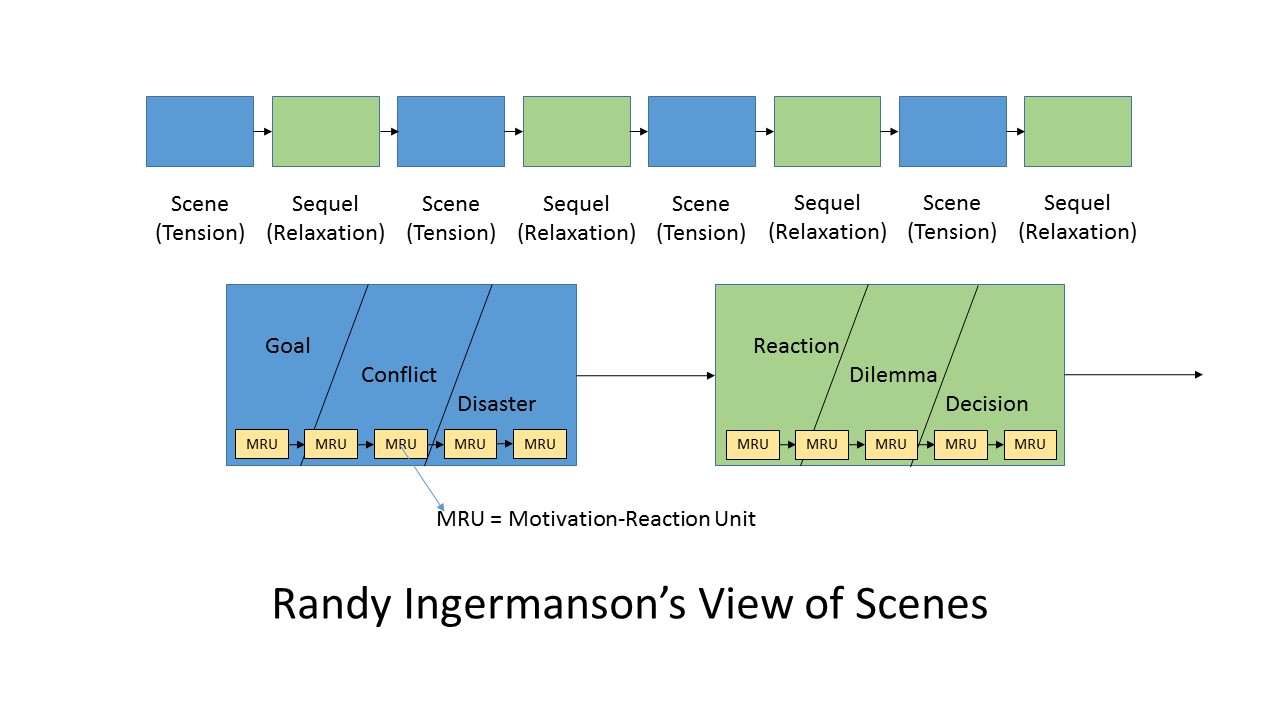
For a more detailed breakdown of these three components with examples, the following resource is very useful.
Scene Structure According to Swain
The article 'Scene Structure According to Swain' offers another excellent explanation with clear examples that will help solidify your understanding of Goal, Conflict, and Disaster.
Read the sections 'Goal', 'Conflict', 'Disaster', and the 'Example' from Spirited Away. Pay close attention to how 'Disaster' is defined as a 'No, and...' or 'Yes, but...' outcome, which is a key mechanical concept for ensuring forward momentum.
The "Sequel": A Unit of Reaction
A Sequel is what comes after a Scene. Its function is to process the disaster and set up the goal for the next Scene. This provides logical and emotional continuity. It also has three parts:
- Reaction: The character's immediate, involuntary response to the disaster. This is often emotional (fear, anger, grief) or visceral.
- Dilemma: A difficult choice the character now faces as a result of the disaster. There should be no easy or obvious answer. The dilemma forces the character to think and re-evaluate.
- Decision: The character makes a choice. This decision becomes the Goal for the next Scene.
This creates a powerful, unbreakable chain of cause and effect:Disaster -> Reaction -> Dilemma -> Decision -> New Goal -> Conflict -> New Disaster
3. Creating Your Scene List
Now you have the tools to build a scene list. For each beat in your outline, you will list the one or more scenes that comprise it. For each scene in that list, you will define its core components.
A functional scene list entry should look something like this:
| Beat # & Title | Scene # | Type | POV Character | Goal / Reaction | Opposition / Dilemma | Outcome |
|---|---|---|---|---|---|---|
| 9. Midpoint | 12 | Scene | Detective Miller | Goal: To confront the CEO with evidence of the fraud. | Opposition: The CEO's lawyers are present; the evidence is dismissed as circumstantial. | Disaster (No, and...): The CEO isn't arrested, and Miller is suspended for harassing him. |
| 9. Midpoint | 13 | Sequel | Detective Miller | Reaction: Fury and despair at being suspended and seeing the guilty man walk free. | Dilemma: Does he drop the case as ordered, or does he risk his career and continue investigating illegally? | Decision: He will continue investigating off-the-books. |
This decision from Scene 13 ("continue investigating off-the-books") now becomes the Goal for Scene 14, which would be the start of the "Bad Guys Close In" beat. The system is self-perpetuating.
Test your understanding!
Imagine a fantasy story. A young thief, Elara, has just discovered that a magical amulet she stole is cursed. This was the Disaster at the end of her last Scene. Now, construct a Sequel for her.
- Reaction: What is Elara's immediate emotional/physical reaction to discovering the curse?
- Dilemma: What difficult choice does the curse present her with? (Remember: no easy options).
- Decision: What does she decide to do, and what new Goal does this create for the next Scene?
Show answer
- Reaction: A wave of cold dread washes over her. She feels the amulet's icy chill seeping into her skin, and she tries to pull it off, but it's stuck fast to her neck. Panic sets in.
- Dilemma: She can either go to the city's mage guild for help, but they will certainly have her arrested for the theft. Or, she can try to find the reclusive hedge witch rumored to live in the dangerous Whisperwood, who might help her for a price but is just as likely to turn her into a frog.
- Decision: She decides to risk the Whisperwood. The mage guild means certain jail time, while the witch is only a possible horrible fate. Her new Goal for the next Scene is: "Find the hedge witch in the Whisperwood without getting killed by the things that live there."
Conclusion
In this lesson, we have moved from the macro-structure of beats to the meso-structure of scenes. By defining each scene in terms of its mechanical function—its goal, opposition, and outcome—you create a highly analytical and robust plan for your narrative.
Key Takeaways:
- A scene list breaks down high-level beats into a sequence of specific, functional scenes.
- The Scene-Sequel model provides a powerful framework for structuring these scenes.
- An action Scene is defined by
Goal -> Conflict -> Disaster. The outcome must be a "No, and..." or "Yes, but..." to maintain momentum. - A reaction Sequel is defined by
Reaction -> Dilemma -> Decision. It processes the previous disaster and generates the goal for the next scene. - This alternating pattern creates a robust cause-and-effect chain, forming the engine of your plot.
Preview of the Next Lesson:
With a detailed scene list in hand, our outline is now a chain of interconnected events. In our next lesson, we will focus on stress-testing this structure. You will learn to test the causal chain of an outline by ensuring each event logically results from the one preceding it. We will formalize the process of checking for plot holes and ensuring every link in your narrative chain is strong and necessary.