Introduction
Welcome to the first lesson in your course on the mechanics of writing. Our goal throughout this course is to approach writing as a technical discipline, focusing on the systems, structures, and repeatable techniques that form the foundation of effective storytelling.
We begin with Module 1, "Story Foundations," which covers the essential components a story is built from. In this lesson, we will tackle the very first step in engineering a narrative: formulating the core idea. Specifically, our learning outcome is to formulate a core story question using the 'What happens if...?' structure.
Think of this core question as the initial input variable for the entire story system. Just as a function in programming takes an input and processes it to produce an output, a story takes a core question and explores its consequences through plot and character. A well-defined question sets the parameters for the entire narrative that follows.
The Story Premise as a Starting Point
Before we can build a plot, we need a starting point—a premise. A premise is simply the foundational situation of your story. The most effective tool for generating a premise is a simple but powerful question: "What happens if...?"
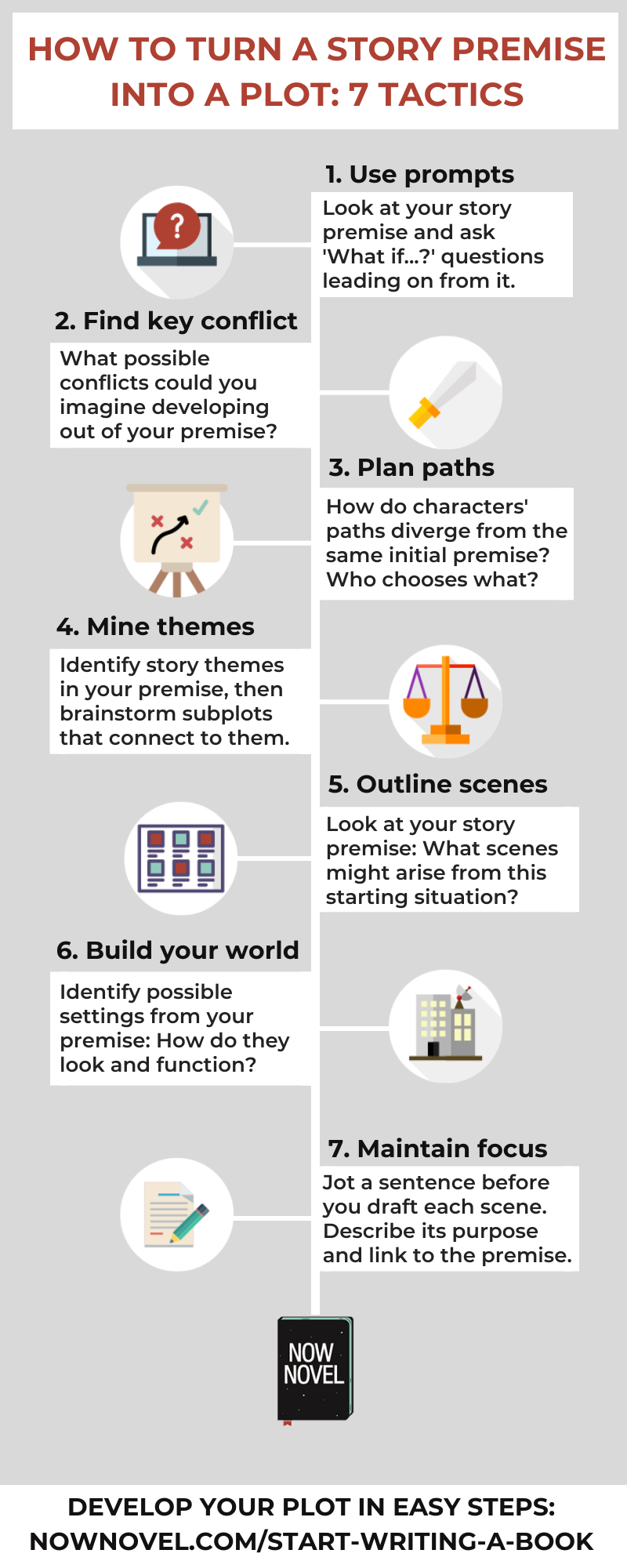
This question prompts you to combine a character or element with an unusual situation, creating a problem space for your story to explore. The infographic below shows how this initial prompt is the first step in a systematic process of developing a full plot.
To see this technique in action, let's watch a short video that explains how to use "what if" questions to generate compelling, high-concept ideas.
The Proven Formula That Makes a Story Irresistible
This video, 'The Proven Formula That Makes a Story Irresistible' from the channel Alyssa Matesic, explains how to craft intriguing story ideas. Pay close attention to the section on asking 'What if...?'
Watch the segment from 04:40 to 05:30. Notice how the examples provided are simple, yet they immediately spark curiosity about how the story might unfold.
As the video demonstrates, this structure is behind some of the most successful stories:
- What if dinosaurs existed in the modern world? (Jurassic Park)
- What if you could travel back in time and prevent the JFK assassination? (11/22/63)
- What if two teenagers with cancer fell in love? (The Fault in Our Stars)
Each of these questions establishes a clear, intriguing situation that demands exploration.
The Components of a Core Question
A simple "What if...?" question is a good start, but a truly robust story idea contains a few key components. We can think of this using a formulaic approach, as outlined in the following article.
Tim Knox: The Magic Formula for Great Story Ideas
The article 'The Magic Formula for Great Story Ideas' by Tim Knox for Writer's Digest provides a simple but powerful equation for story construction. It breaks down a story into its core operational parts.
Read the article from the beginning down to the end of the examples (just before 'In a nutshell...'). Focus on how the formula Character + Situation x Obstacles = Ending is defined and applied to well-known stories.
The article presents a clear system: Character + Situation x Obstacles = Ending.
- The Situation is established by your "What if...?" question.
- A Character is needed to act within that situation.
- The Obstacles are what create conflict and make the situation a story worth telling. Without obstacles, the character would resolve the situation immediately, and the story would end.
A strong "What if...?" question implicitly contains these elements. To make them explicit, we can use a set of diagnostic questions. The next video provides a framework for this.
If You Can't Answer These 6 Questions You Don't Have A Story - Glenn Gers
In this clip from Film Courage, screenwriter Glenn Gers explains that if you can't answer six specific questions, you don't have a fully formed story. These questions are a practical tool for testing and developing your initial 'What if...?' idea.
Watch the segment from 04:31 to 06:18. Listen carefully to the six questions he outlines. Think of them as a checklist to validate your core story idea.
Here are the six essential questions to test if your premise has the necessary components:
- Who is it about? (Character)
- What do they want? (Goal)
- Why can’t they get it? (Obstacle/Conflict)
- What do they do about that? (Action/Plot)
- Why doesn’t that work? (Escalating Obstacles)
- How does it end? (Resolution)
Let's apply this. Take the premise for Harry Potter:
- What if an orphan boy discovers he is a wizard?
Now, we can expand on it using the six questions:
- Who is it about? An orphan boy named Harry Potter.
- What does he want? To understand who he is and find a place to belong at wizarding school.
- Why can’t he get it? An evil sorcerer who murdered his parents is trying to kill him.
- What does he do? He trains as a wizard and, with his friends, investigates the threats against him.
- Why doesn’t that work? The sorcerer is more powerful and cunning than he anticipates, constantly putting him and his friends in mortal danger.
- How does it end? He confronts the sorcerer and, through courage and a unique connection to his parents' love, survives the encounter.
This exercise shows how the simple "What if...?" contains the DNA of the entire narrative structure.
Test your understanding!
Take the following core story question: "What if a timid zookeeper must single-handedly capture a genetically-engineered, hyper-intelligent velociraptor that has escaped in New York City?"
Break this down using Glenn Gers' first three diagnostic questions:
- Who is it about?
- What do they want?
- Why can’t they get it?
Show answer
- Who is it about? A timid zookeeper. This defines the character and immediately establishes an internal conflict (timidity vs. the need for bravery).
- What do they want? To capture the escaped velociraptor. This is a clear, external, measurable goal.
- Why can’t they get it? The obstacle is multifaceted: the raptor is hyper-intelligent (a formidable opponent), the setting is a dense urban environment (New York City), and the character's own timidity will hinder them.
From "What If...?" to a One-Sentence Concept
The "What if...?" question is a generative tool. The next step is to formalize it into a more precise statement known as a one-sentence story concept. This turns the raw idea into a testable hypothesis about your story.
The following resource provides a framework for this refinement. It's a long page with many comments, but the key information is in the main article text and the formulas it provides.
Understanding Premise and the One-Sentence Story ...
The article 'Understanding Premise and the One-Sentence Story Concept' by C. S. Lakin explains how to move from a basic premise to a structured, one-sentence summary of your story. It offers several templates for doing this effectively.
Read the section titled 'You Gotta Have Goal' and the text that follows, focusing on Nathan Bransford’s formula: 'When [opening conflict] happens to [character(s)], they must [overcome conflict] to [complete their quest].'
Let's use Bransford's formula to upgrade our examples:
- Initial Question: "What if dinosaurs existed in the modern world?"
- One-Sentence Concept: "When dinosaurs in a theme park break loose (opening conflict), a group of scientists (characters) must survive prehistoric predators and escape the island (overcome conflict) to reach safety (complete their quest)."
This format is more robust because it forces you to explicitly name the character, the initiating conflict, and the goal. It transforms a question into a statement of purpose for the narrative.
Test your understanding!
Now it's your turn.
- Generate two "What happens if...?" questions of your own. They can be about anything.
- Choose one of them and convert it into a one-sentence story concept using Bransford's formula: "When [opening conflict] happens to [character(s)], they must [overcome conflict] to [complete their quest]."
Try to be specific. Avoid vague descriptions like "it's not as easy as she thinks." A weak concept states a desire; a strong concept includes the opposition.
Example of refining a weak concept:
- Weak: "When a young woman decides she wants to be a chef, she must overcome many obstacles to achieve her dream." (Vague obstacles).
- Strong: "When a talented but un-trained home cook gets a chance to work in a world-class kitchen (opening conflict), she (character) must master punishing techniques and survive the sabotage of a jealous rival (overcome conflict) to win the annual competition for a permanent spot (complete their quest)."
Show answer
There are infinite correct answers. The key is to check if your one-sentence concept follows the formula and contains specific, concrete elements.
Here is an example walkthrough:
-
"What if...?" Questions:
- What if a sentient cleaning robot develops a passion for painting?
- What if gravity suddenly started working horizontally instead of vertically?
-
Developing a One-Sentence Concept: Let's choose the second question.
-
Opening Conflict: Gravity shifts to a horizontal pull, causing worldwide chaos.
-
Character(s): An experienced rock climber who is now uniquely skilled at "upward" movement.
-
Overcome Conflict: She must navigate the treacherous, sideways cityscape, avoiding falling buildings and panicked crowds.
-
Complete their Quest: To reach the city's highest skyscraper, where her daughter is trapped.
-
Final Concept: "When gravity shifts horizontally (opening conflict), an expert rock climber (character) must traverse the deadly, sideways city (overcome conflict) to rescue her trapped daughter (complete their quest)."
-
Conclusion
In this lesson, we have established the first mechanical step in story construction. You have learned that a strong narrative can be engineered from a single, well-defined starting point.
Key Takeaways:
- The core of a story idea can be generated systematically with the "What happens if...?" structure.
- This question creates a premise, or a foundational situation.
- A strong premise contains the seeds of its core components: a character, a goal, and obstacles.
- We can use diagnostic frameworks like Glenn Gers' six questions to test the viability of a premise.
- A "What if...?" question can be refined into a more robust one-sentence concept using formulas, making the story's core logic explicit and testable.
Preview of the Next Lesson:
The "What if...?" question gives you a premise, but a memorable story needs more than just a situation—it needs a unique hook. In the next lesson, we will distinguish between a premise (the situation) and a concept (the situation + a unique complication). We will analyze how adding a specific twist or complication elevates a generic idea into a compelling, marketable story concept.