Introduction
Welcome to your second lesson. In our previous session, we established a systematic method for generating a story's foundational situation—the premise—using the "What happens if...?" question. We saw that this initial situation contains the DNA for the character, their goal, and the obstacles they will face.
However, a situation alone is often generic. "A detective solves a murder" is a situation, but thousands of stories fit that description. To create a memorable and effective narrative, we need to elevate that situation into a unique concept.
Today's learning outcome is to distinguish between a premise (the situation) and a concept (the situation + a unique complication) by analyzing examples. We will treat this as an engineering problem: how to add a specific, non-obvious parameter to an initial situation to make it more powerful and original. This "unique complication" is the hook that captures interest and gives the story its identity.
From Situation to Question: The Role of Complication
At its core, a story is driven by a question that needs an answer. This question arises when a stable situation is disrupted by a complication. This framework, often called Situation-Complication-Question (S-C-Q), is a fundamental tool in structuring arguments and narratives.
Let's visualize this simple but powerful logical flow.

The Situation is a state of equilibrium. It's the "so what?" part of an idea. The Complication is the event that breaks that equilibrium and introduces a problem. The Question is the narrative engine, driving the search for a resolution.
The following table provides more examples of this dynamic in action.
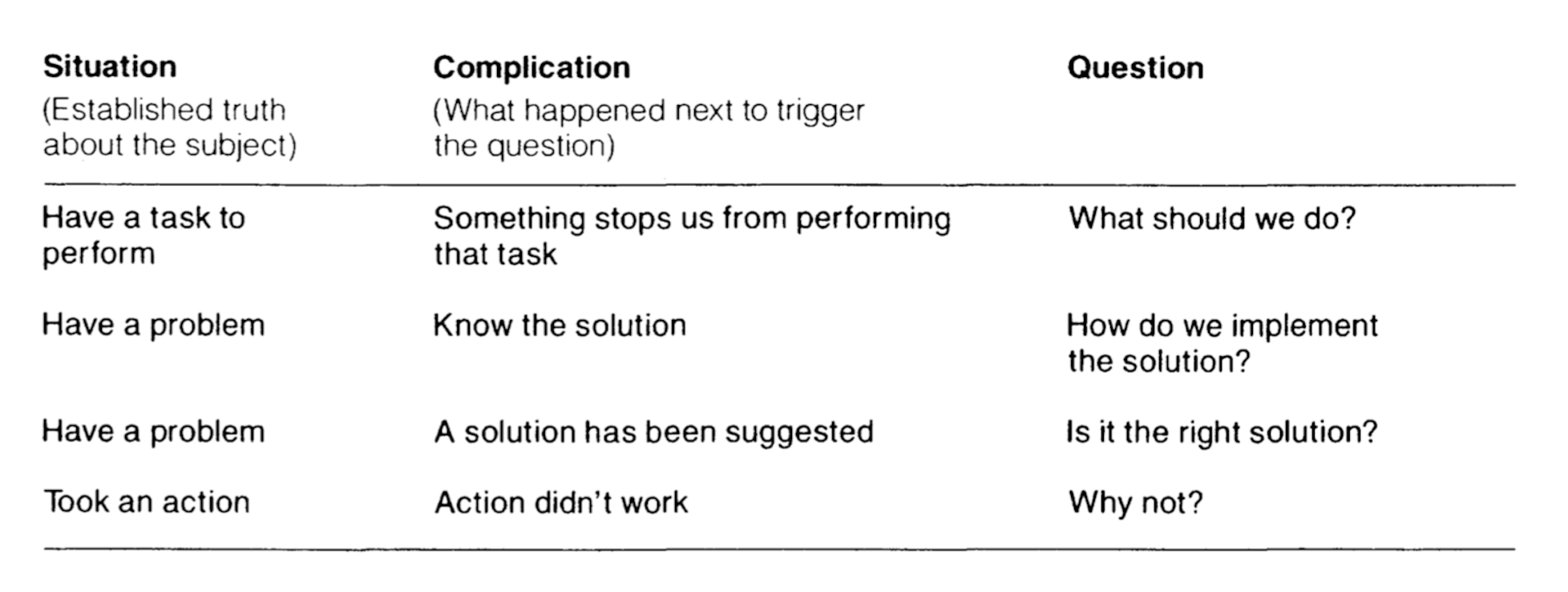
In storytelling terms:
- Premise = Situation: A basic, often generic, setup.
- Concept = Situation + Complication: A unique, specific story idea with a built-in hook.
To see how critical this distinction is, let's examine an article that focuses on this exact mechanism.
Concept vs. Premise: The Inherent Opportunity in ...
The article 'Concept vs. Premise' from Killzoneblog.com provides a sharp, practical distinction between a flat premise and a high-concept idea. Pay close attention to its initial examples and definitions.
Read the following parts of the article: Start from the beginning and read down to the heading 'Thrillers are inherently conceptual.' Focus on the Florida love story example. Read the sections 'The Definition of Concept' and 'The Definition of Premise.' Notice how the author defines concept as the 'contextual framework' or 'compelling energy' that is added to a basic premise.
As the article makes clear, adding a complication transforms a forgettable premise into a compelling concept:
- Premise (Situation): "Two people fall in love in Florida." (Generic)
- Concept (Situation + Complication): "Two people fall in love in Florida, after they find out they are brother and sister torn apart in their infancy." (Specific, high-conflict, and memorable)
The complication is the element that makes the idea "high-concept." It's the unique variable that sets your story's equation apart from all others.
A Taxonomy of Complications: The "Designing Principle"
So, what forms can this "unique complication" take? We can think of it as a "designing principle"—an overarching strategy that governs how you tell the story, injecting originality into a simple premise.
This video provides an excellent breakdown of several types of designing principles.
How to Write an ORIGINAL Story Premise (The Designing Principle)
The video 'How to Write an ORIGINAL Story Premise' by writer Brandon McNulty introduces the concept of a 'designing principle' as the key to making a generic premise unique. It provides clear, actionable examples.
Watch the video from the beginning to 06:00. Pay close attention to the three categories of 'designing principles' he outlines and the examples he uses for each.
From the video, we can establish a useful taxonomy of complications, or "designing principles," that can be applied to a basic situation:
-
A Thematic Layer: The complication is a specific argument or exploration.
- Situation: A group must survive a zombie apocalypse. (Generic)
- Concept: A group must rebuild civilization while surviving a zombie apocalypse. (The Walking Dead)
-
A Structural Gimmick: The complication is in the method of telling the story.
- Situation: A man with amnesia hunts his wife's killer. (Generic)
- Concept: A man with short-term memory loss hunts his wife's killer, and the story is told in reverse chronological order. (Memento)
-
A Modernized Classic (or "X meets Y"): The complication is the fusion of a familiar story structure with a new setting or element.
- Situation: A lion cub comes of age in the jungle. (Generic)
- Concept: A lion cub comes of age in the jungle, in a story structured like Shakespeare's Hamlet. (The Lion King)
This shows that the "complication" is a deliberate choice that shapes the entire narrative.
Test your understanding!
Consider the following simple premise (situation): "A brilliant scientist builds a time machine."
How could you transform this into three different concepts using each of the "designing principles" we just discussed?
- Add a thematic layer.
- Add a structural gimmick.
- Add a modernized classic element.
Show answer
Here are some possible answers. Yours may vary, but they should follow the same logic.
-
Thematic Layer: A brilliant scientist builds a time machine, only to discover that every attempt to "fix" her past mistakes only creates a worse present, forcing her to confront the idea that regret is an essential part of being human. (The complication is the thematic exploration of fate and regret).
-
Structural Gimmick: A brilliant scientist builds a time machine. The story is told from three perspectives: the scientist in the present, her younger self in the past she is visiting, and a future historian studying the temporal paradoxes she created. The narratives intertwine and reveal a complete picture only at the end. (The complication is the multi-perspective, non-linear structure).
-
Modernized Classic: A brilliant scientist, obsessed with reclaiming a lost love, builds a time machine to rewrite their tragic history, only to find his efforts are doomed to fail in increasingly horrific ways. (This is a modern, sci-fi retelling of the Orpheus and Eurydice myth).
Deconstructing a Classic Example: Jaws
Let's perform a detailed analysis of a classic story to see this principle in action. The following article provides an excellent breakdown of the concept and premise for Jaws.
The article 'Concept versus Premise' by Michelle Barker and David Griffin Brown uses Jaws to perfectly illustrate the difference between a simple 'what if' question and a fully developed premise loaded with complications.
Read the article from the beginning down to the heading 'Still Stuck?' Focus on how the authors distinguish the initial concept of Jaws from its much more complex and conflict-rich premise.
Let's break down the Jaws example using our Situation + Complication = Concept formula:
-
Situation (The simple premise): "What if a great white shark was preying on the inhabitants of a beach town?"
- This is a solid starting point, but it's still a generic "monster" story.
-
Unique Complications (The "designing principles" that add specificity and conflict):
- Character-based Complication: The police chief tasked with stopping the shark is deathly afraid of water. This creates a powerful internal conflict.
- Social/Political Complication: The mayor refuses to close the beaches, prioritizing tourist dollars over public safety. This creates a man-vs-society conflict.
- Plot-based Complication: The mayor has ties to the mafia, adding a layer of corruption and danger to the political conflict.
-
Resulting Concept (The full, compelling premise): "When a great white shark begins killing swimmers off the coast of a small resort town, a city-born police chief with a fear of water must overcome political pressure from a corrupt mayor and his own personal terror to hunt down the predator."
By adding these specific complications, the simple situation evolves into a multi-layered concept rich with potential for conflict and character development. The story is no longer just about a shark; it's about a man battling nature, society, and himself.
Conclusion
In this lesson, we have moved from a simple premise to a robust concept by adding a crucial component: the unique complication. This is the mechanism that injects originality and conflict into a story idea.
Key Takeaways:
- A premise is a basic, often generic, situation (the what).
- A concept is a premise elevated by a unique complication (the how or the hook).
- This complication is the engine of the story, transforming a stable situation into an unstable one that demands a resolution.
- Complications, or "designing principles," can be categorized: they can be thematic, structural, character-based, or a fusion of existing ideas.
- Analyzing stories like Jaws reveals how layering multiple complications creates a rich, high-conflict concept from a simple situation.
Preview of the Next Lesson:
The complications we've discussed are what give rise to your story's central conflict. A strong concept contains a problem that cannot be easily solved. In our next lesson, we will focus on this engine directly. We will learn how to construct a central conflict as two clearly defined, irreconcilable opposing forces, ensuring your story has a powerful and sustainable source of tension from the very beginning.