Introduction
In our last lesson, we focused on tactical lying, analyzing how characters use deliberately constructed falsehoods to manipulate external facts and achieve a specific goal. We treated lies as engineered tools to alter a situation.
Today, we turn our analytical lens inward, from the manipulation of external reality to the misrepresentation of internal reality. Your learning outcome is to analyze desire masking, where a character asks for one thing when they actually want something else.
This is a fundamental mechanism of subtext. A character makes a surface-level request (the "ask") which serves as a vehicle for their true, unspoken desire (the "want"). Understanding this two-level system is critical for deconstructing sophisticated dialogue and creating characters with psychological depth. Instead of stating their needs directly, they encode them in seemingly unrelated conversations, creating tension and revealing their vulnerabilities indirectly.
1. The Core Mechanism: Ask vs. Want
At its heart, desire masking is a strategy for navigating situations where stating a true desire is too risky. The risk might come from fear of rejection, social inappropriateness, damage to one's pride, or a potential loss of power.
To protect themselves, characters construct a "safer" surface request that acts as a proxy for their real goal. Let's start with a straightforward example.
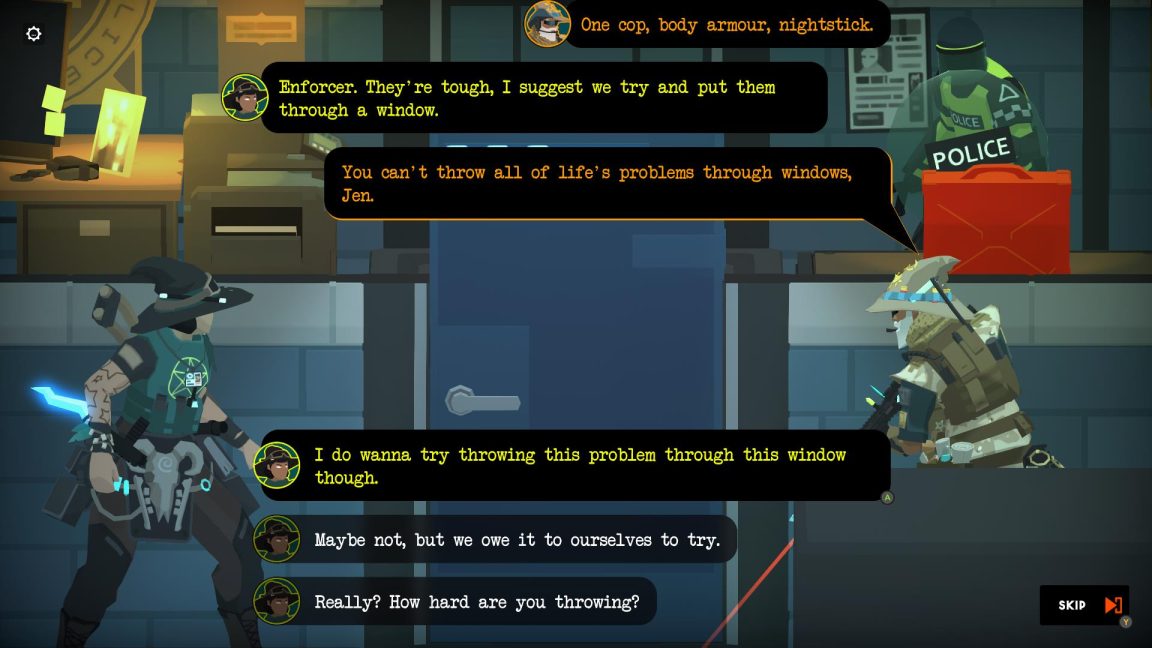
Let's break this down into the Ask vs. Want framework:
- The Surface Ask: "Can we solve this one problem by throwing a guy through a window?" The request is literal, tactical, and specific to the immediate obstacle.
- The Hidden Want: Jen's true desire isn't just about a single tactic. Her repeated insistence suggests a deeper want: a desire for decisive, visceral, and satisfying solutions in a high-stakes world. She might want to feel powerful and effective, or she might be expressing frustration with more complicated, less direct methods. The window is just a symbol for the kind of victory she craves.
The Skrib article, "How to Master Subtext in Dialogue," provides a psychological blueprint for why characters engage in this behavior.
How to Master Subtext in Dialogue: Techniques and Examples
This article explains the psychological principles behind subtext. Understanding these principles gives us a diagnostic toolkit for identifying why a character might be masking their desire.
Read the section 'Psychological Principles Behind Subtext,' focusing on the four bullet points: Conflict Avoidance, Hidden Agendas, Power Dynamics, and Emotional Repression.
These four principles are the root causes of desire masking. When you see a character asking for something indirectly, you can almost always trace it back to one of these pressures. They are either avoiding a fight, pursuing a hidden goal, navigating a power imbalance, or unable to admit their true feelings.
2. Case Studies in Desire Masking
Let's analyze three classic examples where the "ask" is very different from the "want," each driven by a different underlying psychological pressure. The following video provides excellent breakdowns.
The video 'Writing Subtext in Dialogue' by Diane Callahan offers several powerful examples of desire masking. We will focus on three specific scenes that showcase different variations of this technique.
Please watch the following three segments: from 03:51 to 05:37 (The Great Gatsby), from 05:37 to 07:51 (Death of a Salesman), and from 09:23 to 11:02 (Hills Like White Elephants). For each, focus on identifying the surface statement/request versus the true, unspoken desire.
Now, let's deconstruct each example using our Ask vs. Want framework.
Case Study 1: The Emotional Decoy (The Great Gatsby)
Here, a statement about an object masks an overwhelming emotional state. This is a classic example of Emotional Repression.
- The Ask (Surface Statement): "They’re such beautiful shirts." Daisy is literally talking about the clothing.
- The Want (True Desire): "I am shattered by the mistake I made. Seeing your success, which I could have been a part of, is proof of the magnitude of my loss, and I am mourning the life we could have had." The shirts are not the subject; they are the catalyst. They are tangible proof of the wealth Gatsby acquired for her, making her regret concrete and unbearable.
Case Study 2: The Desperate Plea (Death of a Salesman)
Willy Loman's request for a job masks a desperate need for dignity and validation. This is driven by a combination of Power Dynamics (he is a subordinate) and a need to avoid the shame of his failure (Emotional Repression).
- The Ask: "I'd rather not travel anymore... If I could take home sixty-five dollars a week, I could swing it." This is a practical, logistical request about changing his job role and salary.
- The Want: "Please see me. Acknowledge my decades of service and my history with your father. I am failing and obsolete, and I need you to grant me a measure of pity and dignity so I don't have to face my own irrelevance." He isn't just asking for a job; he's begging to be valued.
Case Study 3: The Strategic Probe (Hills Like White Elephants)
The girl's question about the future is a test of the present. This is a clear case of Conflict Avoidance and navigating Power Dynamics. She cannot ask the real question directly for fear of the answer.
- The Ask: "But if I do it [the abortion], then it will be nice again if I say things are like white elephants, and you’ll like it?" She is asking if their dynamic will return to a previous, happier state post-procedure.
- The Want: "Do you still love me? Or am I just a problem you need to solve? I need reassurance that having this abortion will save our relationship, not just serve your desire for an unburdened life." The question isn't about the future; it's a desperate probe for his current feelings and commitment.
3. A System for Analysis
To analyze desire masking in any piece of dialogue, you can use a consistent, three-step process. This converts the intuitive act of reading between the lines into a structured deconstruction.
- Isolate the Surface Request (The Ask): What is the character literally asking for or talking about? This should be a concrete, surface-level statement.
- Identify the Contextual Pressures: Why can't the character state their true desire? Refer back to the four principles: are they avoiding conflict, hiding an agenda, navigating a power imbalance, or repressing an emotion?
- Formulate the True Desire (The Want): Based on the context and pressures, what is the underlying emotional or practical goal? What does the character really want to get out of this interaction?
Test your understanding!
A young programmer, Maya, is speaking to her mentor, David, after he has just received a major promotion she also wanted.
David: "Big news, huh? It's going to be a lot of late nights."
Maya: "You should take a real vacation when this project is done. You've earned it."
Using the three-step analysis process, break down Maya's line. What is her "Ask," what are the "Contextual Pressures," and what is her "Want"?
Show answer
-
The Ask (Surface Statement): "You should take a vacation." This is a piece of friendly, supportive advice. On the surface, she is expressing care for her mentor's well-being.
-
The Contextual Pressures:
- Power Dynamics: David is now her superior in a more significant way. Direct confrontation is professionally risky.
- Emotional Repression/Social Constraints: Expressing direct anger or disappointment ("I deserved that promotion," "This is unfair") would be seen as unprofessional and sour grapes. She is expected to be happy for him.
-
The Want (True Desire): The true want is complex and could be one of several things, all masked by the polite suggestion:
- A Desire to Create Distance: "I can't stand to be around you right now because you represent my failure. Go away so I don't have to see you."
- A Passive-Aggressive Jab: "You're going to be so busy and stressed, while I wouldn't have been. Is this promotion really a good thing?"
- A Test for Recognition: She might be hoping he will respond with, "You've earned a vacation too," or "I couldn't have done it without you," thereby acknowledging her own hard work and disappointment.
In all cases, the polite "ask" masks a much more conflicted and painful "want."
Conclusion
We have now added another critical tool to our dialogue analysis toolkit. By seeing dialogue as a two-level system—the surface ask and the hidden want—you can better understand the mechanics of subtext and character motivation.
Key Takeaways:
- Desire masking is a protective strategy. Characters use it when directly stating their want is too risky due to pride, fear, power dynamics, or social rules.
- The mechanism is Ask vs. Want. A character makes a surface-level request (the Ask) as a proxy for their true, unspoken goal (the Want).
- Analysis is a 3-step process: To deconstruct desire masking, you must (1) isolate the literal ask, (2) identify the contextual pressures, and (3) formulate the hidden want.
Preview of the Next Lesson
We have seen how characters can intentionally misrepresent their own desires to navigate a conversation. In the next lesson, we will explore a related, but distinct, form of conversational failure. Your learning outcome will be to construct deliberate miscommunication where characters interpret the same words through different personal frameworks. This will shift our focus from a single character's subtext to the conflict that arises when two characters' internal realities fail to align.