Introduction
In our last lesson, we focused on a powerful mechanism for maximizing tension: the cliffhanger. We analyzed how a strategically placed cut before, during, or after a turning point can create intense reader curiosity. However, a story built only on peaks of tension becomes exhausting and, eventually, numbing. Effective storytelling is a matter of rhythm—a controlled oscillation between tension and release.
Today, we will analyze the necessary counterpart to high-action scenes and cliffhangers: the "breathing space." Your learning outcome is to analyze the placement of 'breathing space' scenes to manage emotional pacing after high-tension sequences. We will treat this not as an intuitive break, but as a functional and structural component of your narrative engine. Just as an engine has a power stroke and an exhaust stroke, a story needs moments of action and moments of reaction to function correctly.
1. The Core Mechanism: Scene and Sequel
The fundamental model for managing this rhythm of action and reaction is the Scene-Sequel structure. This framework, originally codified by writer Dwight V. Swain, provides a systematic way to think about cause and effect, not just in the plot, but in the character's emotional and psychological journey.
- The Scene is the action unit. It's proactive and externally focused.
- The Sequel is the reaction unit. It's reactive and internally focused. This is your "breathing space."
To get a clear, mechanical breakdown of these two components, please watch the following video. It renames the parts "proactive" and "reactive," which is a useful way to think about their function.
Every Writer Should Know About Scene Sequel Structure
The video 'Every Writer Should Know About Scene Sequel Structure' from the channel Story Marc provides a fantastic, concise breakdown of this foundational concept. It treats the structure as a technical tool for organizing chapters and prose.
Watch from 00:31 to 04:08. The first part (00:31 - 02:21) details the Proactive Scene, which consists of a Goal, Conflict, and Outcome (often a 'Disaster'). This is the high-tension component. The second part (02:21 - 04:08) explains the Reactive Scene (the Sequel), which is your breathing space. Focus on its three parts: Reaction, Dilemma, and Decision.
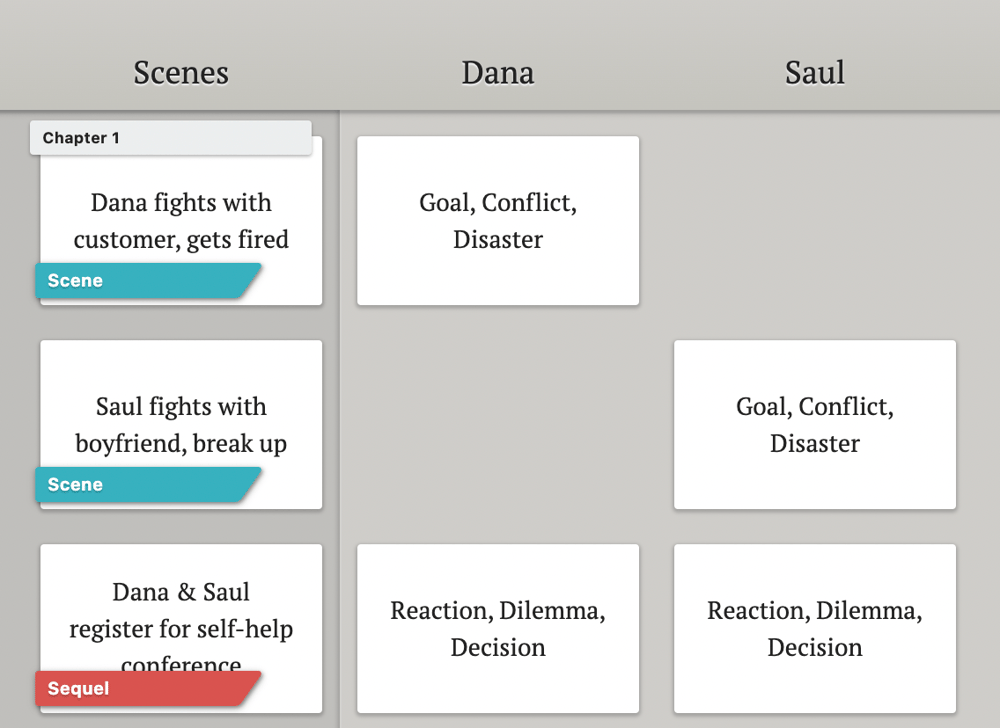
Let's codify this structure. It's a two-part causal chain:

Part 1: The Scene (Action)
- Goal: The character has a specific, tangible objective.
- Conflict: Obstacles prevent the character from easily achieving the goal.
- Disaster (or Outcome): The scene ends, but not with a simple success. The outcome is often a failure or a success with a major complication ("Yes, but..." or "No, and..."). This disaster is the high-tension point that necessitates a reaction.
Part 2: The Sequel (Breathing Space)
- Reaction: The immediate, emotional, gut response to the disaster. This is where the character (and the reader) feels the impact of what just happened.
- Dilemma: The character transitions from an emotional to an intellectual response. They analyze the new situation, review what happened, and consider their options. This is the core of the processing.
- Decision: Based on the dilemma, the character makes a choice. This decision becomes the Goal for the next Scene, thus completing the cycle and launching the next unit of action.
The Sequel is the mechanically defined breathing space. It's not empty space; it's where the events of the plot are processed and given meaning.
2. Proportioning the Breathing Space
Now that we have a structural definition, the key question becomes one of placement and scale. How much breathing space is required? The principle is simple: the scale of the Sequel should be proportional to the intensity of the preceding Scene.
A major military defeat, the death of a loved one, or a life-altering revelation requires a substantial Sequel to feel earned. The reader needs to see the character grapple with the consequences. A minor argument or a small setback might only need a paragraph or two of Sequel before moving to the next action.
This is where you, as the writer, control the story's rhythm. The following article provides a clear, practical guide to this concept.
Ideas To Fix Pacing Problems In Your Novel
The article 'Ideas To Fix Pacing Problems In Your Novel' from BubbleCow offers several diagnostic tools. We will focus on its direct advice regarding scene-sequel proportioning.
Please read the section under the heading 'Fix Slow Sections Without Losing Depth,' specifically the subsection titled 'Use scene–sequel proportioning.' This section gives a direct recipe for how to balance action and reaction.
As the article states, the recipe is:
- Major Action Scene → Longer Sequel (reaction, dilemma, decision)
- Minor Beat → Compressed Sequel (quick reaction, move to next decision)
Over-indexing on Sequels after minor events makes the pace drag and the character seem overly contemplative. Under-indexing on Sequels after major events robs the story of emotional impact and makes the character feel robotic.
3. Adjusting the Pace: Compressing and Expanding Sequels
You have precise control over the story's pacing by manipulating the length and depth of your sequels. For different genres and different moments in a story, you'll want to either expand the breathing space or compress it.
The following resource explains this dynamic well.
Scene and Sequel: The Formula for an Unputdownable ...
The article 'Scene and Sequel: The Formula for an Unputdownable Novel' from DabbleWriter provides further nuance on how to vary the length of sequels to control pacing.
Read the subsection titled 'Mind Your Pacing.' It directly explains how sequels slow the pace and provides a concrete example of a highly compressed sequel for a fast-paced thriller versus a longer sequel for other genres.
Techniques for Pacing Control:
- Expanded Sequel: For character-driven stories or after a major turning point, you can dedicate a full scene or even a chapter to the Sequel. You would show the character's emotional reaction in detail, explore the nuances of their dilemma, and dramatize the moment of decision. This slows the pace, allowing for deep character exploration and emotional resonance.
- Compressed Sequel: In a thriller or during a high-action sequence, you can compress the Sequel into a few sentences or a short paragraph. As the example in the article shows, the reaction, dilemma, and decision can happen in a rapid-fire internal sequence, maintaining forward momentum while still grounding the action in character choice.
- Threading Reflection into Motion: Another technique, mentioned in the BubbleCow resource, is to weave the Sequel's components into the start of the next action scene. The character can be processing the last disaster while they are already moving toward their next goal. This is an efficient way to provide reflection without bringing the story to a halt.
Test your understanding!
A detective has just survived an ambush where her partner was killed (Disaster). She escapes and makes it to a safe house. Her next major plot goal is to identify the mole in her department who set them up.
Outline the Reaction, Dilemma, and Decision for a full, expanded sequel. Then, outline a highly compressed version suitable for a fast-paced thriller where she is still being actively hunted.
Show answer
Expanded Sequel (Breathing Space Scene):
- Reaction: The detective gets inside the safe house, bolts the door, and collapses. She might break down in tears, punch a wall in anger, or sit in numb shock, replaying her partner's final moments. This could take several paragraphs or pages to convey the full emotional impact.
- Dilemma: After the initial wave of emotion, she starts to think. The ambush was a professional hit; someone inside leaked their location. Who knew they were going there? She mentally lists the three people with that knowledge: her captain, a trusted colleague, and a data analyst. She weighs the pros and cons of trusting each one. Going to the captain is protocol, but what if he's the mole? Contacting her colleague is risky. The analyst is a long shot. The central problem is she's alone and can't trust the system.
- Decision: She decides she cannot officially report in. Instead, she will use her own resources to investigate the three suspects, starting with the one she trusts least: the data analyst who has been acting strangely for weeks. This decision gives her the goal for the next action scene.
Compressed Sequel (Maintaining Momentum):
- (All happening in one or two paragraphs as she's running or barricading a door)
- Reaction: A sob catches in her throat as her partner's face flashes in her mind, but she shoves it down. No time for grief. Grief gets you killed.
- Dilemma: It was a setup. Only the captain, Dave, or the new analyst knew. The captain is too by-the-book. Dave is a possibility, but the leak feels technical. It has to be the analyst.
- Decision: Forget the safe house. She changes direction, heading for the analyst's apartment. She'll get answers now, before he has a chance to run.
Conclusion
Today we've systematically deconstructed "breathing space" into a functional component of narrative architecture. By understanding and applying the Scene-Sequel model, you can move beyond intuitive pacing and begin to consciously engineer the emotional and psychological rhythm of your story.
Key Takeaways:
- Effective pacing requires an oscillation between high-tension Scenes (Action) and lower-tension Sequels (Reaction/Breathing Space).
- The mechanical model for this is Goal → Conflict → Disaster → Reaction → Dilemma → Decision.
- The Sequel is the functional breathing space that allows characters and readers to process the consequences of the action.
- The length and depth of a Sequel should be proportional to the intensity of the preceding Scene's disaster. You can expand or compress this space to control the story's pace.
Preview of the Next Lesson
We have now examined two critical elements of managing reader experience: creating tension with cliffhangers and providing release with sequels. Both of these techniques play with what the reader knows and when they know it. In our next lesson, we will dissect the psychological mechanics of two related but distinct tools: we will distinguish between suspense (the reader anticipates a known danger) and surprise (an unexpected event occurs).