Introduction
Welcome to our final lesson in the "Revision and Diagnostic Analysis" module. In the previous lesson, we operated at a high level of abstraction, creating a diagnostic test for thematic closure by treating the entire story as a system that must produce a consequential answer to a core question. Today, we zoom in to the micro-level of individual sentences and paragraphs.
Your learning outcome is to identify and cut prose that is stylistically pleasing but does not serve the story's function.
From a computer science perspective, this is analogous to code refactoring. You're not fixing compilation errors (plot holes) or logical flaws (character inconsistency), but improving the efficiency, clarity, and maintainability of the codebase. A "beautifully written" but non-functional paragraph is like a "clever" but unreadable and unnecessary function; it adds complexity and cognitive load without contributing to the program's core purpose.
The common writing advice for this is "kill your darlings." We will reframe this as a pragmatic cost-benefit analysis: if a piece of prose doesn't contribute to the story's momentum or purpose, its aesthetic value is irrelevant.
1. Defining the Problem: Purple Prose
The technical term for prose that is stylistically pleasing but functionally weak is purple prose. It is writing that is overly ornate, drawing attention to itself rather than to the story. This is a critical failure because it breaks reader immersion—the primary goal of narrative prose.
To effectively identify and cut this prose, we first need a clear diagnostic checklist of its attributes.
What Is Purple Prose? Everything You Need To Know
This article from Jericho Writers, 'What Is Purple Prose?', provides a superb mechanical breakdown of the issue. It gives us a set of 'red flags' to use as a diagnostic tool when analyzing a text.
Read the sections 'Purple Prose Definition,' 'Too Many Adjectives And Adverbs,' 'Excessive Sentence Length,' 'Excessive Emotion,' and 'Generic Or Clichéd Images.' As you read, think of these not as artistic sins, but as specific anti-patterns that reduce the efficiency and clarity of the prose.
The core problem with purple prose is that it's author-centric. It showcases the author's vocabulary or ability to construct a complex sentence, rather than serving the reader's experience of the story.
2. The Core Function of Prose: Character Immersion
If decorative prose is an anti-pattern, what is the correct pattern? The alternative to "purple prose" is not necessarily bland, "beige" prose. Effective prose has a clear function: to immerse the reader in the character's specific point of view. The details described, the words chosen, and the rhythm of the sentences should all reflect how the POV character perceives the world, not how the author does.
"How do you write immersive descriptions?" | #AskAbbie
This video by author Abbie Emmons provides a powerful demonstration of this principle. She contrasts beige prose (too simple), purple prose (too ornate), and immersive prose (just right) using concrete examples from her own work.
Watch from 00:40 to 07:58. Pay close attention to the three versions of the scene she presents. Analyze why the final, character-driven version is the most effective. It's not simply a matter of style; it's mechanically superior because it performs multiple functions at once—it describes the action while simultaneously revealing the character's internal state, personality, and relationship dynamics.
As the video demonstrates, functional prose is efficient. The description of a rumbling volcano isn't just a fancy metaphor; it's a specific reflection of the character Weston's perception of Tessa's anger, tying into their history. Every word is doing work.
3. The "Kill Your Darlings" Protocol
Knowing that prose must be functional, we can now establish a protocol for "killing our darlings." This isn't an emotional act of sacrifice; it's a logical decision based on a simple test: Does this passage, paragraph, or sentence serve the story's momentum? If the answer is no, it must be cut, regardless of how well-written it is.
Pulp Romance Writing Guide Blueprint
The 'Pulp Romance Writing Guide Blueprint' is written for a commercial market where efficiency is paramount. Its advice is blunt, pragmatic, and directly applicable to our task.
Read the three anti-pattern sections under the headings 'Writing Style Development,' 'Developmental Editing,' and 'Pacing.' Pay special attention to the directives: 'Avoid Purple Prose,' 'Don't Confuse Polishing with Rebuilding,' and 'Kill Your Darlings (and Your Darlings' Darlings).' The key principle is that the story's overall function and momentum have absolute priority over the elegance of any single part.
The guide makes a critical point: "Don't confuse polishing with rebuilding." Spending hours perfecting the prose in a scene that is boring or serves no purpose is a waste of time. You must first validate the function of the scene itself. If the scene is filler, all the prose within it, beautiful or not, is also filler.
Test your understanding!
A writer has crafted a two-page, lyrical description of a forest at dawn. The prose is beautiful, with intricate sentences and vivid sensory details. The scene occurs as the protagonist, a detective on the run from assassins, is simply passing through the forest to get to the next town. The description does not reveal anything new about the character, the plot, or the assassins.
Based on the protocol from the 'Pulp Romance Writing Guide Blueprint', what should be done with this scene?
Show answer
The scene must be cut or radically condensed.
Analysis:
- Function Test: Does the scene advance the plot or reveal character? No. The protagonist is just passing through. The beautiful description doesn't change their situation or mindset in a meaningful way.
- Pacing Test: Does it maintain momentum? No. For a detective on the run from assassins, stopping for a two-page, lyrical description of a sunrise kills all tension and urgency. It's a classic example of a darling that "stops the story dead in its tracks."
Conclusion: The prose, while stylistically pleasing, is non-functional. It should be replaced with a single, efficient sentence, e.g., "He ran through the forest until the first light of dawn broke through the canopy, signaling he was close to town."
4. A Toolkit for Condensing Prose
Once you've identified prose that needs cutting, the execution can happen at several levels of granularity. You might cut an entire paragraph, or you might simply trim the fat from within a sentence.
How to Condense Your Novel (I cut 16k words with this...)
This video by ShaelinWrites, 'How to Condense Your Novel,' provides a clear hierarchy of cutting techniques, from the scene level down to the individual word.
Watch the following segments for specific, actionable techniques: Cutting Tangential Paragraphs (06:13 - 07:13): How to identify and remove paragraphs that are interesting but don't serve the scene's arc. Cutting Action Beats (07:13 - 08:28): How to remove small physical actions that were in the author's head but don't aid the reader's visualization. Condensing Description (13:05 - 13:45): How to select the one strongest image from a block of description and cut the rest. Line Editing (13:45 - 14:26): The final pass for removing unnecessary words, which the presenter notes is a skill that improves with practice.
5. Automating the Diagnosis: Prose Linters
Just as you use a linter to check your code for stylistic issues or common errors, you can use software to analyze your prose. Tools like the Hemingway Editor can't tell you if your story is good, but they can flag symptoms of weak or non-functional prose.
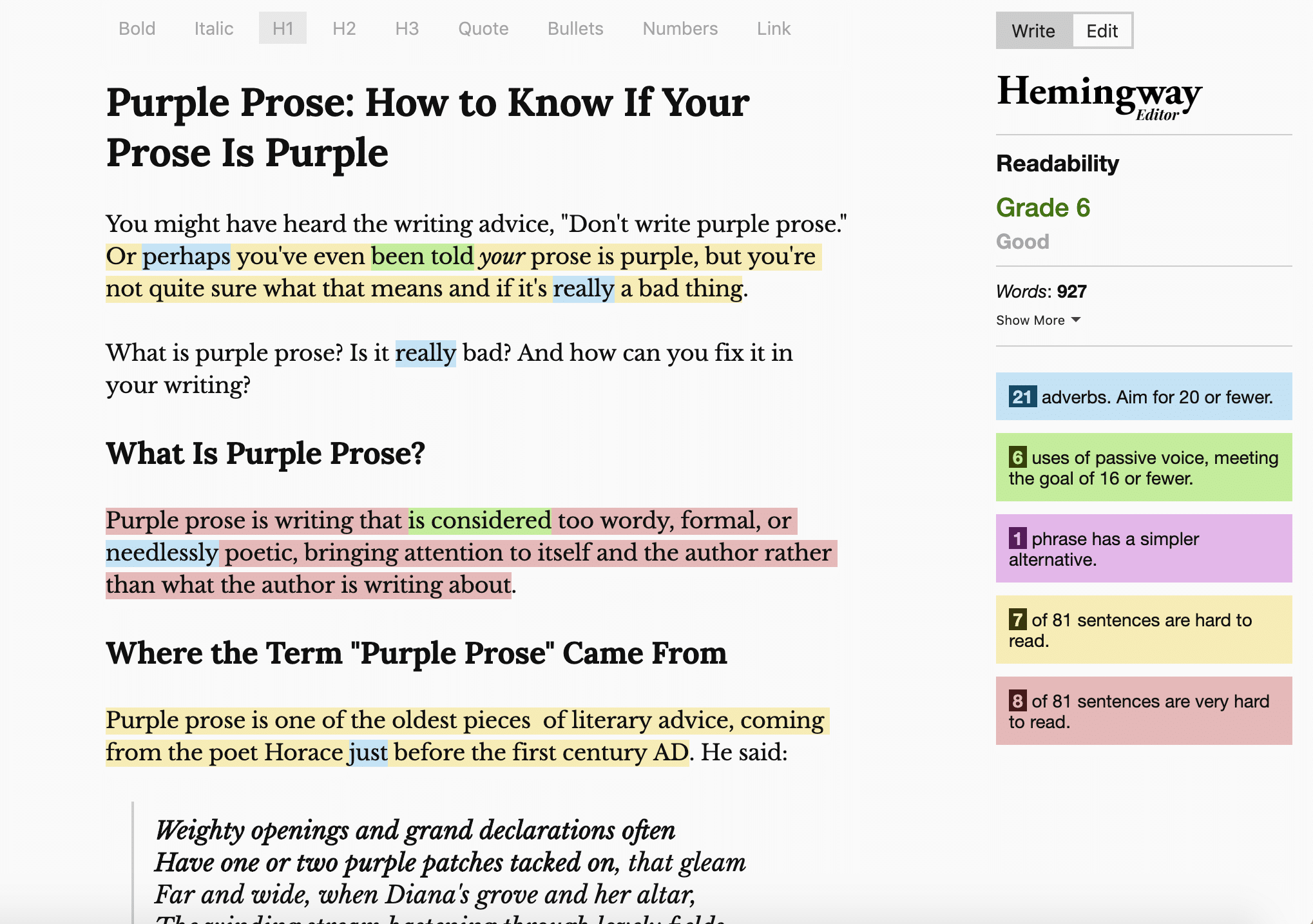
Using such a tool can help you spot patterns in your own writing. For example, you might discover you overuse adverbs or write sentences that are consistently too long. This data can guide your manual revision process, allowing you to apply the principles from this lesson more effectively.
Conclusion
You have now learned to diagnose and correct one of the most common issues in revision: prose that is beautiful but useless. This is a critical skill for moving from an intuitive writing process to a technical, results-oriented one.
Key Takeaways:
- Function Over Form: Prose must primarily serve the story's function (reader immersion, characterization, plot advancement). Its aesthetic quality is secondary.
- Purple Prose is an Anti-Pattern: Overly ornate language that draws attention to itself breaks reader immersion and is therefore a functional failure.
- The "Darling" Protocol: A "darling" is any piece of writing that does not contribute to the story's momentum. To test it, ask: "If I delete this, does the story suffer?" If the answer is no, it must be cut.
- Condensing is a Multi-Level Process: You can cut entire non-functional scenes, tangential paragraphs, redundant descriptions, or individual filler words.
Preview of the Next Lesson
In this lesson, we focused on a specific revision task: cutting non-functional prose. This is a form of "polishing." However, as we noted, sometimes the problem isn't the prose but the entire scene, which requires "rebuilding."
In our next lesson, we will formalize this distinction. You will learn to distinguish between a flaw requiring a line-edit (polishing) and one requiring a full rewrite of the scene (rebuilding). This will provide you with a triage framework for revision, ensuring you don't waste time polishing a scene that is fundamentally broken.